

Andy Burnham wants change to define his leadership
After a revolving door of prime ministers, UK voters might want a break from the past
THERE is a saying, apocryphally attributed to Albert Einstein, that goes: “The definition of insanity is doing the same thing over and over again and expecting different results.”
As the race to succeed UK Prime Minister Keir Starmer heats up, that quote may well be on the mind of Labour MPs seeking to replace him.
Starmer is now the sixth prime minister to head out of office since the 2016 Brexit referendum, whose 10th anniversary occurred on Tuesday (Jun 23).
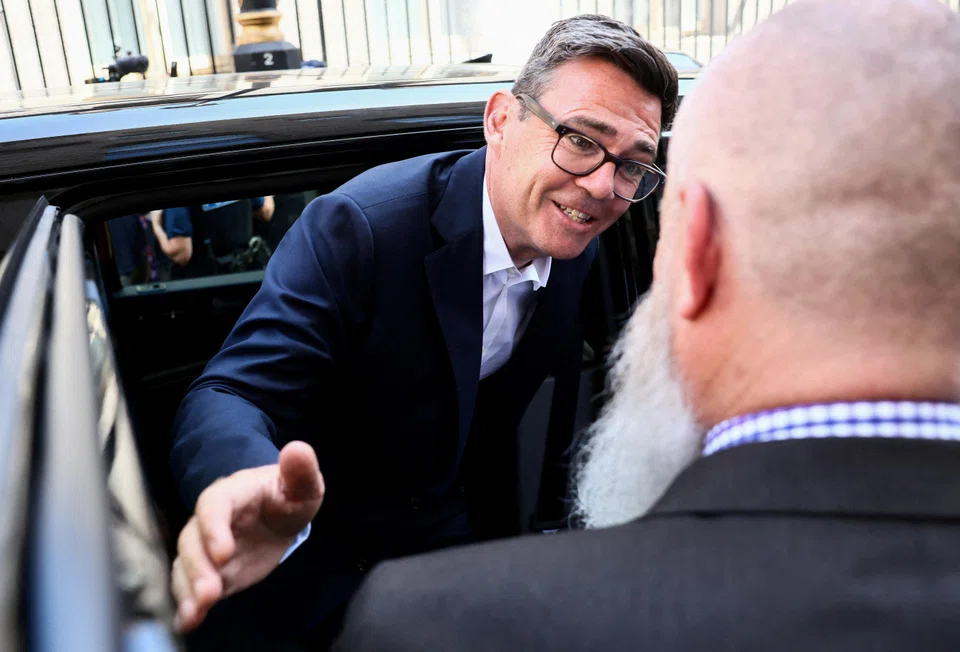
It is not yet certain if there will be more than one contender for Starmer’s seat beyond former Manchester mayor Andy Burnham, who won the Jun 18 Makerfield by-election to return to the House of Commons as an MP.
There will be much back-room negotiation in coming days.
Burnham will want to persuade other potential leadership candidates, such as Chief Secretary to the PM Darren Jones and former armed forces minister Al Carns, not to stand. Wes Streeting, the former health secretary, has already decided to back the former Manchester mayor.
Still, Burnham is unquestionably the favourite to succeed Starmer, and could enter 10 Downing Street unopposed in what amounts to a “coronation”.
That’s because he is currently the least unpopular major politician in the UK.
Polls of voting intentions for the next general election show populist right-wing Reform UK leading. The party is led by Brexiteer Nigel Farage, a key ally of US President Donald Trump.
Labour MPs hope that Burnham can enhance their party’s political fortunes on a national level.
But it is unclear how much his popularity in north-west England, home to Manchester, will extend to other areas of the UK. In particular, Labour needs to win seats in Scotland and Wales to secure a second term with an overall majority.
However the political winds blow, it is likely that Burnham would lose favour if he wins power – he will immediately face many tough decisions if he does assume the role of prime minister.
Pledging to end neoliberalism
Burnham has been much criticised for his ideological flexibility. He was a minister in former prime minister Tony Blair’s centrist, pro-business government.
Since then, he has moved leftwards and declared that he wants to end Britain’s years of neoliberalism.
This is a huge claim that indicates he would want his potential leadership to be defined by change, not continuity. In short, his team believes that revamping policy is the best way to ensure Burnham gets an extended period in office.
That’s a lesson learnt from the last four prime ministers in the past five years who are perceived, rightly or wrongly, by many voters to have failed to break from the past decisively.
During the previous 10 years as mayor of the UK’s fastest-growing city, Burnham has promoted a “Manchesterism” philosophy, which he describes as “business-friendly socialism”.
In so doing, he claims to have tackled structural economic weaknesses, such as privatisation and deregulation, that were inaugurated by Margaret Thatcher’s premierships.
That four-decade legacy of her policies, Burnham asserts, has left the country “stuck in a rut” in a “high inequality, low-growth doom loop”.
None of this is to say that his agenda will succeed or that he is a radical socialist, as Reform UK may claim if he becomes prime minister.
During his period as mayor of Greater Manchester, Burnham relied heavily on private investment, especially foreign direct investment, to rejuvenate the city region.
What it does imply, however, is that Burnham favours transformation and doing away with the old. He has consistently called for bolder fixes than many of those that the Starmer government has promoted since 2024.
With Labour’s big majority in the House of Commons, the main constraint on the prospective prime minister may be financial.
Many market participants already anticipate that the UK government may be entering a period of sustained fiscal loosening amid hotter inflation caused by the Iran war, higher government spending expectations and intensified political uncertainty.
Burnham, for instance, has repeatedly criticised the Starmer government’s economic approach that has led the UK to be “in hock to the bond markets”.
A Burnham government could tweak, if not outright jettison, the current fiscal rules that limit the scope for new borrowing.
This in a context where the country’s debt-to-gross domestic product ratio is 95.1 per cent, as at end-May.
The UK’s Office for Budget Responsibility, the fiscal watchdog, estimates that every percentage point rise in yields costs the government an extra £15 billion (S$25.7 billion) a year in debt interest by 2030.
Chancellor of the Exchequer Rachel Reeves – who is likely to be replaced in the next government – will be keeping an eye on any such development.
She has only £23.6 billion of fiscal headroom to meet her goal of achieving a balanced budget by 2029-2030, the scheduled end of the current parliament’s term.
Another factor that could limit a Burnham premiership would be nationwide issues – when he previously could focus on the Greater Manchester area.
Nationalist parties in Scotland, Wales and Northern Ireland that want to leave the UK are, for the first time ever, simultaneously in all three devolved legislatures. This is something that would take up much of Burnham’s time in Downing Street.
On the whole, if Burnham does assume leadership of the UK, he would likely shake things up to persuade voters that he represents a decisive break with the past.
The writer is an associate at LSE IDEAS at the London School of Economics
TRENDING NOW

Indonesia stocks suffer worst plunge in nearly 30 years as MSCI proposes standalone status
The grid is the transition: Why Asean’s next energy challenge is coordination

Firms linked to haze pledge cooperation in meeting with Shanmugam; government to table changes to haze law

If Europe goes to war, the fallout will be felt in East Asia

