

China tech stocks: Time for investors to dive in?
Optimism is high amid China’s tech resurgence with DeepSeek’s “Sputnik” moment and Jack Ma’s return, but analysts are sounding a note of caution

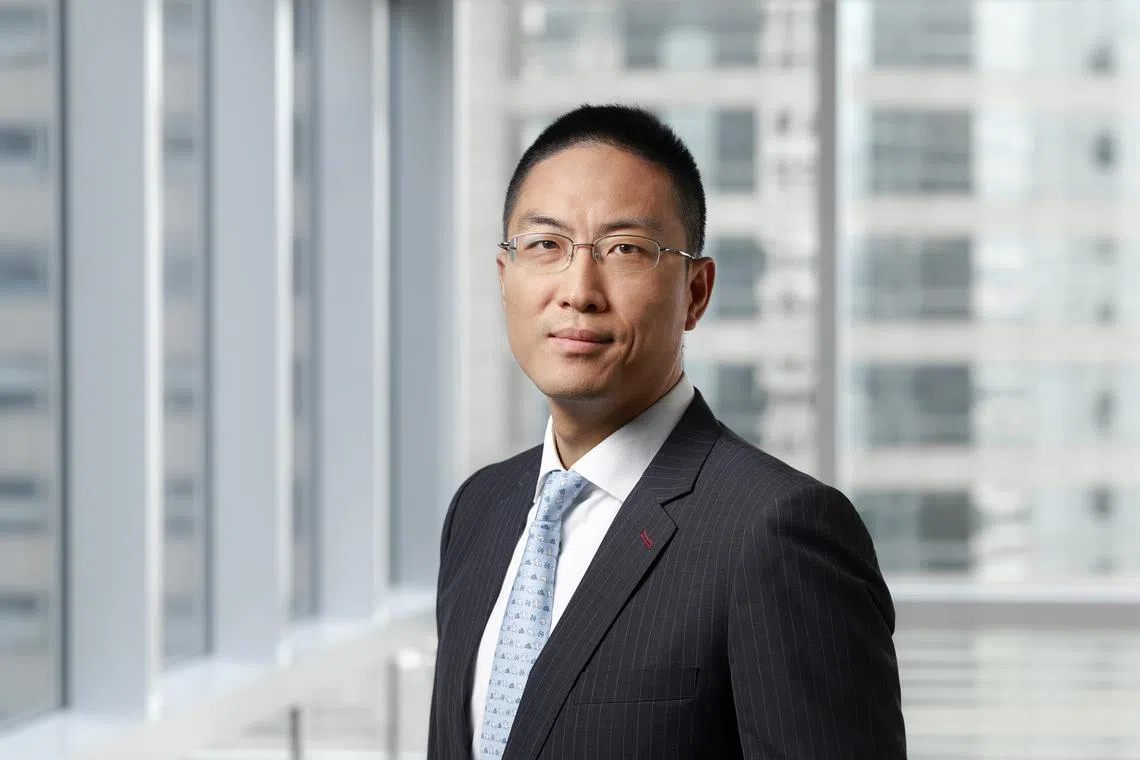
[SINGAPORE] As Chen Dong of Pictet Wealth Management travelled around South-east Asia last month – to Singapore, Thailand, the Philippines and Indonesia – his clients were visibly curious about Chinese tech stocks.
“A lot of them were burned before and so they are cautious. But I think the enthusiasm is pretty obvious,” says Chen, the firm’s Hong Kong-based chief Asia strategist.
“They’re seeing more and more people on the streets owning BYD cars in their countries; maybe they themselves own this (car). They probably have tried the DeepSeek chatbot themselves,” he tells The Business Times over a call.
“All these are sending very positive signals about the development of Chinese tech – it’s not just about the stock price, but also supported by what they see and hear.”
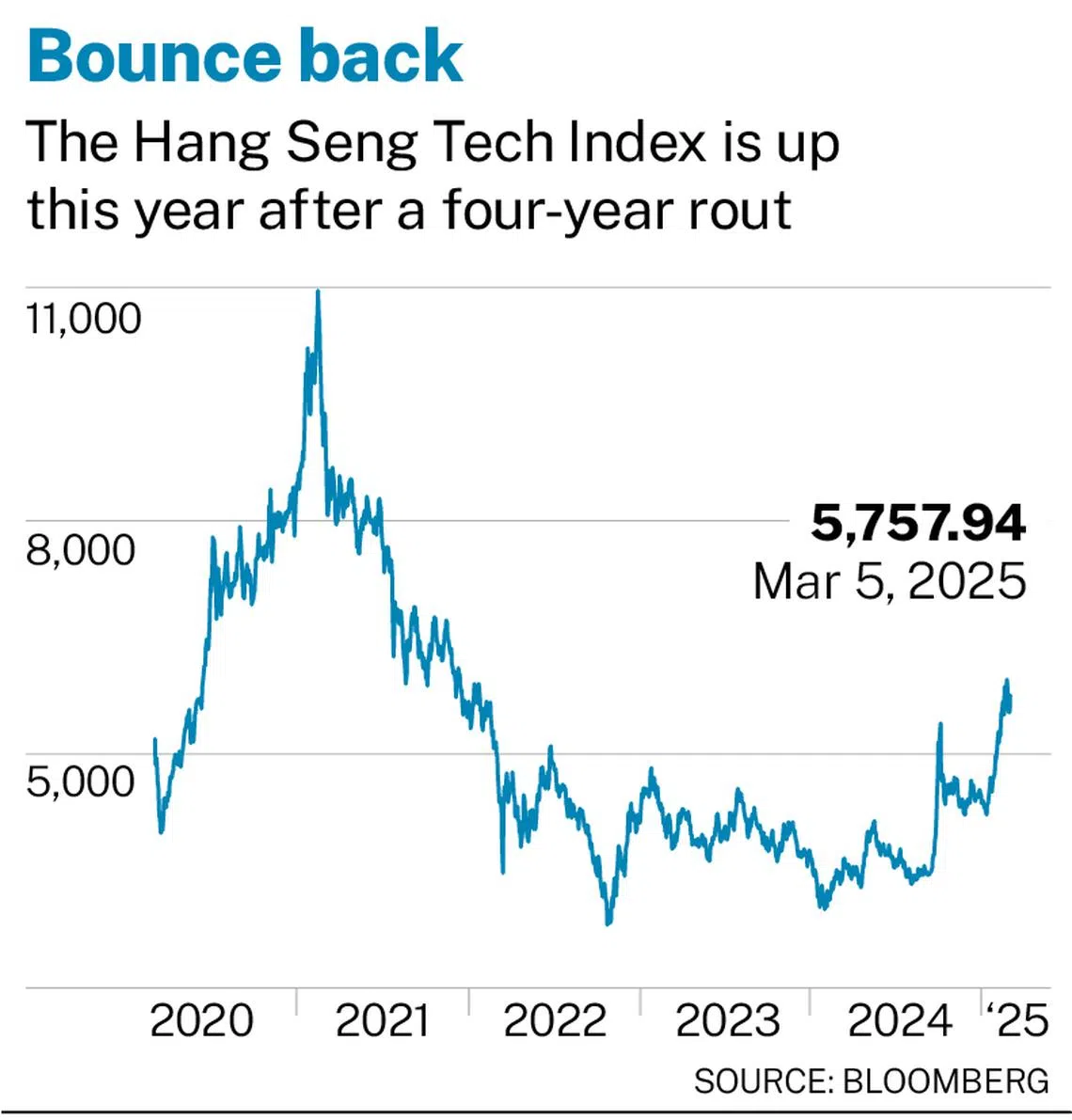
Like Chen’s clients, many global investors are warming up to Chinese tech stocks again after a bruising rout. The Hang Seng Tech Index – which nosedived from 2020 to 2024 – has rallied 32.1 per cent this year, as at Mar 5.
Even after the US’ latest tariffs and China’s swift retaliation on Mar 4, the index was up 4 per cent the next day, as Beijing announced its ambitious 5 per cent growth target.
A catalyst for the rally was the Jan 20 release of R1, an artificial intelligence (AI) model by Hangzhou-based startup DeepSeek that performs on par with ChatGPT, at reportedly a fraction of the cost.
This shows that China can still innovate under US restrictions, “disrupting narratives” of reliance on Western chips, says Wang Zichen, a research fellow at the Center for China and Globalization (CCG), a Beijing-based think tank.
The rally received a further boost on Feb 17, when President Xi Jinping met with Chinese tech leaders, including DeepSeek’s Liang Wenfeng and the once-sidelined Jack Ma. Many see this as marking the end of the country’s tech crackdown.
“We are unlikely to see another major crackdown going forward, especially at a time when China is trying to encourage animal spirits in the stock market,” says Thio Siew Hua, head of equities at Lion Global Investors.
Cheap valuations are the big appeal in the current rally. Many major Chinese stocks are trading at just 11 to 15 times earnings, compared with 26 times earnings for the S&P 500, notes Ben Charoenwong, associate professor of finance at Insead.
But for all the excitement, investors still have many questions: Should they join the rally? Where should they place their bets? What are the risks?
Industry players BT spoke to believe that many China tech stocks have room to run, with growth themes in high-tech sectors such as chip manufacturing, cloud computing and electric vehicles (EVs) – in line with China’s pursuit of “new quality productive forces” to drive the economy.
But a selective eye and patience are still needed. US tariffs and China’s growth slowdown remain risk factors. And large language models (LLMs) are still hard to monetise, meaning that AI may not drive earnings upgrades in the near term.
“Mother of all breakthroughs”
Veteran China investor Wong Kok Hoi explains his view on Chinese tech with a golf analogy: “I would say that US tech companies might already be on the 18th tee box – in a round of golf there are 18 holes… whereas Chinese tech companies might only be on the second box.”
In other words, China is still at an early stage in tech innovation with more breakthroughs to come, says Wong, founder of the hedge fund APS Asset Management, at his Tanjong Pagar office.
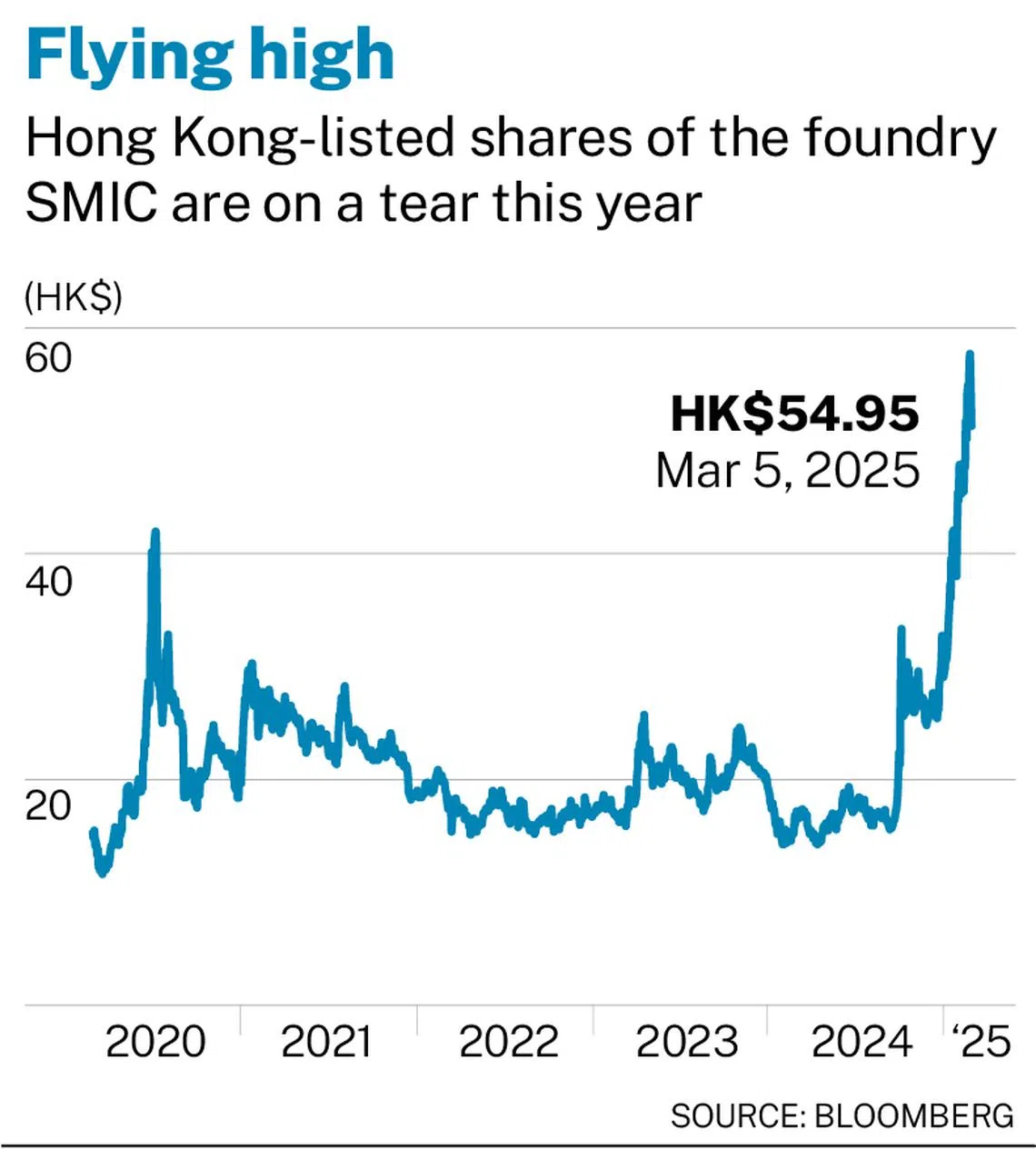
He is bullish on the country’s semiconductor industry. One of his long-term bets is SMIC, which he invested in about 10 years ago. The Shanghai-based foundry is seen as mainland China’s equivalent of TSMC, the world’s largest chipmaker.
In the wake of DeepSeek, SMIC’s Hong Kong-listed shares have hit new highs, up 73.3 per cent this year as at Mar 5.
For Chen of Pictet, DeepSeek’s breakthrough “illustrates that superb model performance actually could be achieved even if you don’t have the top-notch GPUs (graphics processing units)”, he says.
“This actually opened the door for a lot of domestic semiconductor makers, whether they are a fabless designer or foundry, or other supporting material providers. The entire value chain actually could benefit from this as well. So this is a very broad-based kind of re-rating,” he adds.
APS’ Wong is keeping an eye out for even more catalysts in China’s semiconductor space. In a recent letter to investors, he cited extreme ultraviolet (EUV) lithography – which is needed to make advanced chips – as being the potential “mother of all breakthroughs” for China.
The technology is now near-monopolised by Dutch equipment maker ASML. But if China develops domestic capabilities, this could be a game changer for the tech sector and economy, Wong reckons.
Asked if the US’ trade restrictions could prevent such breakthroughs, Wong cites DeepSeek. “All these tech bans have created a lot of inconvenience for China, and also slowed down China’s investment in tech in the short term. But in the long term so far, it’s failed, hasn’t it?” he quips.

China’s cloud computing sector could also benefit post-DeepSeek – with greater AI usage, the demand for their cloud computing could increase.
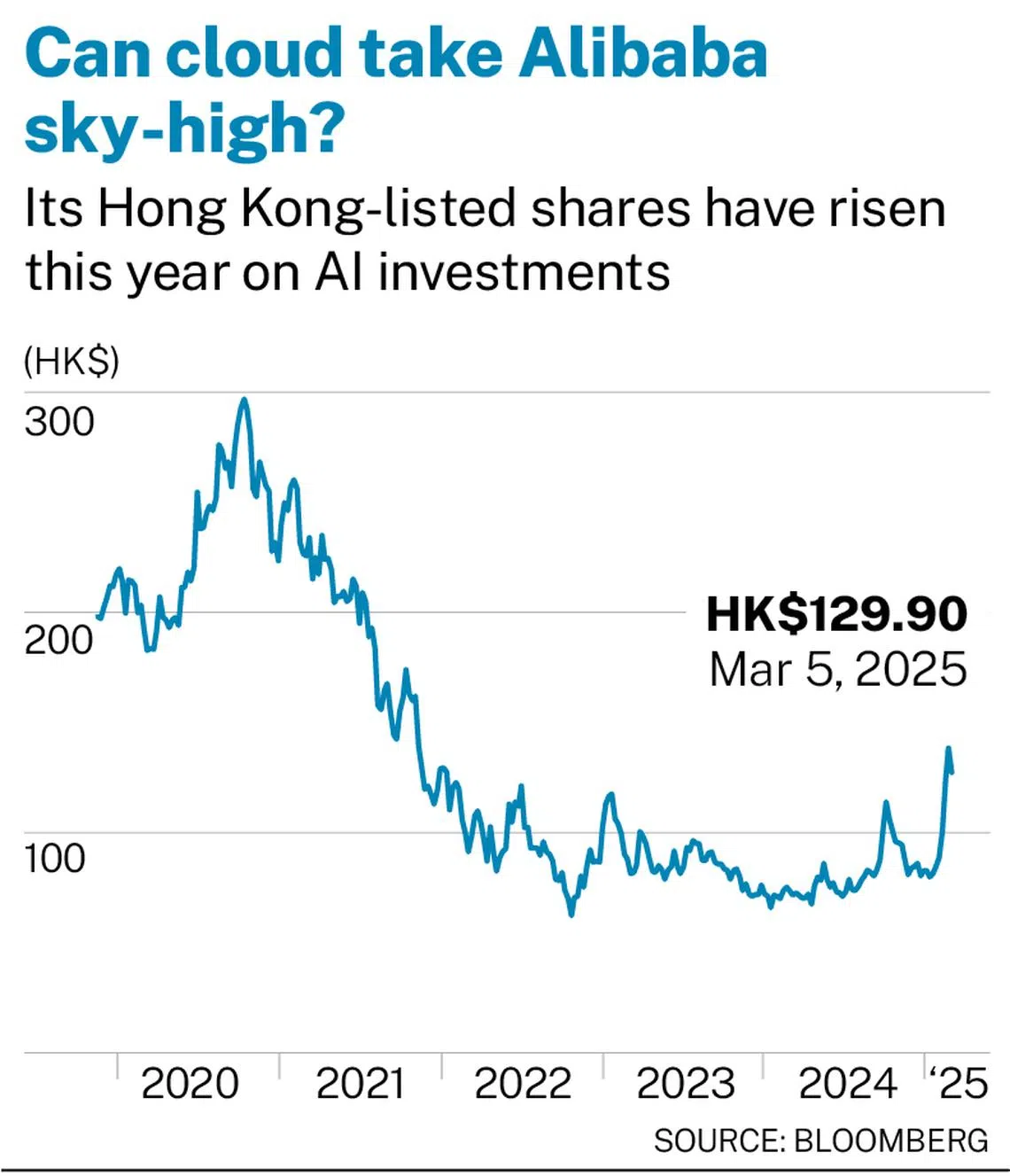
Chinese internet giants are stepping up AI investments. Alibaba will invest at least 380 billion yuan (S$70 billion) in cloud computing and AI over the next three years. Tencent has released a new model that it claims is faster with replies than DeepSeek’s R1. Baidu is integrating DeepSeek into its search engine. These stocks have also rallied; for instance, Alibaba is up 56.8 per cent this year as at Mar 5.
Yet another beneficiary would be the EV sector, which could ride on AI advancements to introduce more smart driving features. Pictet’s Chen notes that EV giant BYD recently added free self-driving features on most of its models, even the cheap ones – creating a direct and daily use-case for AI.
Risks and “retrograde” steps
These bullish outlooks come with caveats that investors need to be mindful of.
On the EV front, for instance, Chen notes that China’s crowded EV sector is still undergoing consolidation and only some players will emerge as winners. “You don’t need 300 different brands at the end of the day,” he points out.
In cloud computing, investors will need to carefully assess the earnings mix of each company and to what extent AI could actually make a difference to overall profit. At Alibaba, for instance, the cloud unit’s earnings would be “a drop in the ocean” compared with its e-commerce business, says APS’ Wong.
Robert Lea, a senior analyst at Bloomberg Intelligence, similarly notes that improvements in Alibaba’s cloud business are “unlikely to move the needle in terms of (its) group earnings”, as opposed to a pure-play cloud company.
More broadly, the monetisation model for LLMs is also still unclear, notes Lea, who has been tracking DeepSeek from as early as mid-2024.
With hundreds of LLMs in China alone, this is “a commoditised sector, which makes it very difficult to monetise, let alone break into profit”, he says.
He notes that Baidu is set to make its AI chatbot, Ernie Bot, free of charge from Apr 1, which could be seen as a “retrograde step on monetisation”. With such uncertainties, potential earnings improvements are hard to calculate.
“There is scope for these large platforms to utilise the models to drive cost and efficiency savings, which has to be to their benefit. But again, it’s very hard to put a number on that… It’s a qualitative argument at the moment,” he says.
Geopolitical risks are another big wild card. US president Donald Trump on Mar 4 unveiled fresh tariffs on China, prompting a swift retaliation from Beijing. Further escalations could dampen the outlook and spook investors.
Domestically, China’s economic indicators also “still paint a cautious growth prospect, underpinned by less-than-desired consumer spending”, notes Wang of the CCG.
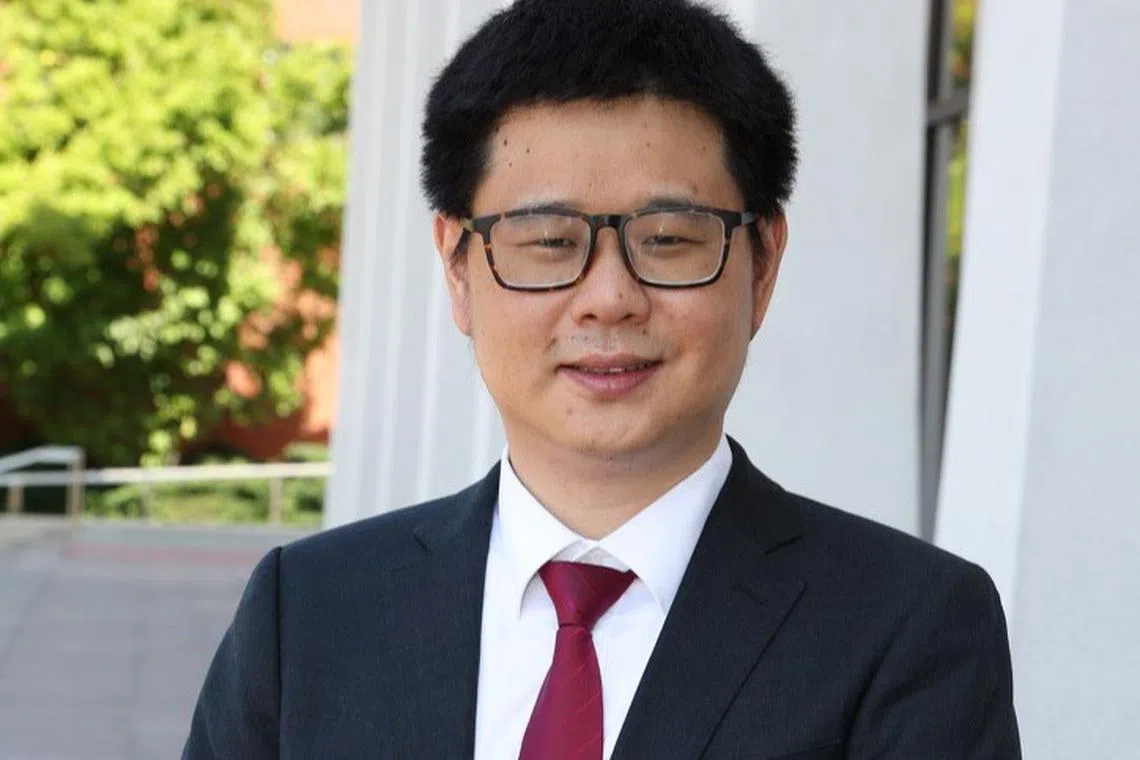
And while the tech crackdown appears to have ended, it has “permanently altered investor risk assessment”, says Assoc Prof Charoenwong.
“The visual reconciliation with Jack Ma is an encouraging signal, but it doesn’t necessarily mean a return to the pre-crackdown era of relatively unfettered growth,” he says, adding that investors may be more demanding of valuation discounts to compensate for uncertainties.
Playing the long game
While there are still jitters over China tech stocks, Assoc Prof Charoenwong also strikes an optimistic note. Post-crackdown, investors have developed more “sophisticated” risk assessment frameworks, which he reckons is “healthy”.
Furthermore, the “fundamentals of some Chinese companies do seem very solid”, he says, adding investing in the sector requires careful stock selection and risk management.
He recommends three attributes to look for in companies: a clear alignment with national priorities, low dependence on US tech, and good free cash flow without a continuous need for external funds.
Pictet’s Chen also suggests that investors look at companies that are willing to reward their investors with dividends or buybacks. “Even if, for various reasons, their share price does not reflect the underlying value, you still get compensated along the way by waiting,” he says.
There are now more ways for investors to get exposure to China tech, such as through the newly launched Singapore Depository Receipts for Meituan and Xiaomi.
Exposure through exchange-traded funds (ETFs) is another popular option. Ong Xun Xiang, head of ETFs at Lion Global Investors noted that the firm’s Lion-OCBC Securities Hang Seng Tech ETF was the top-traded ETF by volume on the Singapore Exchange as at January.
“We expect the ETF’s trading interest to continue as investors ride on this new wave,” says Ong.
Ultimately, investing in China tech takes a willingness to play the long game – like APS’ Wong has with his decade-old bet on SMIC – and an understanding of the country’s entrepreneurs.
Wong points out that China is moving from a “1 to n” mindset of simply scaling up existing solutions, to creating new products from scratch, or what is often dubbed “0 to 1” innovation.
“In the past, Chinese business people have preferred the ‘1 to n’ model where they can monetise their investment fairly quickly, sometimes in one to two years,” he says. But with DeepSeek’s success – and the sheer number of science and tech graduates in China – Wong expects more “0 to 1” breakthroughs.
As Wang of the CCG highlights, it “would not be prudent to bet against Chinese innovation”.
TRENDING NOW

Nvidia reinstates Jensen Huang as CEO; Trump says move poses no national security risk

Beyond the greenback, Vietnam’s big borrowers turn to Asian-currency bonds

Indonesia’s coal tycoon Low Tuck Kwong replaced as Bayan Resources president-director

Six workers file employment claims against Crystal Jade Food Manufacturing

