No monkey business, please
Singapore
THEY'VE been popularised as emojis with the advent of smartphones, but where do the three wise monkeys - who exhort us to see no evil, speak no evil, and hear no evil - come from?
In the Year of the Monkey, it's an entirely appropriate question to ponder.
The short and easy answer, it seems, is Japan - coincidentally, the same country that gave the world emojis.
But there's actually a fair bit of confusion surrounding the three monkeys' origin. While experts (yes, there are experts, but more on that later) agree that the trio came from Japan, others say they could have come from China or Africa.
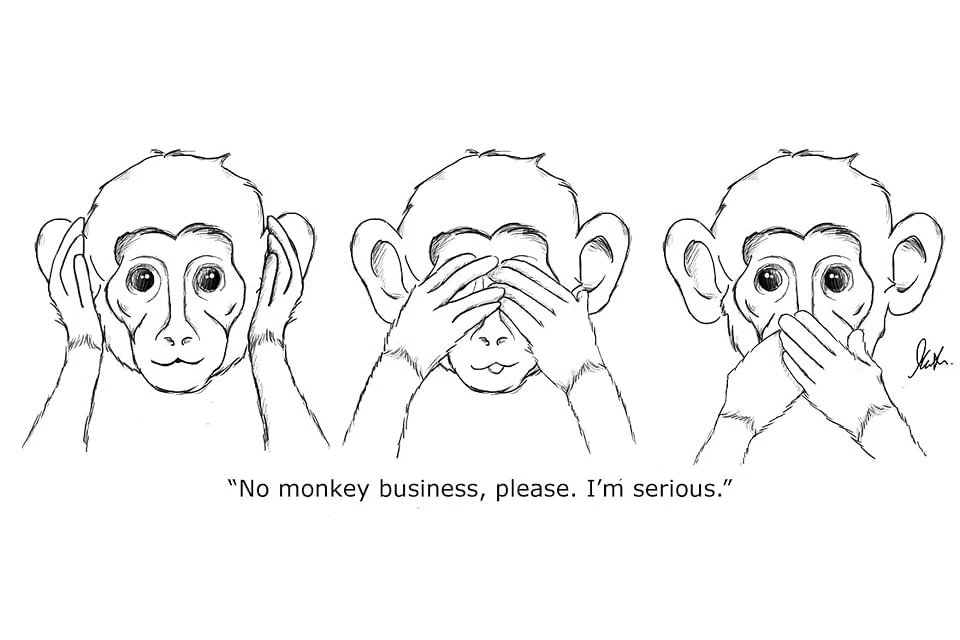
For those who may not be acquainted with them, the primates are traditionally found in Japanese paintings, carvings and statues. Together, they are a pictorial adage: three monkeys holding their hands over their eyes, ears and mouth. Together, they embody the proverbial principle to see, hear and speak no evil - hence the moniker, "no evil monkeys".
Origin of the species
The oldest known appearance of the threesome is in Nikko, Japan, on a 17th-century carving at the Toshogu Shrine of the Koshin belief - a now-forgotten Japanese folk religion. The wise monkeys feature in one of eight panels wrapped around the shrine, and are part of a larger depiction of a life well and ethically lived.
But many believe the monkeys were first conceived in China, pointing to a similar 4 BC Confucian saying as proof: "Look not at what is contrary to propriety; listen not to what is contrary to propriety; speak not what is contrary to propriety; make no movement which is contrary to propriety."
Still, that Confucian maxim says nothing of monkeys. It's only in the mid-1600s in Japan that the three apes begin to appear - on Koshin wooden planks, stone slabs and paper scrolls.
Interestingly, figurines of the three frequently crop up in Africa - although these are mostly modern statues produced as souvenirs for export to the rest of the world.
In fact, the souvenir industry has taken it upon itself to add a fourth monkey in the mix. With his hands over his crotch, he is supposed to represent "do no evil" or even "have no sex"; it's an admittedly shrewd invention to boost their novelty value and, of course, sales.
(Pretty sure that fourth monkey isn't going to fly here, though, given Singapore's falling birth rate.)
Collectors' monkeys
Wherever their place of origin, it's fair to say the monkeys have earned their place in popular culture, far beyond the borders of Japan.
In fact, there are an estimated 300-plus "no evil monkeys" collectors worldwide; most have met over fierce eBay bidding wars. In Europe, hobbyists have gathered every year since 1993, while in America, the first meeting was held in 2001.
At these sessions, collectors present fresh research on all things three monkeys, show off new acquisitions, and share trade secrets on the best places to find new pieces.
Once, the US collectors even hosted Mahatma Gandhi's grandson as a guest speaker. The link? When Gandhi died in 1948, it was discovered that he had less than 10 belongings. These included a small set of three monkey figurines - a notable exception to his lifestyle of non-possession.
The groups also maintain up-to-date websites and ever-growing mailing lists. Some collectors have even organised pilgrimages to Japan; there, they visit Koshin shrines where carvings of the three monkeys abound.
Apeshifting
As with all symbols that have spread worldwide, however, the wise monkeys have come to mean different things in different places. In the East, the apes remain as two-pronged reminders: not just for people to do good, but also to refrain from causing harm.
In the West, however, the message is less cheery. The trio are typically associated with "sins of omission" - a deliberate unwillingness to see and engage with evil in the world.
In the digital realm, too, the monkeys have taken on a whole new meaning. For example, the "see no evil" monkey - which, by the way, is the 23rd most used emoji out of 1,679 on Twitter - has come to represent embarrassment. Even though that's pretty far removed from the original sentiment, I like to think of it as modern-day evolution.
This monkey business could go on forever; alas, column inches demand an end. So go forth and send off your Chinese New Year greetings with the three wise monkeys emojis - for now you know whence they came.