

Dogged interest: Corporate buyers unleashed on animal health market
Despite high-profile acquisitions in Singapore’s vet sector, risk of monopoly may be all bark and no bite


[SINGAPORE] Keep his clinic independent or join a corporate network? Veteran veterinary surgeon Ryan Leong had already faced this decision once before.
In 2024, the four-clinic chain Pets Avenue, which had begun with a single branch co-founded by Dr Leong in 2015, was sold by his business partner to American pet-care giant Mars.
In November, Mars came back with an interest in Pets Avenue Veterinary Clinic and Referrals, a clinic and surgical referrals practice that Dr Leong had set up in Telok Kurau earlier that year.
He admits that, as the clock ticked down to the August 2026 deadline for a response, the offer looked tempting.
“The carrot that was dangled before me was very attractive,” he says, without specifying the sum involved.
Ultimately, Dr Leong said “no”. He wanted the autonomy to build a like-minded team and make business decisions without involving a corporate owner with different priorities.
He has since rebranded his clinic as Chiron Veterinary Referrals, as the Pet Avenue name now belongs to Mars.
Still, his dilemma is one that more of Singapore’s independent vets may soon face, as corporate groups and private equity (PE) firms look to buy up clinics here.

Furry flurry
Vets and industry watchers to whom The Business Times spoke say the sector has become increasingly attractive to investors, as owners are willing to spend more on specialist care, while a fragmented market of small practices means that there are plenty of acquisition targets.
Based on checks by BT, Singapore had 125 veterinary clinics as at July 2026, of which roughly 80 per cent were independently owned.
Mars, the American chocolate and confectionery behemoth that also owns pet-food brand Royal Canin, has rapidly become the largest owner of clinics here through Mars Veterinary Health.
The conglomerate entered Singapore in 2020 with the purchase of Veterinary Emergency & Specialty (VES) Hospital in Whitley Road for an unspecified amount.
In April 2026, Workers’ Party MP Kenneth Tiong noted that Mars was running at least 19 of Singapore’s licensed veterinary centres, or about one-sixth of the market, at the time.
Other smaller corporate owners are also actively acquiring.
VetPartners – which is the largest vet group in Australia and New Zealand, with more than 260 clinics – bought Companion Animal Surgery in Balestier in 2019, its only clinic in Singapore.
Pet Space, which is Hong Kong’s largest vet group with 11 clinics there, bought Animal Recovery Veterinary Centre in Singapore and relaunched the formerly independent clinic under its own branding in January 2021.
Meanwhile, Catalist-listed Asia Vets Holdings was a cash company formerly known as Smartflex Holdings until it bought the Animal Ark brand in 2018. It now runs two clinics, in Springleaf and Tampines.

Fragmented market
The market activity does not surprise Dr Teo Boon Han, president of the Singapore Veterinary Association (SVA).
The interest from investors follows market trends in human healthcare here, he says, and is part of a broader global push towards consolidation in veterinary care.
The veterinary market attracts investors because of the size of the consumer dollar, as well as the prevalence of acquisition targets.
“Pet owners are increasingly willing and able to spend on preventive healthcare, diagnostics, and treatment for their fur kids,” adds Dr Teo, who is also managing partner of VetTrust Singapore and a senior veterinarian at Canopy Veterinary Centre in Jurong.
Singapore’s pet-care market is expected to reach US$184.4 million this year, up 3.5 per cent from 2025, according to Euromonitor International.
Spending on animal health is also shifting from routine vaccinations alone to more expensive services such as diagnostics, cancer care, complex surgery and intensive care, points out Sunny Soh, senior professional officer at the Singapore Institute of Technology (SIT).
For PE firms, the draw goes beyond individual clinics.
“The real attraction is not veterinary clinics themselves,” says Luke Pais, EY-Parthenon’s Asean private equity leader, who has consulting experience in the pet-food sector.
“Once a network reaches scale, it becomes difficult to replicate because the moat is the ecosystem of vets, specialists, data, referral pathways and client relationships.”
Larger groups aiming for economies of scale in procurement, technology, marketing and administration can snap up clinics in a market that Dr Teo observes is highly fragmented. Most practices are either founder-run or part of brands with just two to five outlets.
Soh notes that a group that owns both neighbourhood clinics and a referral hospital can capture consumers across the whole patient journey – and, because most owners pay out of pocket rather than through insurers, providers have more freedom over pricing.
Unlike in Malaysia, where the government rejects veterinary practices that are set up as a partnership or company with shareholders who are not vets, anyone can own a clinic in Singapore as long as the vets working there are licensed.
Moreover, multinational groups can easily bring foreign vets into Singapore, says Dr Teo, since the working language here is English and accredited qualifications from the UK, US, Australia and New Zealand are accepted without requirements for further exams.

Staying independent
Many vets at independent practices value their nimble culture and lighter bureaucracy.
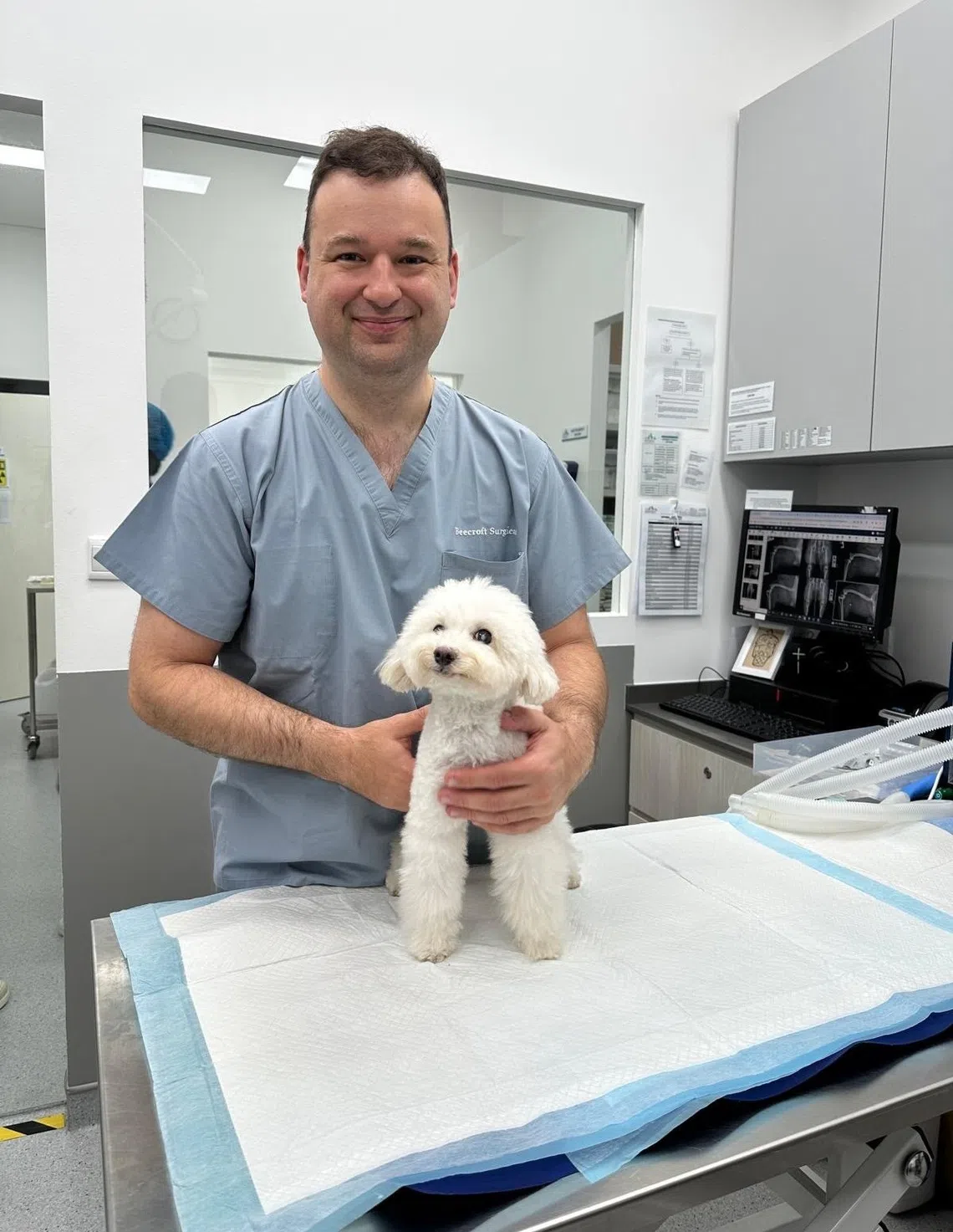
Specialist surgeon Patrick Maguire and his wife, Dr Rina Maguire, co-own Beecroft Animal Specialist and Emergency Hospital, a 24-hour referral hospital with around 150 staff and no outside investors.
Dr Patrick Maguire says he has been approached by corporate and PE buyers to sell, but talks never got far as he was not comfortable with the business structures proposed.
Like Dr Leong, he values being able to make decisions without “another layer of corporate ownership above us setting those priorities”.
Still, neither Dr Leong nor Dr Patrick Maguire thinks corporate ownership is inherently flawed.
SVA’s Dr Teo cites greater purchasing power, stronger recruitment, centralised administration and certain career opportunities as clear advantages that larger groups have over small practices.
SIT’s Soh estimates corporate-owned practices can leverage their scale to cut the unit costs of drugs and consumables by 15 to 30 per cent, while groups with pet-food arms can also capture value from prescription diets.
Yet the cost savings available to larger businesses do not automatically mean lower prices for pet owners, as they may be kept as margin, used to pay down acquisition debt or buy equipment.
As a result, some pet owners may be tempted to blame corporate ownership for rising bills and falling standards. Still, the independent vets who spoke to BT disagreed.
Dr Leong takes such complaints “with a pinch of salt”. When a clinic changes hands, the same vets and nurses usually stay on, he says.
As for one concern raised by EY-Parthenon’s Pais – that a network could steer referrals towards its own affiliated referral centres or laboratories – Dr Leong says that has not been his experience. Despite declining to join Mars, he still receives referrals from Mars-owned clinics “all the time”.
Dr Patrick Maguire, who previously worked in a corporate-owned practice in Ang Mo Kio for two years, adds that surgeons want good outcomes for their patients regardless of where they are based. The higher costs, he argues, are more because owners’ expectations have risen.
“You can’t have cut-price veterinary medicine and at the same time expect the highest levels of specialist care and 24-hour staffing.”
Watching the watchdogs
Overseas markets have seen significant consolidation.
Mars, the same privately held group buying up clinics here, paid US$9.1 billion for US hospital chain VCA Animal Hospitals in 2017. Other veterinary chains in its portfolio of more than 2,000 clinics include Banfield Pet Hospital, BluePearl and Linnaeus.
PE-backed groups have been busy too.
National Veterinary Associates, the largest private free-standing veterinary hospital chain in America, has been majority-owned since 2019 by a conglomerate with stakes in various global F&B and consumer brands.
The buyer, JAB Consumer Partners, also acquired Sage Veterinary Partners for US$1.1 billion and Ethos Veterinary Health for US$1.65 billion in 2022.
Meanwhile, VetPartners privatised Australia-listed National Veterinary Care in 2020 and was in turn bought out by Swedish investor EQT for A$1.4 billion (US$970 million) in 2023.
As deals piled up, competition in these markets thinned – prompting regulators to step in.
The US Federal Trade Commission warned that Mars’ VCA deal would likely raise prices and lower the quality of some speciality and emergency care. It made Mars sell 12 clinics and required JAB to offload clinics.
Australia’s competition regulator began requiring merger notifications in January 2026 and has referred at least one vet clinic acquisition for an in-depth review.
In the UK, where large groups own about six in 10 practices, the competition regulator found in March that prices had risen at twice the rate of inflation, with large groups charging 18.3 per cent more than independents. New rules introduced in response will require practices to publish prices and disclose their shareholders.
In Singapore, where investor interest in the vet industry is still nascent, the Competition and Consumer Commission of Singapore (CCS) has not conducted any in-depth review of the level of competition in the sector or started any investigation, as it has not found reasons to suspect violations of the Competition Act at this point.
The agency actively monitors mergers and is aware that there have been acquisitions in the veterinary sector over the years, but has not received any notifications on them.
CCS remains open to looking into anti-competitive practices, such as collusion, abuse of dominant positions or mergers that might substantially lessen competition, and “will continue to monitor the market and review whether intervention may be necessary”, says its spokesperson.
EY-Parthenon’s Pais notes: “Singapore’s competition framework already prohibits mergers that substantially lessen competition.
“Consolidation is beneficial when scale funds better clinical care and productivity. It becomes problematic when the principal value driver shifts from efficiency to reduced customer choice and pricing power.”
For instance, the line is crossed when ownership is unclear, referrals are effectively captive or prices become difficult to compare, he adds.
If any regulation of veterinary market competition were to be introduced in Singapore, Dr Lee Yen Teik, senior lecturer in finance at the National University of Singapore Business School, expects that the authorities would require transparency, such as clear ownership disclosures and published prices, rather than impose curbs on ownership.
Buyers press “paws”?
Several years into the vet clinic buyouts, whether the acquisition activity is slowing down is an open question.
SIT’s Soh sees limits to further consolidation. In his view, Mars has already bought the “trophy assets”, leaving smaller targets that yield diminishing returns per deal.
BT has found no public record of acquisitions by Mars since it picked up Pets Avenue in 2024. The company did not respond to media queries.
Meanwhile, a spokesperson for Asia Vets tells BT that the company will stay disciplined as a buyer – weighing factors such as whether a clinic is “culturally compatible” with the group and can retain its vets, “rather than pursuing acquisitions simply to increase our scale”.
As for whether Asia Vets would consider a sale if approached by a corporate group or PE firm, the spokesperson says: “As with any listed company, the board would consider any proposal presented to it in accordance with its responsibilities and applicable regulations.”
The speed at which clinic networks can grow is limited by the local vet shortage, according to Soh. He expects corporate ownership to plateau at around 35 to 50 per cent of the market, leaving one dominant group, one or two smaller ones and a lasting independent fringe.
Independents with strong reputations or specialised capabilities will always have room, says SVA’s Dr Teo, adding that there are natural constraints on consolidation because Singapore is a small concentrated market.
He also notes that potential buyers can be very diverse – ranging from large, family-owned companies such as Mars with a long track record in veterinary care, to PE players with shorter investment holding periods that aim to sell within a few years.
What matters are safeguards to ensure fair competition and clinical independence, he adds. “While profits are important, I do hope that investors in the sector operate responsibly and respectfully, take care of the veterinary team on the ground, and serve as enablers to advance the veterinary profession.”
TRENDING NOW

Once staunchly pro-China, Malaysian Chinese businesses are now distancing themselves from Beijing

Cliff Tan has 7 million followers and a 4-month waitlist. Why won’t he expand his business?

Grab CEO’s wife Chloe Tong on life with Anthony Tan and finding her purpose

Singapore F1 to proceed despite haze; no changes planned to outdoor entertainment

