

Don’t mourn DFI’s sale of Cold Storage, Giant; its modernisation journey could pay off soon
While the group has a seemingly formidable portfolio of retailing brands, its shares have delivered a negative total return of 65.8% over the past 10 years

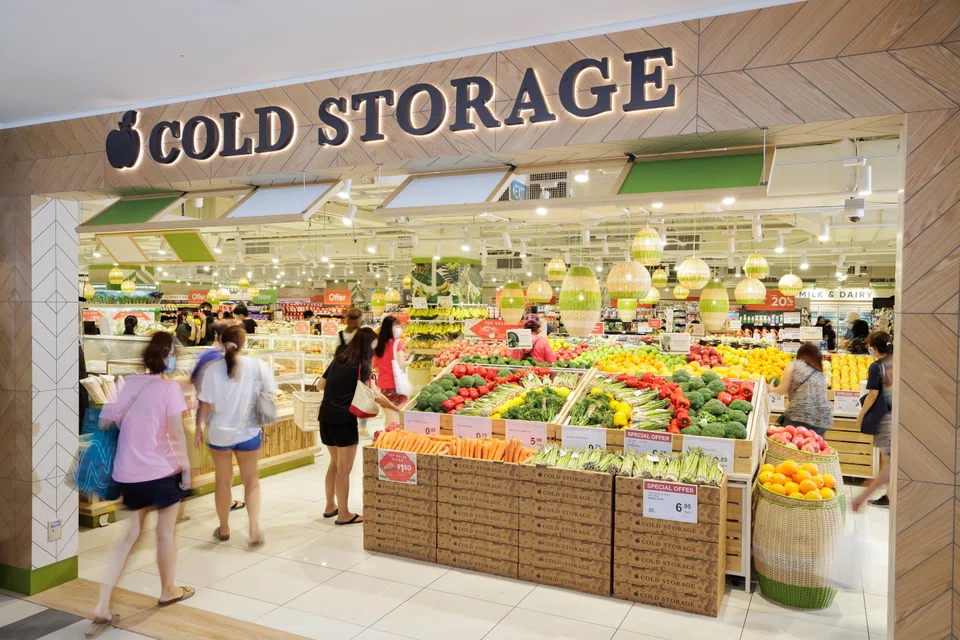
[SINGAPORE] Some investors might have been perplexed when DFI Retail Group said earlier this week that it had agreed to sell its Cold Storage and Giant stores in Singapore for S$125 million.
For one thing, DFI has been associated with these well-known brands for several years. More to the point, the announcement came only a fortnight after the company reported headline financial numbers for 2024 that seemed to indicate the whole group – including its Singapore food business – is turning around.
Upon closer examination, however, the deal seems to dovetail with DFI’s broad strategy of pruning its business portfolio, investing in technology and harnessing data to drive profitability.
On Mar 10, the company said its underlying earnings attributable to shareholders for 2024 increased 29.8 per cent to US$200.6 million – or US$0.149 per share. The group’s underlying operating profit was up 16.8 per cent at US$343.1 million, while revenue slipped 3.3 per cent to US$8.87 billion.
DFI’s total dividend for 2024 increased 31.3 per cent to US$0.105 per share.
The group’s health and beauty division – which includes its Mannings and Guardian stores – contributed operating profit of US$210.8 million, down 0.8 per cent against the previous year.
Its convenience stores achieved a 16.6 per cent increase in operating profit to US$102.3 million, while operating profit contribution from its home furnishing stores was down 13 per cent at US$16.1 million.
The group’s food business saw a 27.6 per cent increase in operating profit to US$57.8 million. Among the factors cited for the improved performance was that its Singapore food business turned profitable in Q4 2024.
DFI is guiding for underlying profit attributable to shareholders of between US$230 million and US$270 million in 2025 – which implies growth of 24.6 per cent at the midpoint.
CGS International subsequently raised its target price for DFI shares from US$1.85 to US$2.71 while RHB pushed its target price up from US$2.70 to US$2.79.
So, why is DFI selling its Cold Storage and Giant stores in Singapore? Wouldn’t it make more sense to hold on to them and ride the turnaround in profitability?
While the company has a seemingly formidable portfolio of retailing brands, it has been a terrible play on Asian consumer spending – as a result of technological change, shifting consumer behaviour and intense competition.
During the 10-year period up to the day before the sale of its Singapore food business was announced, DFI’s shares delivered a negative total return of 65.8 per cent. The only other component of the Straits Times Index that performed worse over the same period was Seatrium (formerly Sembcorp Marine), with a negative total return of 92.9 per cent.
To strengthen its position, DFI has been shrinking its portfolio and refocusing resources on its most promising businesses.
For instance, the group completed the sale of its Hero Supermarket business in Indonesia in June 2024. It is now fully focused on its Guardian and Ikea businesses in that market.
DFI also said in September 2024 that it would sell its associate stake in Yonghui Superstores for nearly 4.5 billion yuan (S$829 million). The divestment was completed in February, and put the group in a net cash position.
With the sale of its Singapore food business announced this week, DFI plans to pivot its focus and resources to its Guardian and 7-Eleven businesses in the city-state.
Interestingly, the buyer of DFI’s Singapore food business – a retailing group called Macrovalue – also bought its Cold Storage, Giant and Mercato stores in Malaysia back in 2023.
“We firmly believe that Macrovalue is ideally positioned to drive the next phase of growth for the Singapore food business with its expanded scale and procurement power across both Malaysia and Singapore,” said DFI’s group chief executive, Scott Price, in a statement on Mar 24.
With a stronger balance sheet, the group is in a better position to expand the market shares of its remaining businesses and boost their profitability.
DFI noted in a recent financial performance review that it had rolled out more than 20 new channels in 2024 for customers to access its retail portfolio – spanning apps, websites and third-party platforms.
Among them is a new 7-Eleven app in Hong Kong that had garnered some 137,000 monthly active users and 30,000 daily active users in December. Another of these new channels is supermarket chain Wellcome’s quick-commerce partnership with foodpanda.
DFI is also leveraging data from its yuu Rewards loyalty programme to drive sales and boost profit margins through improved assortment at its stores.
The yuu Rewards programme now has 5.3 million members in its home market of Hong Kong, and 1.8 million members in Singapore.
DFI also highlighted its fledgling retail media network, which offers integrated online and offline advertising. It said more than 100 marketing campaigns had been sold since the business was launched in Q1 2024, with supplier partners that included Procter & Gamble, Unilever and Coca-Cola.
DFI described the business as “a potentially significant source of profit”.
Long story short, the company is modernising and retooling its retailing operations to thrive in the 21st century. Letting go of the Cold Storage and Giant stores is just part of that journey.
DFI shares closed on Wednesday (Mar 26) at US$2.39 – or 16 times its 2024 earnings per share. Based on its total dividend for 2024, the company’s shares offer a yield of 4.4 per cent.
TRENDING NOW

LTA proposes combining car COE categories, adding rebate-surcharge system

StarHub to acquire MyRepublic’s mobile business amid ongoing telco consolidation

DBS, OCBC, UOB rout lops billions off STI as inflation, rate concerns spook investors

Grab CEO’s wife Chloe Tong on life with Anthony Tan and finding her purpose

