

Dyna-Mac shareholders may have dodged a bullet as company delists
Investors must scrutinise offers closely as M&A activity ticks up

WHEN South Korean conglomerate Hanwha first launched its cash offer for shares in offshore oil-and-gas contractor Dyna-Mac in September 2024, it purportedly had no plans to take the Singapore-listed company private.
To be precise, offeror Hanwha Ocean SG said then that it “does not have any present intention to actively pursue the delisting” of Dyna-Mac from the mainboard of the Singapore Exchange.
However, Hanwha also made it clear that, should trading in Dyna-Mac shares be suspended if it loses its free float – with less than 10 per cent of its shares in public hands by the end of the offer – the offeror would not undertake or support any action for the trading suspension to be lifted.
If such an event were to arise, Hanwha Ocean SG said that it “reserves the right and discretion… to assess the options available at such time”.
It added that, in this case, there was “no assurance” that its “current intention” not to delist Dyna-Mac would be carried into effect.
In a third scenario, where the offeror received valid acceptances for at least 90 per cent of the shares it did not already own, it said that it intended to exercise its right to compulsorily acquire all the Dyna-Mac shares not acquired under the offer. The offeror would then proceed to delist the company, it noted.
Hanwha Ocean SG is a special-purpose vehicle owned by shipbuilding company Hanwha Ocean and defence, aerospace and space player Hanwha Aerospace. Both companies are listed on the Korea Exchange.
The offer came after Hanwha Group in May upped its stake in Dyna-Mac by acquiring a 23.9 per cent stake in the company from Keppel subsidiary KepInvest Holdings.
Hanwha would eventually raise its offer price to S$0.67 a share, as analysts and investors – including the estate of Dyna-Mac founder Desmond Lim – baulked at the initial offer of S$0.60 a share.
The estate of the late founder, which was Dyna-Mac’s single-largest shareholder, said that the initial offer did not “adequately reflect the value and growth potential” of the company, which has grown to become a “global multi-disciplinary” contractor.
As it played out, Hanwha had some 95.15 per cent of Dyna-Mac shares sewn up by the close of the offer on Nov 20. As previously laid out, it said that it would go on to make a compulsory acquisition of all the offer shares not acquired under the offer, and delist the company.
Some shareholders would have preferred to stay on board the Dyna-Mac cruise, and see the share value rise in tandem with its growth story.
But the wreckage that soon followed should quickly clear up any misgivings about selling their shares and exiting the company amid the takeover.
Wielding the axe
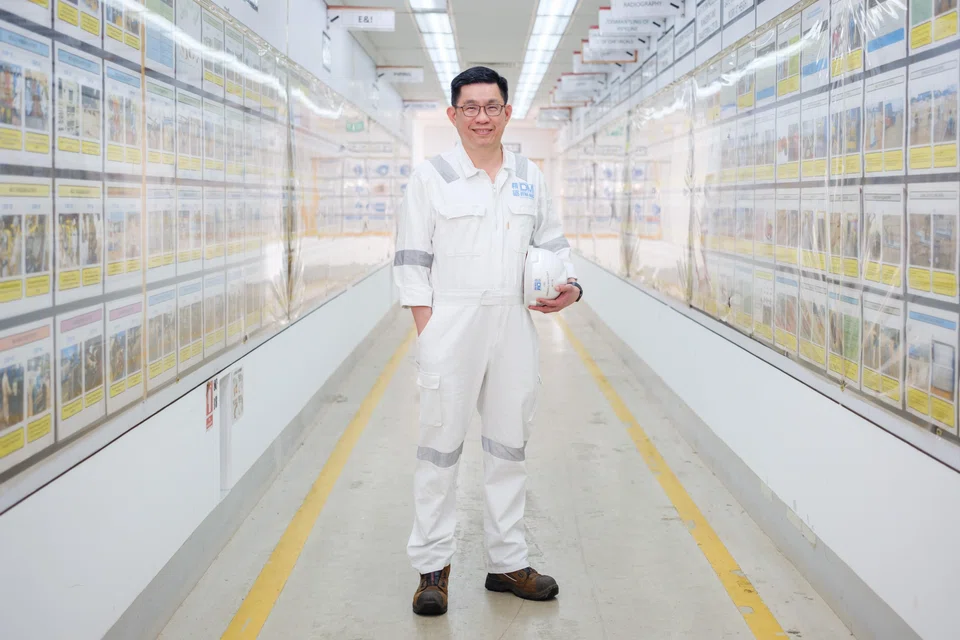
Just weeks after the close of the offer, the board of now Hanwha-controlled Dyna-Mac on Dec 16 announced that it was firing executive chairman and chief executive officer Lim Ah Cheng – better known in the industry as AC Lim – with immediate effect.
The “strategic decision” came following a review of the business to identify areas where the strategic direction and operations of Dyna-Mac could be improved, the board said. It added that the daily running of the business will continue to be overseen by its directors and management team.
For investors familiar with Dyna-Mac’s story, this would come as a shock.
Since taking the helm in 2020, Lim had orchestrated a revival of Dyna-Mac’s fortunes. Lim overhauled the company’s business practices to bring it back from the brink of bankruptcy and achieve remarkable growth.
For the first half of the 2020 financial year – just months after Lim became CEO – the group registered a net loss of S$14.2 million, on revenue of S$51.4 million. Fast forward to H1 FY2024 ended June, and Dyna-Mac raked in earnings of S$38.8 million as revenue ballooned to S$259.7 million.
Under his leadership, Dyna-Mac grew its order book to S$681.3 million as at June 2024, with deliveries scheduled until the end of FY2026. Meanwhile, the group’s net cash position stood at S$307.7 million, with zero bank borrowings.
Industry watchers are no strangers to Lim’s grit.
Amid a shortage of workers during the early days of the Covid-19 pandemic, for example, Lim’s Dyna-Mac leveraged its relationship with relevant government agencies to broker a deal to bring workers to Singapore – including arranging the necessary air transportation and quarantine facilities. Through his efforts, Dyna-Mac was able to bring in more than 1,000 workers during the pandemic.
While the list of accolades runs long, he was most recently in September conferred the Outstanding CEO Award at the Investors’ Choice Awards 2024 organised by the Securities Investors Association (Singapore). Indeed, it could be argued that a large part of Dyna-Mac’s success – from contract wins to workers’ productivity and morale – hinged on Lim’s personal pull.
In this light, the board’s “strategic decision” to remove him so suddenly is puzzling. Take away Lim, and Dyna-Mac is arguably little more than a bunch of fabrication yards and some cash in the bank.
Post-termination, Lim’s future could remain bright: there should be no lack of offers for a turnaround maestro.
Dyna-Mac’s future could be a little less certain.
Executive search

The company on Dec 24 posted a job listing on MyCareersFuture seeking a new CEO. The quality of candidates that will be attracted by the listed salary range of S$15,000 to S$22,000 a month remains to be seen. This will work out to be less than half of the S$593,904 in base salary that Lim earned in 2023, according to Dyna-Mac’s latest annual report.
Lim also took home another S$2.4 million in 2023, comprising S$738,038 in cash bonus and S$1.6 million awarded in shares under a share plan.
Dyna-Mac’s board said that the amount of payments due to Lim following his termination is “under discussion”.
Chopping Lim before the end of the year might see Dyna-Mac save a bundle from bonus and performance payouts, but that would be not seeing the wood for the trees.
The job listing is also due to expire soon on Jan 14. It would certainly be challenging to find a suitable candidate to replace the CEO in this short time. And it would hardly be surprising if Hanwha proposes an internal or associated candidate to fill the role after the job ad expires.
While Hanwha noted in its offer document that it was not seeking explicitly to take Dyna-Mac private, shareholders should be glad that they got paid out and the company is going to be taken private after all.
But with merger and acquisition (M&A) activity expected to gain momentum in 2025, investors should keep a wary eye on offers – especially those where there could be changes to controlling shareholders that might cascade into key management changes.
TRENDING NOW

LTA proposes combining car COE categories, adding rebate-surcharge system

StarHub to acquire MyRepublic’s mobile business amid ongoing telco consolidation

DBS, OCBC, UOB rout lops billions off STI as inflation, rate concerns spook investors

Grab CEO’s wife Chloe Tong on life with Anthony Tan and finding her purpose

