

‘End of an era’ in Europe
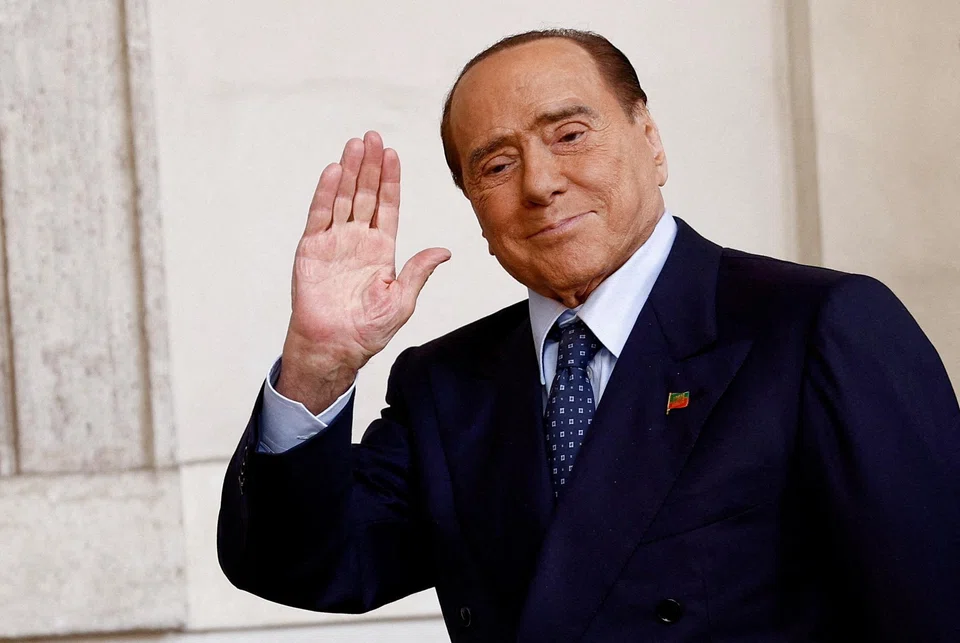
THE death on Monday (Jun 12) of Italy’s longest-serving prime minister, Silvio Berlusconi, shone a spotlight on how much European politics has changed in the last few decades in a populist direction.
After taking office in 1994 for the first time, the billionaire businessman led four Italian governments until 2011, although not consecutively.
He showed a remarkable propensity to bounce back from sex scandals and corruption cases (he faced trial at least 36 times), and in many ways was a forerunner of many of the populist politicians of today in Europe like the UK’s Boris Johnson, and indeed further afield too, such as former US president Donald Trump.
Internationally, Berlusconi also had strange political bedfellows, including Russian President Vladimir Putin, and populists of a more recent vintage such as Trump. As recently as last October, Berlusconi was reportedly still describing Putin as a “friend”, despite Moscow’s invasion of Ukraine.
When Berlusconi first assumed the Italian prime ministership, only a handful of key states with populations over 20 million – including Italy and Venezuela – had populist leaders.
Alongside the conservative maverick leader in Rome, for instance, Hugo Chavez was Venezuelan president from 1999 to 2013, aligning himself with the governments of Fidel and then Raul Castro in Cuba.
However, this then-relatively small “populist club” expanded significantly after the onset of the 2007 global financial crisis that heralded what has been called the “great recession”.
The role of economic downturn and austerity in the wake of that economic tsunami has been key to the rise of populism in Europe, especially in those states most impacted by the eurozone crisis such as Greece.
Unrest, however, has also tapped into pre-existing disquiet with established European political parties and systems. In all, a broad range of economic, political, social and technological factors have driven societal discord and dissension across much of the rest of the world too.
It is in the last decade that there has been the biggest rise in populism across Europe and the wider world, including Trump winning power in 2016, and Johnson in 2019.
For those who prefer their political history neatly arranged, it is perhaps therefore fitting that Johnson’s own political career in the UK may be ending at the same time as Berlusconi died.
The former Italian prime minister was probably at his most powerful in the early 2000s, when Johnson was a journalist, and it is clear from the latter’s writing that the then-budding UK politician admired him.
On Monday, the same day of Berlusconi’s passing at the age of 86, Johnson submitted his resignation as an MP.
The implosion of the latter’s political career, for now at least, came as a damning report is soon to be released into his behaviour as prime minister in the midst of the pandemic during the so-called “partygate” scandal.
However, Johnson, at age 58, could yet stage a political comeback once the Conservatives lose power.
Despite all of his many flaws, the former prime minister remains very popular among Conservative members, and it is therefore plausible that he may try to run again for the Tory leadership in the future.
In the last century, four UK prime ministers have served second periods in Downing Street after losing an election. There remains an outside possibility that Johnson might be the fifth such person to achieve this feat.
What makes Johnson’s presence potentially potent is that he was turfed from Downing Street not by losing a national ballot.
Instead, he was deposed in an internal party vote which may be regretted by increasing numbers of Conservative members if the party loses power in dramatic fashion at the next general election.
For Johnson to have a serious shot at a comeback, it may also be necessary for a wider swath of the electorate as a whole to become less negative about his legacy from 2019 to 2022.
For instance, an Ipsos survey released last year showed almost half the UK public felt that Johnson had done a bad job as prime minister, the worst rating of any post-war leader.
The fact that Johnson could yet stage a comeback, despite all of his indecent behaviour which would no doubt have ended his political career in a different generation, showcases that the era of populism is far from over.
To be sure, some data indicates that the number of populist leaders has fallen since the pandemic began.
However, populism is still widely prevalent in Europe, including the success in 2022 of Giorgia Meloni coming to power as the Italian prime minister. Meloni, a right-wing nationalist supported by Berlusconi, exemplifies how European populism tends to be of a different conservative variety to Latin America, where left-wing populism predominates.
Yet, while leaders from across different continents have different flavours of populism, they tend to win power through common campaign tactics. This includes attacks on immigration.
While populists can be very effective campaigners, they tend to be very poor at governing. This has absolutely been the case with Trump and Johnson, and was too with Berlusconi.
Take the example of Johnson who, despite winning a big majority in 2019, achieved very little of significance during his years in power to 2022. This includes the failure of his central vision to “level-up” the country by increasing pay, living standards, and the number of jobs, particularly in the poorer regions of the country, so that there is better equality all-round.
Berlusconi didn’t leave a legacy of great accomplishment either.
His time in charge of Italy was largely spent in fruitless battles with the judiciary and media, and The Economist famously described him in 2011 as “the man who screwed an entire country”.
Yet, while the governing record of politicians like Johnson and Berlusconi has been poor, there is a plausible case for why populism may only grow in appeal again in coming years. This may be fuelled by the aftermath of the Covid pandemic which triggered a deeper, broader global recession than even that of the global financial crisis.
Rising economic inequality is key too. While some affluent cohorts have seen their wealth increase even since the pandemic began, poorer people have often seen their incomes stagnate or worse.
So while the death of Berlusconi and the “demise” of Johnson may indicate the end of an era in European politics, the political phenomenon of populism may yet rebound. This despite the fact that politicians of this ilk have done so little to tackle the core economic and political challenges that power them to office.
The writer is an associate at LSE IDEAS at the London School of Economics
TRENDING NOW

Malaysian king buys stake in Singapore-listed mining firm expanding into rare earths

Grab CEO’s wife Chloe Tong on life with Anthony Tan and finding her purpose

Once staunchly pro-China, Malaysian Chinese businesses are now distancing themselves from Beijing

Longer wait times expected as S’pore healthcare institutions report system disruptions

