

Expect carved-out Jurong Lake District site to draw warm response from developers
Town Hall Link white site is expected to be made available in March 2026

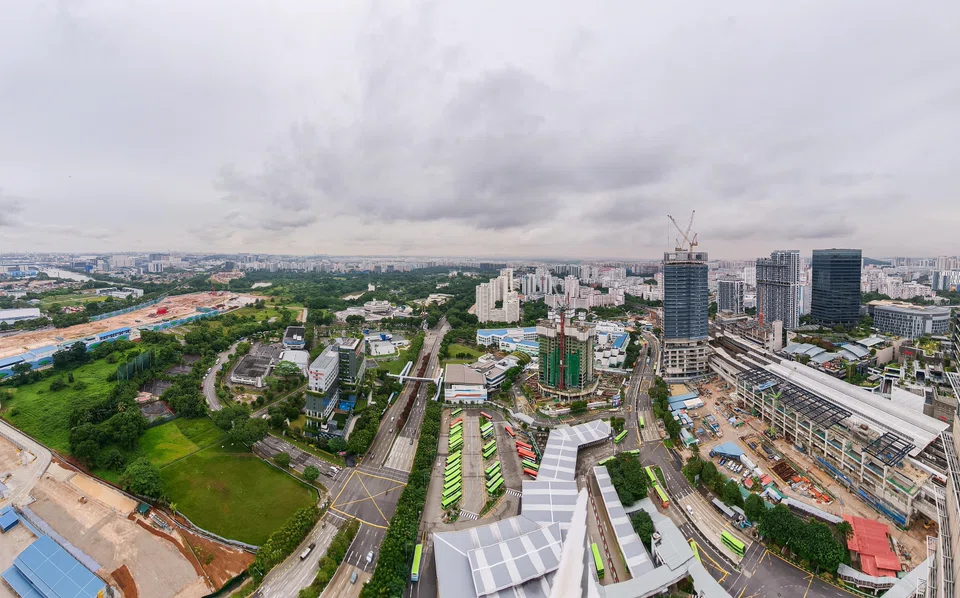
[SINGAPORE] Plans to develop Jurong Lake District (JLD) as Singapore’s second Central Business District (CBD) were dealt a blow when the Urban Redevelopment Authority (URA) did not award the tender for a 6.5 hectare (ha) white site in JLD in September 2024.
The master developer site, which encompassed three plots of land, was envisioned to be built up over 10 to 15 years to house at least 1.57 million square feet (sq ft) of office space, up to 1,700 private homes and close to 800,000 sq ft of space for other uses such as retail and food and beverage.
A five member consortium comprising CapitaLand Development, City Developments Limited , Frasers Property , Mitsubishi Estate and Mitsui Fudosan (Asia) had submitted two concept proposals for the site.
While the URA said one proposal was shortlisted, the tender for the site was not awarded as the tendered price, which worked out to about S$640 per square foot per plot ratio (psf ppr), was deemed to be too low. The land cost for the site – with maximum gross floor area of over 3.9 million sq ft – would amount to about S$2.5 billion.
Despite the hiccup, plans to develop JLD could soon gather fresh momentum with the government’s recent move to carve out the white site at Town Hall Link from the JLD master developer site for sale via the Reserve List of the H1 2026 government land sales programme.
Back in September 2024, I suggested following the URA’s non-award of the tender for the 6.5 ha white site at JLD that the master developer model should be ditched and the said site broken into several smaller sites for sale to better meet the risk appetite of developers.
I applaud the carving out of the Town Hall Link white site.
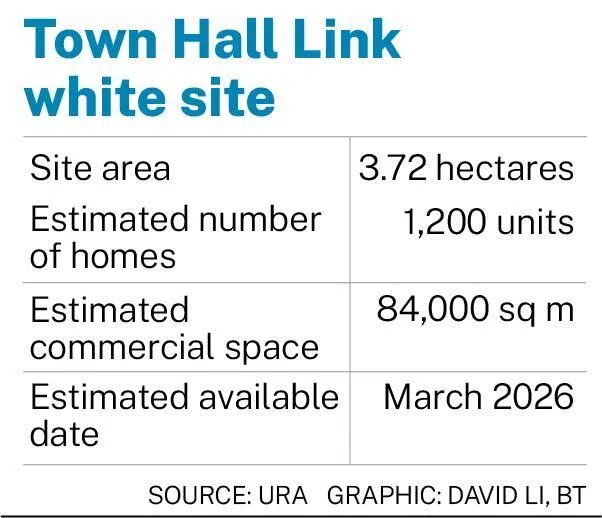
The Town Hall Link site will yield a total of about 2 million sq ft of gross floor area (GFA), comprising a minimum of around 0.43 million sq ft of office space, up to 1,200 private homes and around 0.47 million sq ft for complementary uses such as a hotel, retail and community uses.
In addition, the government will be undertaking some infrastructure works upfront to reduce the cost burden on developers.
The site is expected to be made available in March 2026. When released, chances are a developer or a group of developers might successfully trigger it for sale and the subsequent tender could draw keen interest among developers as well as a top bid way above S$640 psf ppr.
Overall size
First, the Town Hall Link site’s maximum GFA is about half that of the JLD master developer site. The former’s smaller size means a shorter development timeline, lower gross development costs and reduced project development risk. In short, developers should find the former much more palatable compared with the latter.
Indeed, perhaps a two- or three-member consortium could undertake developing the Town Hall Link site – having fewer consortium members can make co-ordination work among parties smoother.
In perspective, the Housing and Development Board’s recent tender of a mixed use development site with maximum GFA of nearly 1.3 million sq ft – comprising a residential and commercial development integrated with a bus interchange – drew three bids and a top bid of S$1,179 psf ppr, which exceeded analysts’ expectations.
Housing component
Second, the Town Hall Link site has a large residential component – the housing quantum is a maximum of nearly 1.1 million sq ft of GFA or close to 55 per cent of the site’s total GFA.
Condo units at the Town Hall Link site will be well served by public transport and other amenities. Given many Singapore residents aspire to condo living, growth in household formation, low interest rates and a resilient economy, expect strong demand for new private homes at Town Hall Link.
Crucially, having a large housing component in an integrated development helps a project’s cash flow and de-risks a project.
For one, selling new homes off plan generates cash flow when construction is underway. This is especially useful when the other components of an integrated development project such as the office and retail components do not generate any cash flow ahead of completion.
Office quantum
Third, the Town Hall Link site’s minimum office quantum is slightly over 27 per cent of that of the JLD master developer site.
Demand for good grade office space at JLD may be uncertain. Will users flock to high-quality and sustainable work spaces at JLD?
For one, despite the city state’s excellent public transport connectivity, many people living in the east may resist commuting to Jurong for work.
Thus, while the government has ambitious plans to grow JLD as a major decentralised office location, introducing a smaller initial office quantum to test users’ appetite for such space and hopefully overcome scepticism over JLD’s viability as an office location makes sense.
On the other hand, attaching too large an office component to a site at JLD can complicate the financial feasibility studies of developers and lead parties to either avoid such a site or be excessively conservative in their financial computations.
Our urban planners deserve huge kudos for the city state’s urban transformation. Making Singapore attractive for living, working and playing has helped the Republic attract talent and investments.
Nonetheless, plans to grow JLD require the support of private sector players. If JLD is to become a thriving second CBD, developers will need to risk time and capital to build interesting spaces there that users embrace. For one, the Town Hall Link white site’s land cost could amount to S$1.8 billion if the site is sold for about S$900 psf ppr.
The Town Hall Link white site has the critical mass needed to catalyse the next phase of JLD’s development and should be palatable to developers. Hopefully, deep-pocketed developers looking for large projects to showcase their capabilities and make sound financial returns will be drawn to it.
TRENDING NOW

If Europe goes to war, the fallout will be felt in East Asia
Indonesia stocks suffer worst plunge in nearly 30 years as MSCI proposes standalone status

Keppel seeks US$1 billion for Vietnam investments as it joins country’s international financial centre
Philippines’ FDI slowdown exposes uneven investment prospects across S-E Asia

