Reality check on sustainability not necessarily a setback: OCBC’s Mike Ng
The emphasis on economic viability will define the next phase of green finance, says the bank’s group CSO

The strategies and stories that shape today’s leaders
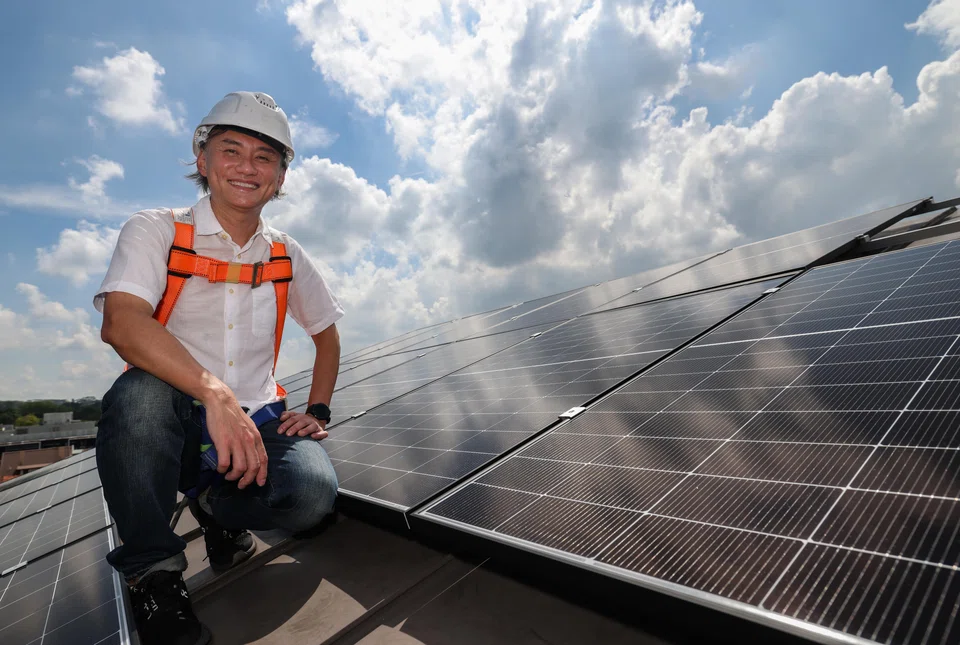
[SINGAPORE] Installing solar panels on the rooftop of his residential property has made Mike Ng more intentional about how he uses electricity.
The solar panels were installed less than three months ago and already, his family has started scheduling activities such as laundry, water heating and the charging of his electric vehicle according to the weather.
“I really think it’s quite cool that the electrons generated on my rooftop are going straight to my EV. In fact, these days I charge my EV only during daytime, and I’ll look at the cloud cover as well. So if the sun is shining very brightly, I’ll take the chance to plug it in immediately,” said Ng, who is 54 years old.
Since his appointment as group chief sustainability officer (CSO) at OCBC – a new role created by South-east Asia’s second-largest bank in 2023 – Ng had been contemplating installing solar panels at home, but found the installation process to be quite complicated.
However, costs have since come down, efficiency has improved, and the installation process has become more seamless. This ultimately sealed the decision for Ng, who has been central to OCBC’s green initiatives since 2018.
A veteran banker who mostly did project financing for fossil fuel companies in the power sector for most of his career, Ng was roped into developing sustainable finance solutions for the bank after he started handling more solar and wind power projects in 2017.
He then took on the role of head of sustainability office at OCBC’s global wholesale banking department in 2022, before being appointed CSO in August 2023.
His experience installing solar panels at home reflects the principles that guide his professional work in sustainable finance.
“If you look at sustainability, most of the solutions that are successful are those where the environmental benefits and the economic incentives align. That’s also how I think about sustainable finance. The goal is not to force sustainability into the economy. The goal is to make sustainability part of how the economy creates value,” said Ng in an interview with The Business Times.
The next phase of sustainable finance
The emphasis on economic viability, Ng believes, will define the next phase of sustainable finance.
Once the darling of investors and corporate executives, the field of ESG has been undergoing a reckoning over the last year or so as the space has come under scrutiny from multiple sides.
Some critics have questioned the credibility of corporates’ and investors’ green efforts, while others argued that it was becoming unrealistic.
Some of these knock-on effects are felt in Singapore. Regulators here have pushed back mandatory sustainability reporting for companies, while Singapore investment company Temasek has acknowledged that it is unlikely to meet its 2030 interim decarbonisation targets.
Ng views these developments less as a setback for sustainability than as a necessary stage of maturation, where the focus is no longer just on setting targets, but also about the credibility of these goals and delivery plans.
“Sustainability went through a phase that I thought (may) have gotten a little bit overzealous,” he said.
“So it’s a good thing, I would argue, that everyone is taking a step back to do a bit of a stock take and really figure out what is important, and the important thing is to help the real economy transition.”
Ng has been the bank’s first CSO for just under three years, but the sustainable financing space has changed significantly within that short span of time.
He likened his journey as a tale of two halves: The first half saw strong global momentum for the net-zero commitment, while the second half is characterised by a recalibration of these ambitions.
“So moving from ambition to execution, from broad commitments to practical pathways, and from a narrative-led approach to one that is grounded in economics, risk management and real-world constraints,” said Ng.
This requires tackling harder questions, especially in the context of Asia where markets are at different stages of their energy transition.
“Sustainability in Asia is fundamentally about transition, not just end-state targets. The region has diverse energy needs and developmental priorities, so the pathway has to be more tailored and inclusive... The transition will look different across markets, and that diversity needs to be recognised,” he noted.
This shift has brought about more honest conversations about trade-offs, costs and timelines. But what matters is that financiers and corporates continue to move towards the right direction, while being pragmatic about the pace and recognising that progress might not be linear.
Ultimately, it is about balancing idealism and realism.
“In the early phase, the conversation was driven more by idealism. Now, it’s about aligning the ambition with technological visibility, policy support, financial viability and societal needs. Sustainability works only if it’s grounded in economics and real-world constraints, and transition works only if it is just and inclusive,” added Ng.
No perfect answers, but better trade-offs
Even though ESG has lost its momentum, banks are still facing greater scrutiny over their financing activities as stakeholders focus more on credibility and the real-world impact of climate commitments.
Over the last few years, all three local banks have been criticised over some of the deals they have participated in. More recently, a complaint was lodged with the Singapore Exchange against OCBC, alleging disclosure gaps over its financing of Indonesian nickel miner Harita Nickel.
For Ng, it essentially comes down to navigating trade-offs, knowing that the end result would not likely please everyone.
“We need to recognise that the transition is complex and there are no perfect answers, only better trade-offs... What I’ve learnt is that sustainability is rarely about choosing between a good option and a bad option,” he said.
There are multiple priorities that need to be balanced: reducing emissions, meeting rising energy demand, ensuring energy remains affordable and maintaining energy security. While all are important, they do not always align, and can at times pull in different directions.
“The role of a bank is not to pretend that those trade-offs don’t exist... At the end of the day, the question is not whether every decision we make will satisfy every stakeholder, because that’s unlikely. The more important question is whether we are helping to support a transition that is credible, practical, and inclusive for the economies and the communities that we serve,” he added.
Having to navigate such complexities has meant that the skill sets required of a bank CSO far extends beyond that of a conventional banker.
To be an effective CSO, Ng has learnt that being up to speed on various disciplines – policy, technology, geopolitics, as well as behavioural and societal trends – are needed, as sustainability often sits at their intersection.
This is all the more crucial given that sustainability is a constantly evolving field as investors’ expectations shift, regulations get updated and technologies improve. Being able to engage with a wider system of stakeholders is also key.
“Most other C-suite positions have rather clearly defined functional boundaries. Sustainability, on the other hand, cuts across virtually every part of the organisation. So the role is less about owning a single function, and more about connecting different parts of the organisation and understanding developments outside the bank, and helping the bank navigate a rapidly changing environment,” said Ng.
“A good CSO... requires as much curiosity as expertise, because the issues are evolving so quickly that no one can claim to have all the answers, and the most important thing is to keep learning and to remain open to new perspectives.”
Three questions with OCBC’s group chief sustainability officer Mike Ng
Q: Was there a pivotal moment in your career or personal life that changed your approach to leadership?
It’s not so much a single moment, but more a series of self-discoveries as I took on broader responsibilities. Early on in my career, I was very focused on decision-making through the lens of completeness. I wanted to gather as much data and information as possible and tried to get as close to 100 per cent certainty.
I realised that this approach was not sustainable. In many real-world situations, data is imperfect, and waiting for complete information is often not an option. So that was an important shift for me, learning to get comfortable making decisions with just 70 per cent of the information.
The second shift came in how I thought about teams. Early on, when I was building my project finance team, I naturally tended to hire people with similar backgrounds to myself, which worked well in more narrowly defined settings.
As my responsibilities expanded, I began to appreciate that complexity requires diversity of thinking. So I now place much greater value on building teams with a wide range of perspectives and skills, even when that creates more debate and friction. In fact, that friction is often what improves decision quality.
Q: What is one piece of “unconventional wisdom” you swear by that most business schools would tell you is wrong?
Good leaders should be willing to change their minds. Early on in my career, I assumed that senior leaders had strong convictions because they have all the answers (but)... the more experience I gain, the more I appreciate the complexity of the issues that I’m dealing with. I’m also much more conscious of what I don’t know, and I think humility is important because nobody knows what they don’t know.
That has made me much more comfortable revisiting assumptions and changing my views. We place too much value on consistency and not enough value on adaptability in a rapidly changing world.
Q: When you feel burnout creeping in, what’s your non-business-related “panic button” activity or routine that reliably resets your focus?
Hiking. It strips life down to its essentials. In banking, everything feels urgent. Everything, everywhere all at once. When I’m walking a trail, none of those things matter at that moment. My focus narrows to the next step, the weather, the scenery, the terrain, and in some cases, making sure that I do not run into bears.
After spending months dealing with complex problems, it’s nice to spend a few days focused on something as straightforward as putting one foot in front of the other. When I’m climbing a mountain, the summit can sometimes look impossibly far away. It is critical that I stay positive with the confidence that I can do it and to deliberately remind myself to just enjoy the moment.
That perspective gives me the confidence that other challenges can be overcome, although they could seem very daunting at the outset. Hiking reminds me that most challenges are solved the same way mountains are climbed – one step at a time.