Wheeler-Dealer
While 4 wheels are good, 2 wheels are better at Mobike. But Joe Xia, co-founder and CTO of the bike-sharing firm, is also thinking beyond bicycles in his vision of providing full-fledged transportation services.

Annabeth Leow
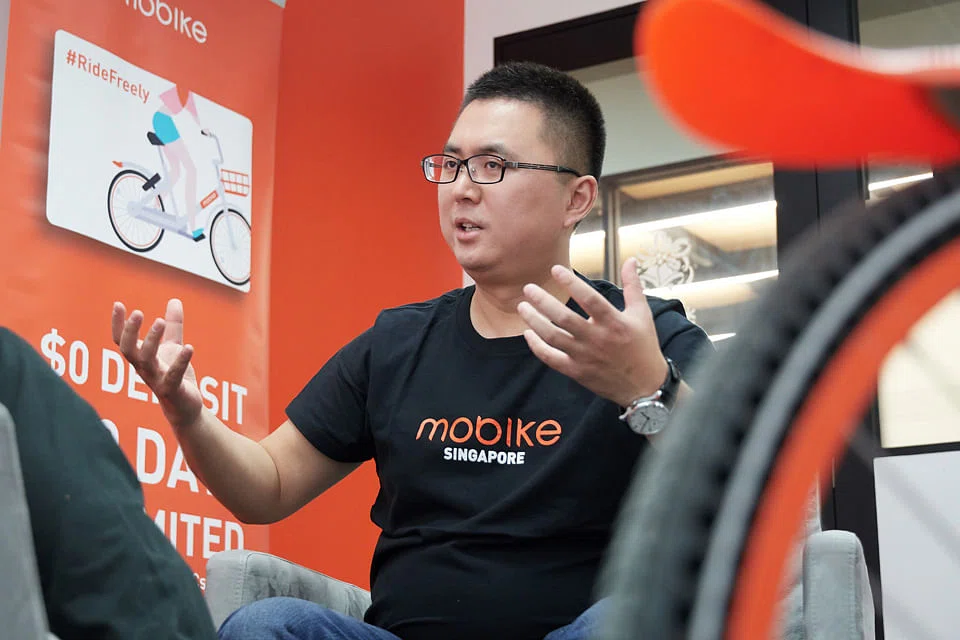
PITEOUS pictures of wrecked two-wheelers may grab the public's attention, but Mobike co-founder and chief technology officer Joe Xia Yiping, 36, is unfazed by how startups in the so-called "sharing economy" might rub people the wrong way at the outset.
"I think it's okay for some of the companies to run into some regulatory issues - I wouldn't say issues, I'd say challenges," he tells The Business Times while on a visit to the Chinese bicycle-sharing firm's Singapore office, in a co-working facility downtown.
"Because a lot of the markets, or a lot of the infrastructure or regulations, are not ready for certain sharing economy models.
"But what I can foresee is, the sharing economy is going to transform a lot of things in the city... And that's unstoppable."
Bicycle sharing is, of course, not new. As early as 1999, Singapore was experimenting with a pilot system in public housing estates, with rides to be paid for with newly introduced transit smart cards.
But the rise of the smartphone - complete with mobile apps, on-the-go payments and GPS location-tracking - has turned the dockless edition of bicycle sharing into an entity of its own.
After job stints at Ford and Fiat Chrysler, Mr Xia traded four wheels for two in 2015, embarking on a corporate quest to hack the bicycle. Mobike, with its fleet decked out in distinctive orange livery, hit the republic's shores in March last year.
It came hot on the heels of both Singapore's home-grown oBike and Chinese rival ofo. The expansion marked Mobike's first international debut, about a year after it rolled out services in Shanghai.
And the business seems to have taken off with a vengeance. Mobike is already in the rarefied "unicorn" stratosphere, having scored more than US$1 billion in venture funding. It counts among its backers Chinese giant Tencent Holdings and Singapore state investment firm Temasek Holdings.
The company's rapid ascent helped to land Mr Xia in Fortune magazine's "40 under 40" last year, with a debut in 20th place. That accolade puts him on the same list as French president Emmanuel Macron, Facebook founder Mark Zuckerberg and tennis superstar Serena Williams.
Whether in 1999 or 2018, though, the problem that Mr Xia hoped to tackle has remained the same.
"Really, if you look at cities, there's no such last-mile solution," he says. "Before we started this business, although there were a lot of station-based bike-sharing projects - mainly owned by the government - there were a lot of user experience challenges for those systems to be widely adopted.
"Things like, it's hard for users to find the bicycles, to find the locations, to have to go through a registration process.
"Even when you rode to your destination, you couldn't just park it anywhere you wanted. You had to say, 'Hey, I need to find a station, maybe a few hundred metres away from here.' You had to ride there and go back. It just wasn't convenient enough."
And convenience is the key reason that Mr Xia believes the startups of the sharing economy are here to stay.
Real customer needs
"It's not fake customer needs or products that no one is using. The reason they became popular and they can copy and paste to different countries in such a fast way is that they really meet customers' needs," he says.
"It's real needs. It's just whether those sharing economies will be conflicting with regulations. It just takes time to solve that. But eventually, it will be solved."
But in the debate over whether public transport is a public good, does Mr Xia think that governments could muscle into the dockless bicycle sharing space?
"I don't think so," he says. "You need a company that has the knowledge engine to really operate."
Shortly after Mobike's arrival, the Land Transport Authority canned plans for a state-backed bike-sharing pilot in the Jurong Lake District. Explaining its decision in March last year, the statutory board said that "the ongoing plans by the private dockless bike-sharing system operators have obviated the need for a government-run system backed by government grants".
But that does not mean that firms like Mr Xia's have written off the role of the public sector in this arena.
"There's probably a very close relationship between the company and the government," he tells BT. "And, from a sharing-economy perspective, I think the government will come up with more regulations that are simpler for companies like us.
"And it's going to be mutual. We actually help the city to solve the challenges they were facing previously - either filling the gap of last-mile solutions, or helping to reduce traffic and air pollution - helping to improve people's lives in the city.
"So this is what we're offering. But what governments need to do is how they come up with regulations to be better at supporting this - and making sure we don't bring trouble to the cities, and are able to serve the customers in those cities very well."
The European Union's top court may have ruled Uber a taxi company last year - and not a tech firm, as it professed itself to be.
But for Mr Xia, the value proposition of bike-shares like his still lies very much in its technological potential. "In order to keep us as a market leader, we put a lot of effort into developing new products and improving new technology," he says.
Because Mobike's fleet is hooked up to a network, the bicycles offer data that can be analysed to grow the business, as well as monetised in tie-ups with other companies.
"We have a system where we monitor supply and demand," he says. "First of all, as a company, we have to ensure our business can have enough turnover to make enough money. So we certainly don't want to put out hundreds of thousands of bicycles, and each bicycle is only ridden a few times.
"So we have a system which we use to monitor the whole city's efficiency... As long as we see the trend of growth slowing down to certain levels, we might just stop adding more bicycles. But it's all about how large the market is."
Riding on IoT
Mr Xia, who was trained as a communications engineer and has experience in the telecommunications sector, is understandably thrilled about the potential for the Internet of Things (IoT).
Before he helped to set up Mobike, he also worked in the automotive industry - "but not the traditional business areas", he says.
"I focused more on the smart car, kinetic car, areas which are, compared with bike sharing, very similar," he explains.
"Previously, I was working on how to connect a car to the back-end, to be able to provide more services to the car. Right now, after I started bicycles, whenever I connect a bicycle to the back-end, I see how to explore."
Another advantage, in his view, is Mobike's roots in China, with its manufacturing experience in "things that are good quality but very low cost".
"If you look at China, either Baidu or Wechat or Alibaba, they're not real global companies, because when you're talking about purely software, there're a lot of boundaries for those companies to become a global company," Mr Xia argues.
"You can call Facebook a global company, but they don't have a service in China. There're always barriers.
"But we're a Chinese company, having the advantage of hardware. When you combine hardware and software together, that's our advantage."
Still, connectivity requires allies. And, luckily, there is no lack of those coming to the table. Mobike inked an agreement in December last year to partner Singtel in mobile payments, IoT, data analytics, and marketing.
That includes exploring new IoT technologies, such as eMTC (enhanced machine-type communication) and NB-IoT (narrowband Internet of Things), which, simply put, let devices "talk" to one another in more focused and energy-efficient ways. Cyclists here can also expect to get a front-row seat to the party.
With Singapore both Mobike's first international location and biggest market outside China, Mr Xia says that "we're definitely going to put a lot of energy in this market, meaning a lot of new technology - what we've tried and tested - in Singapore first".
It may be bicycles today, but what might the Mobike model disrupt tomorrow?
"As a transportation platform, right now, we're providing more of a bicycle service," Mr Xia says. "But in the future, we're thinking, how are we going to provide other transportation services. Because, in a city, transportation is not just about bicycles. It's about bicycles, it's about buses, it's about subways, it's about people travelling.
"Right now, we're covering three to five kilometres. How are we going to cover five to eight, eight to 15, 15 to 25 kilometres, or beyond 25 kilometres?
"And definitely, we need an innovative product to satisfy the requirements, to meet the requirements of users."
Yet he is tight-lipped about the specifics of this vision, adding only: "I can generally talk about what we envision in the future, when we're talking about transportation services."
He has mentioned in other interviews that this could cover anything from electric bicycles - as opposed to the pedal variety - to flying cars.
Mr Xia shrugs off the suggestion, floated by some industry observers, that China's bike-sharing giants are more like funds sitting on an investable trove of user deposits.
'Bike' to basics
"The main focus for the company is still the bike sharing," he says. "We're not yet successful, really successful, in bike sharing. We're still only halfway there. There's a lot of countries where we have to launch our resources and we still have to focus on improving our product, improving the technology as well."
Mr Xia insists that all of Mobike's revenue comes from the core bike-sharing business at present.
But he demurs when asked to put a number to the turnover of the company, which he says is not yet profitable. "We're a fairly young startup," he notes. "We're not a big company, we're not ready to share a lot of this information."
Instead, he says, "we should focus more on how we're going to grow the user base, how we're going to grow the basics".
He adds: "We have the hardware, we have the software - so it's easy for us to expand globally, as long as we figure out how we're going to have a unified product that we can copy-paste to each of the countries."
But what about fears that the globalisation of the shared bike will just mean a mass of abandoned or wrecked rides, on streets and kerbs from Hangzhou to Washington, DC?
"Although we want to launch very fast, we still want to be - every time we expand to a city - we want it to be a solid move," says Mr Xia firmly.
"So in every city, we actually build a good relationship with the government, before we launch. We actually inform them and get the concurrence from them before we launch.
"And we actually make sure our product meets the local safety or government regulations, to make sure we don't have any challenges with that.
"But after that, we will launch. Some of our competitors, they just go into a market, they put a lot of bicycles on the street without telling the government. This is a big difference."
Mr Xia concludes with a tripartite flavour of utopia: "I think, in a sharing economy, it really involves three parties.
"It's not a single party's responsibility. It's the government, it's the company, and it's the users, because we share a lot of things in cities. We share the bicycles, we share the facilities, we share the space.
"But how we're going to work together in the future to improve the experience in the city - that's something we need to explore. We should continue to focus on that."
JOE XIA YIPING
Co-founder and chief technology officer, Mobike
Born in October 1981
Education
BSc in Communication Engineering from Nanjing University of Posts and Telecommunications
MSc from University of Essex, specialising in telecommunications and information systems
Career
2006-2009: Led ZTE China's R&D teams, focusing on connected cars and Internet of Things initiatives
2009-2014: Held various positions at the Ford Motor Company, including team leader for Ford's in-vehicle communications and entertainment system, as well as feature and product development supervisory roles for connected services
2014-2015: Worked as Fiat Chrysler Automobiles' head of Asia-Pacific Uconnect Connectivity
2015: Co-founded Mobike with Hu Weiwei and Wang Xiaofeng