

Fed chair Warsh’s hawkish Jackson Hole turn favours soaring banks over struggling S-Reits
Rising bond yields may reach a tipping point that chokes off growth and deflates richly priced blue chips

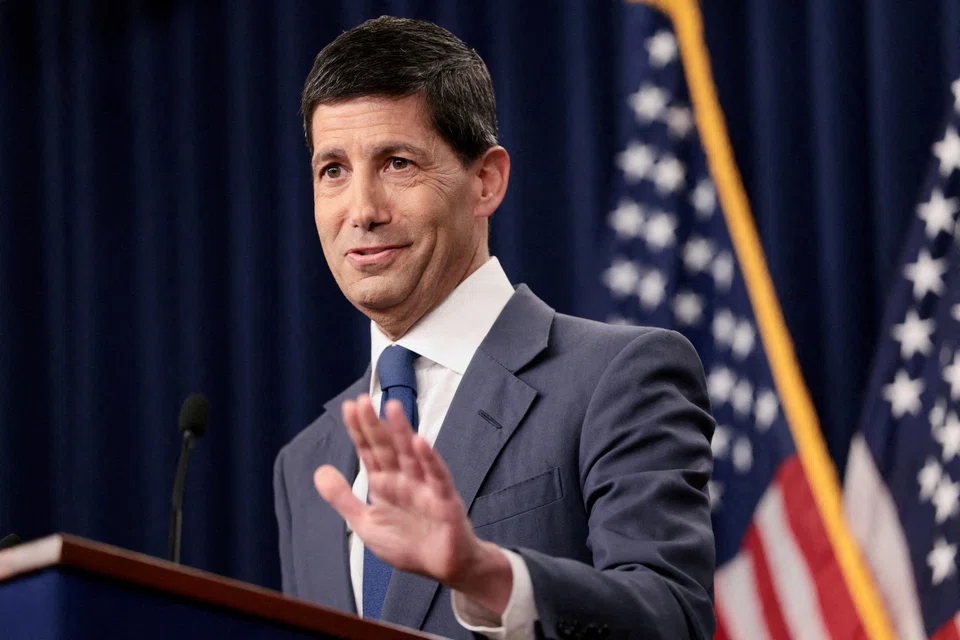
[SINGAPORE] In the end, market watchers seemed to interpret US Federal Reserve chair Kevin Warsh’s much-awaited speech on Friday (Aug 28) as a curtain-raiser for a September rate hike.
This was somewhat ironic, given his reluctance to provide any forward guidance on the Fed’s rate moves, but it was arguably a positive outcome for the markets in the short term.
Much could now depend on whether the Fed follows through, and leaves the market with no doubt that it is committed to keeping a lid on US inflation.
Whatever the case, unless some major geopolitical event occurs, investors will probably have to get used to navigating the markets in the face of higher and more volatile interest rates, in my view.
The thrust of Warsh’s speech at the Fed’s annual conference at Jackson Hole was not exactly new. Notably, he spent some time making the case again for ending the practice of giving early indications of the Fed’s rate moves.
“The Fed needs clear market signals, as unfiltered as possible,” he said. “At the same time, market participants themselves should be tracking real information across the economy. They should draw their own conclusions; form their own expectations of output, employment and inflation; and stay sharply attuned to risks.”
As if to highlight those risks, Warsh went on to say that the US economy appears to have strengthened, and that credit spreads are at the low end of historical ranges. “Credit and loan markets are showing few signs of policy restraint.”
While US unemployment – at 4.1 per cent – is low by historical standards, annual inflation (as measured by the personal consumption expenditures index) is running at 3.7 per cent – which is above the Fed’s 2 per cent target. “So the Fed’s predominant focus right now should be on prices,” Warsh said.
Towards the end of his speech, Warsh made a widely quoted remark that seemed to suggest imminent action. “Here is my standard: We must be confident that underlying inflation is moving to our objective, clearly and at sufficient speed. Otherwise, we have work to do.”
Resetting expectations
The weeks leading up to Warsh’s Jackson Hole speech had been quite tumultuous for the bond market.
During a press conference following the Fed’s meeting from Jul 28 to 29, Warsh had said that “materially higher” nominal and real bond yields over the preceding weeks was a sign that his policy of reduced forward guidance was working.
“Market participants are learning to play the ball, not the referee – and market prices will continue to respond in the direction and magnitude they see fit. This is, in my view, a change for the better – and we’re just getting started.”
On the other hand, Warsh was vague about the conditions that would prompt the Fed to raise the federal funds rate. In a response to one question during the post-meeting press conference, Warsh seemed to suggest that higher rates may not be the only remedy for stubborn inflation.
“If inflation continues to be elevated through the forecast period, interest rates could well be part of that solution. But I wouldn’t say it’s in isolation.”
Not surprisingly, these comments sparked a fall in yields on two-year US Treasury bonds, and a further surge in yields on 10-year and 30-year US Treasury bonds – which turned the spotlight on rising debt costs for consumers, companies and governments, and sharpened scrutiny of asset valuations across the risk curve.
With the Fed chairman’s seemingly hawkish Jackson Hole speech having reset expectations of an imminent rate hike, yields on two-year Treasury bonds surged 13 basis points back to their July highs of 4.36 per cent.
Yields on longer-term Treasury bonds did not slide back down, though. Instead, 10-year and 30-year Treasury bonds yields edged up to 4.73 per cent and 5.21 per cent, respectively.
Higher, more volatile inflation
Looking ahead, it seems unlikely to me that the underlying drivers of inflation and interest rates will ease.
In particular, the geopolitical turmoil that has impacted energy and food prices will probably keep flaring up. Persistent moves by the US to impose tariffs on its trading partners could also roil global supply chains from time to time.
Meanwhile, sovereign debt levels are rising relentlessly. On Aug 19, the US Treasury said the nation’s debt had topped US$40 trillion for the first time. On the same day, the Treasury said it would boost the size of liquidity support buybacks for longer-dated bonds, from US$2 billion per operation to at least US$4 billion.
Then there is the emergence of artificial intelligence, which Warsh has characterised as a major shift in the global economic landscape that has created the potential for substantially higher growth.
“It wasn’t so long ago – in the run-up to the crisis of 2008 and over the decade that followed – when economists and policymakers were speaking of secular stagnation and a global saving glut,” Warsh said.
“It was a widely held view that an excess of capital would sit on the sidelines for a long, long time, because there just wouldn’t be enough compelling investment opportunities. All the good stuff had been invented. So growth would be low and slow.”
While it is unclear how AI will impact productivity, and whether it will be complementary or competitive to labour, the major AI labs, chipmakers, energy producers and cloud providers have mobilised trillions of dollars in capital and are already generating hundreds of billions of dollars in revenues.
The way I see it, this explains why 10-year and 30-year US Treasury bond yields seemed to break out of a secular decline in 2022 – the year the post-pandemic recovery took off and OpenAI launched ChatGPT.
Banks versus S-Reits
For investors in Singapore, the prospect of higher and more volatile inflation and interest rates has weighed most noticeably on the performance of Singapore real estate investment trusts (S-Reits).
Since the beginning of the year (up to just before Warsh’s Jackson Hole speech), the iEdge S-Reit Index chalked up a total return of minus 3.9 per cent, with less than one-third of its constituents in positive territory.
Of the eight heavyweight S-Reits that are constituents of Straits Times Index (STI), only two have achieved positive total returns this year – CapitaLand Integrated Commercial Trust (3.6 per cent), and Keppel DC Reit (2.6 per cent).
The STI itself achieved a total return of nearly 27 per cent – driven by the performance of the three banks, which are widely seen to be beneficiaries of rising interest rates.
There was a wide dispersion in performance among the banks, though – reflecting their varied first-half financial results. OCBC was the best-performing constituent of the STI during the period, with a total return of 63.8 per cent. DBS returned 40.4 per cent, while UOB returned 21.2 per cent.
In my view, the divergence between the soaring banks and the struggling S-Reits may continue to be the defining story of the Singapore market for a while longer.
Yet, investors should keep in mind that rising bond yields may reach a tipping point and begin choking off growth in weaker economic sectors – which could deflate some of the most richly priced blue-chip stocks in the local market.
TRENDING NOW
S$8 billion wiped off OCBC value as shares slide 5.8% in heavy trade

Grab CEO’s wife Chloe Tong on life with Anthony Tan and finding her purpose
Brookfield denies accusation it cut Soilbuild out of Mapletree deal
8 public officers referred to police over property buys near unannounced MRT stations: Chan Chun Sing

