

Gold dazzled last year, but may lose some lustre in 2025
With the Year of the Snake upon us, market watchers are split on how the precious metal will fare after a record-breaking 2024


WHEN investors long for a steady asset in times of uncertainty, gold stands out as a solid portfolio diversifier that weathers not only geopolitical upheavals, but also fiscal risks.
Even if we strip out last year’s sharp rise in gold prices, it is clear that the purchasing power of gold has remained steady over centuries. As JPMorgan put it in 1912: “Gold is money. Everything else is credit.”
The yellow metal’s spot price had risen 26.5 per cent through 2024, after having shot up by 34.4 per cent on Oct 31, amid the uncertainty in the lead-up to the US presidential election.
Gold slightly outperformed the S&P 500, which had notched a total return of 25 per cent as of end-2024.
But this year, not all market watchers are as optimistic about gold prices rising further after such a banner year. This tempering of sentiment comes as US president-elect Donald Trump continues to stoke inflation and as the US dollar strengthens, while retail demand, especially for gold jewellery, from China and India remains muted.
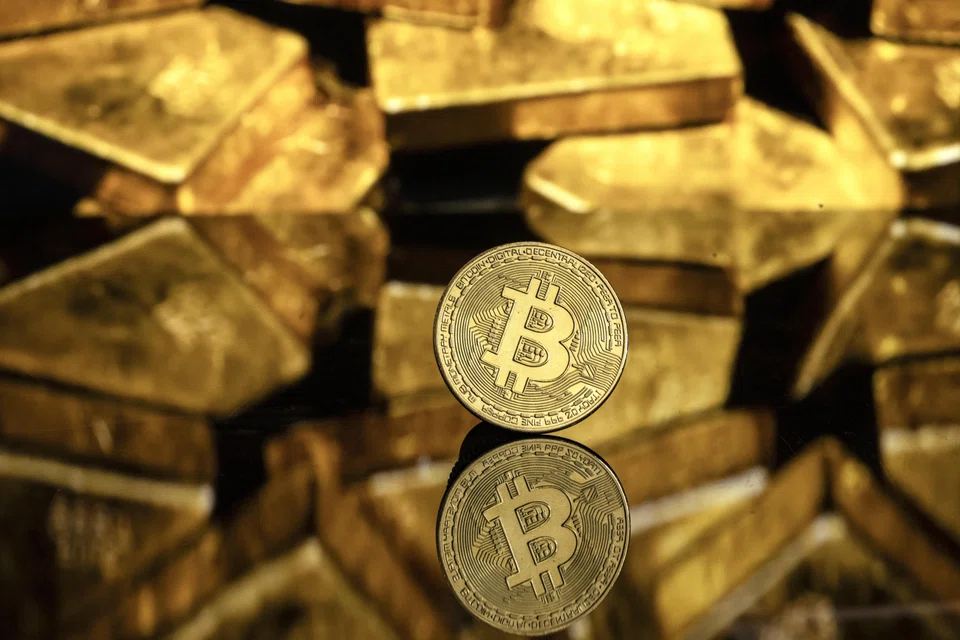
Meanwhile, cryptocurrencies are gaining traction as a mainstream portfolio diversifier, making for a less-than-optimistic scenario for investors still hot on gold.
Gold rush in 2024
Bloomberg data indicates that gold outperformed all the other asset classes – including equities and energy in terms of annualised returns between Oct 28, 2022 and Oct 31, 2024. During this period of rising geopolitical uncertainty, the metal notched returns of more than 25 per cent.
Its outperformance last year showed how its price drivers have changed. A strengthened greenback and higher US real interest rates, which would typically depress gold prices, did not cool the gold rally that started in the fourth quarter of 2022.
On average, gold prices traded more than 20 per cent higher in 2024 than the year before.
Senior portfolio managers of Allianz Global Investors Frederik Fischer and Chai Jingjing flag two reasons for this.
Fischer says: “One is the growing fiscal deficit during and after Covid-19, positioning gold as an alternative to treasuries; the other reason is that some central banks increased their gold reserves, prompted by geopolitical risks such as Russia’s invasion of Ukraine in 2022, which led to de-dollarisation.”
While Donald Trump’s win in November sent gold prices tumbling, this was likely a “near-term phenomenon”, says Fan Shaokai, global head of central banks in the World Gold Council.
“Following Trump’s win, the fiscal policies under the Republicans may be inflationary, with tariff policies potentially putting pressure on Asian equity markets and potentially supporting investment in gold.
“Growing deficits will also continue to exert pressure on the credit ratings of US Treasury bonds, which should lead to an increase in central banks’ demand for gold, in an effort to diversify reserves.”
Rhona O’Connell, head of market analysis for EMEA (Europe, Middle East and Africa) and Asia at StoneX, notes that Trump’s likely policy position on issues such as tax cuts, tariffs, robust foreign affairs and stress on the budget deficit – even if watered down by Congress – are “virtually all gold-friendly”. She thus believes that gold’s stalled momentum post Trump’s victory was a necessary price consolidation as the market gets set for a new, higher paradigm.
George Milling-Stanley, State Street Global Advisors’ chief gold strategist, believes that central bank purchases will continue to support gold prices in 2025. This demand for the metal will come primarily from emerging markets, which have accounted for about 15 per cent of total end-user demand of gold over the past 14 years.
Cautiously bullish on gold, Milling-Stanley says that conditions like the current macroeconomic and geopolitical environment have proven favourable for higher gold prices throughout market history.
“Gold has hit many ceilings, but has broken through every single one of those ceilings,” he notes.
Would gold still be sought-after as an inflation hedge?
With the global inflation trajectory still unclear ahead of Trump’s inauguration as US president, analysts are split on the demand for gold as a hedge against inflation.
Alexandra Symeonidi, corporate credit analyst on the emerging markets debt team at investment bank and private wealth manager William Blair, believes that gold’s safe-haven characteristics will still shine amid geopolitical risks and market uncertainty.
“US policy and economic uncertainty, including inflation risks, support higher gold prices even in a strong dollar environment,” she says, adding that global trade tensions can cause inflationary pressures, which would further boost demand for gold as a hedge against inflation.
“However, current high price levels might desensitise physical demand, including that by consumers and central banks, potentially preventing price spikes.”
On the other hand, commodities data firm BMI expects inflation to continue easing in 2025, which would slow the speculative demand for gold as a hedge against inflation to slow.
The team assumes Trump will not push through with his proposed introduction of a full 10 per cent universal tariff, and that even if he does so, the total tariff cost would likely be absorbed by slightly lower profit margins and a slightly stronger US dollar, dampening the ultimate impact on the US consumer.
Where are gold ETFs heading?
For either retail or institutional investors, an easy way to get portfolio exposure to gold is via bullion-backed exchange-traded funds (ETFs).
While gold ETFs have been gaining traction over the past year, November 2024 marked the first net loss of flows in six months globally. Collective outflows stood at about US$2 billion that month, a sharp reversal from the US$4.3 billion of inflows in October.
StoneX’s O’Connell, noting some selling of gold ETFs after the US election, says that the practice of investors swopping them out for crypto as a Trump trade was nevertheless “not statistically significant”.
But December 2024 saw global gold ETF flows turning positive at US$778 million, led by Asia and Europe, while North America saw mild losses, according to the World Gold Council.
Overall flows for the year stood at a net positive US$3.4 billion across physically-backed global gold ETFs.
As North America and Europe-based gold ETFs account for nearly 95 per cent of all ETF volumes, where they compete mainly with bonds, gold ETF demand is particularly sensitive to interest rate movements, says Thomas Rupf, chief investment officer for Asia at VP Bank.
“Interest rates and, hence, opportunity costs, will continue to decline in 2025. This means that we continue to expect increased interest from Western investors… to allocate capital to gold-backed ETFs and drive net inflows,” he says.
State Street’s Milling-Stanley points to the bullion-backed ETFs’ protective nature against market downturns; given a low-to-zero correlation to equity and fixed-income, the portfolio diversifier lowers potential volatility.
SPDR Gold Shares ETF, the world’s largest gold ETF, notched seven months of positive flows in 2024. As US-based gold ETFS generally lead the market, this suggests a positive trend for global gold ETFs, he says.
Is crypto the new gold?
Gold’s popularity and standing as a hedge against market uncertainties might change as cryptocurrency gets the spotlight after Trump’s win.
A clear headwind to gold is a shift in generational preferences for cryptocurrencies, amid a rising interest in crypto as a financial asset among US financial institutions and large corporations such as Tesla.
Uncorrelated with equities, cryptocurrencies are often deemed as “digital gold” that also provides a safe haven from a stock market crash. It is also similar to gold as a form of easily transferable currency traded outside the regulated financial system.
But Rupf of VP Bank says: “The desired diversification effect (of cryptocurrencies) does not materialise when it is added to a mixed equity-bond portfolio. The price of gold, on the other hand, is more stable and shows very little correlation with such a portfolio.”
He points out that gold’s long-standing reputation as a stable store of value and its physical nature also provide a sense of security that cryptocurrencies lack.
The BMI team notes that in the long run, cryptocurrencies can pose a downside risk to gold if younger investors start to treat crypto as a mainstream asset at the expense of gold.
“However, in the short term, investors of both assets may have fundamentally different goals. Investors may choose gold as a traditional safe-haven asset as a hedge against inflation, whereas many investors in cryptocurrencies could be more speculative in nature,” says BMI in a report.
Is gold mining a new investment opportunity?
Other than investing in gold itself, the value chain of gold production seems to offer some attractive investment opportunities.
Steve Land, portfolio manager of Franklin Gold and Precious Metals Fund, notes that gold mining companies’ business fundamentals have “improved significantly” on the back of the gold bull market. The fund mainly invests in equities of gold and precious metal companies.
However, despite the past five years being the longest, most profitable period for the mining industry, investors remain sceptical. Valuations have thus been undemanding, he says.
The modest expectations are led by cost concerns. Historically, gold mining companies’ costs rose significantly between 2000 and 2011, during a strong run in gold prices. These prices pulled back between 2011 and 2015, triggering gold mining companies’ equities to fall even faster, despite their efforts to cut costs.
Land says: “Many past experiences are weighing on gold equities, but many things are different this time. Cost control is better, so record gold prices are translating into higher earnings.”
StoneX’s O’Connell highlights that while the fortune of gold mining stocks are linked to gold prices, other factors – the management of the companies, their location and hedging policy – need to be considered as well.
“They (mining stocks) are more volatile than gold itself, and carry more risk as well as, potentially but not necessarily, more reward,” she said.
Allianz Global Investors’ Fischer highlights past incidents of mining companies being flagged for severe controversies in the ESG (environmental, social and governance) arena, which means these companies could suffer from higher capital costs from having to meet environmental standards.
How sustainable is gold production?
For investors concerned about ESG, investing in the supply chain of gold poses questions on its environmental impact.
William Blair’s Symeonidi notes that gold’s carbon footprint remains substantial, given the nature of gold mining, processing and refining, despite efforts to blunt the environmental impact of these activities.
But Nicholas Frappell, global head of institutional markets at ABC Refinery, Australasia’s largest precious metal refining company, believes that gold refining is not as energy-intensive as aluminium refining, contrary to common belief.
The industrial purifying process has been standardised to an electrolytic process, which is less polluting than the aqua regia refining process previously used by the industry. In addition to technological advancement, strict regulations over both producers and refiners have forced them to address environmental concerns of gold mining, says StoneX’s O’Connell.
However, while large-scale gold mining companies tend to observe best practices, artisanal miners are tougher to regulate, says John Mulligan, head of sustainability strategy at the World Gold Council.
“They’re often operating in areas where there is limited government capacity, limited rule of law… These are problems beyond the gold market; they are social-structural problems,” he says. He notes that the council as been working with governments and industrial players to enforce responsible sourcing in gold mining.
In 2019, the gold industry’s international trade association launched the Responsible Gold Mining Principles, a framework that sets out clear expectations on responsible gold mining.
Mulligan notes that the industry is on track to reduce emissions by 40 per cent emissions by 2030, and to achieve net-zero emissions by 2050.
Will gold hit US$3,000 an ounce in 2025?
While some market watchers believe that the fundamental price drivers for gold – such as geopolitical uncertainties and central banks’ de-dollarisation efforts – remain on track, not all are optimistic about a further upside to gold prices.
Goldman Sachs forecasts gold to hit US$3,000 an ounce by mid-2026, pushing back the forecast previously made for end-2025 on the back of expectations of fewer Fed rate cuts.
Structural central bank demand will remain the main price driver, on top of investment demand supported by cyclical Fed rate cuts. The bank expects such demand to outweigh the drag from a normalisation in speculative demand.
BMI, however, notes “strong downside risks” to gold, given the uncertainty over rate cuts that would likely limit investment flows into the yellow metal.
Sabrin Chowdhury, head of commodities research of BMI, says: “With Trump’s victory, the resilience of the US economy in 2025, combined with the potential for higher inflation via tariffs, will likely see the Fed take a more cautious approach on interest rate cuts. This will cap interest in gold.”
Being bearish towards gold, BMI expects the prices of the metal to ease and average at US$2,500 in 2025, but remain elevated in the coming years compared to pre-Covid times. This is due to a greater risk-on sentiment as the global economy recovers in the later part of the decade.
Gold prices will average US$2,195 an ounce between 2024 and 2028, up from its 2019 level of US$1,393, BMI predicts. The team expects any easing in the Russia-Ukraine conflict to come about this year at the earliest, which will reduce holdings of gold by the most risk-averse investors.
VP Bank’s Rupf notes that while geopolitical and economical uncertainties will continue to create tailwinds for gold in 2025, the metal will not repeat its strong performance of 2024, largely due to dampened consumer buying from China and India.
Despite high prices and weak economic sentiment holding back purchases, especially in China, Rupf expects gold to rise beyond its recent highs towards US$3,000 an ounce in 2025.
Meanwhile, Macquarie’s strategy team expects gold to face ongoing pressure from the greenback’s strength heading into 2025, but be supported by improved physical buying and steady official sector demand. The team projects that the price will settle at US$2,500 an ounce by the fourth quarter.
“If Chinese investor buying returns or markets fear that President Trump’s policy proposals could deliver a material deterioration in the US fiscal outlook, the price could quickly challenge US$3,000 per ounce, with any breaks above October’s high liable to be reinforced by systematic momentum buying,” says a Macquarie report.
However, State Street Global Advisors disagrees that the stronger US dollar will be a headwind to gold prices, as central banks’ consistent purchases, despite a stronger dollar in the past three years, suggest that monetary authorities are motivated by long-term strategic considerations rather than price sensitivity.
“We expect them to continue adding to their gold reserves in the year ahead,” says the team.
The asset manager expects gold to range between US$2,600 and US$2,900 in 2025, with the potential to rise to US$3,100 under certain economic scenarios, such as a weak labour market in the US nudging the Fed to cut rates to between 3.25 per cent and 3.5 per cent.
So even as industry watchers do not foresee a gold rush in the coming year, it seems that the yellow metal will still keep some of its shine for time to come, with investors having various options for their portfolio.


