Hanwha shouldn’t need a majority interest in Dyna-Mac to drive long-term shareholder value

INVESTORS appear to be betting heavily that Hanwha Ocean SG will raise its offer price for Dyna-Mac.
Shares in the offshore and marine engineering company closed on Wednesday (Oct 9) at S$0.635.
This was 5.8 per cent above the current offer price of S$0.60, and 28.3 per cent above the stock’s last closing price before the offer was announced on Sep 11.
The offer from Hanwha Ocean SG – a special-purpose vehicle controlled by Hanwha Ocean and Hanwha Aerospace – is conditional upon it ending up with more than 50 per cent of Dyna-Mac’s shares.
Hanwha Ocean and Hanwha Aerospace, which have both provided undertakings to accept the offer from Hanwha Ocean SG, own nearly 282.9 million Dyna-Mac shares. This is equivalent to 24 per cent of Dyna-Mac’s total number of shares.
The offer is also conditional on the Competition and Consumer Commission of Singapore (CCCS) deciding that the deal will not lessen competition in any market in Singapore.
The CCCS said on Oct 4 that it is inviting public feedback on Hanwha Ocean SG’s offer for Dyna-Mac.
Why is Dyna-Mac trading above S$0.60 despite these conditions?
On the face of it, there appears to be widespread confidence that it is worth more than S$0.60 per share even if the offer does not succeed; and that Hanwha Ocean SG will have to raise its offer price if it is serious about gaining outright control of the company.
Dyna-Mac has certainly given investors a lot to be optimistic about recently. The group reported a 283.9 per cent increase in net profit to S$38.8 million for the six months to Jun 30, on a 42.5 per cent increase in revenue to S$259.7 million.
It attributed the sharply higher net profit to the completion of major projects, improved productivity and a higher volume of projects undertaken.
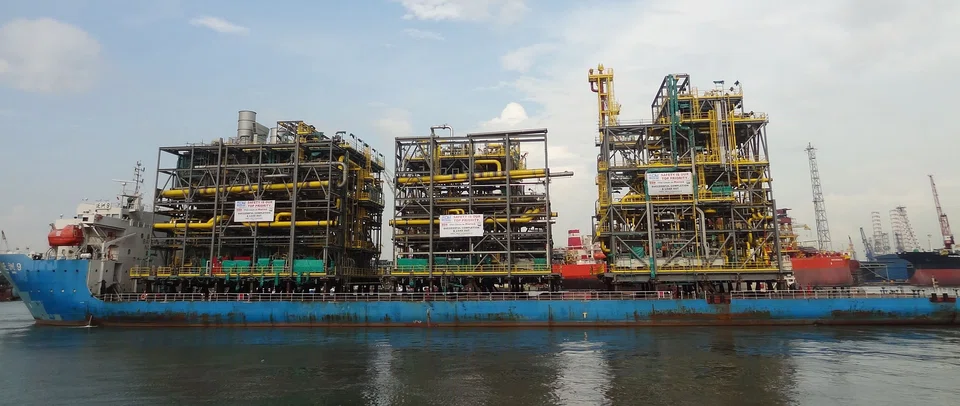
The company said in a statement accompanying the results that the outlook for its key business of fabricating topside modules for floating, production, storage and offloading (FPSO) vessels is buoyant.
It also noted that the global FPSO market is expected to grow 14.6 per cent per annum, to US$34.7 billion by 2032. The company’s order book stood at S$681.3 million as at Jun 30, with deliveries scheduled to 2026.
Dyna-Mac added that it had recently expanded its capacity and upgraded its yard facilities. This will enable it to take on larger projects, and boost its productivity.
The group highlighted that it had a net cash position of S$307.7 million (including its holdings of Singapore Treasury Bills) as at Jun 30; and that its growth plans include seizing inorganic opportunities and forging strategic alliances with industry leaders.
Hanwha Ocean SG’s offer of S$0.60 per share values Dyna-Mac at S$707.1 million, or just over 9.1 times the group’s annualised earnings for the first half of FY2024.
One key shareholder of Dyna-Mac that has publicly stated its opposition to the offer is the estate of Desmond Lim Tze Jong, the late founder of the company.
In a media release on Sep 23, Lim’s estate said that the offer does not reflect the value and growth potential of Dyna-Mac’s business. It also pointed out that Dyna-Mac’s shares traded as high as S$0.615 on Aug 13; and that analysts had price targets ranging from S$0.64 to S$0.715.
“The estate is not opposed to proposed offers for Dyna-Mac; but like all shareholders, it strongly believes that any offer must be compelling and reflect the true value of Dyna-Mac,” said a spokesperson for Lim’s estate.
Lim’s estate is the single largest shareholder of Dyna-Mac. A filing on Oct 8 showed that it holds more than 414.1 million shares, representing a 35.1 per cent stake in the company.
So, what will it take to persuade Lim’s estate to part with its Dyna-Mac shares? How high will Hanwha Ocean SG have to raise its offer price?
Here’s the thing: The Hanwha group is not bent on acquiring every single Dyna-Mac share it does not already own.
The offeror has stated that it does not plan to actively pursue a delisting of Dyna-Mac.
Yet, in the event the free-float requirement is not satisfied at the close of the offer, and trading in Dyna-Mac is suspended, the offeror does not intend to take any action to remedy the situation.
The offeror has also said that it will exercise its compulsory acquisition rights if the level of acceptances allows it to do so.
On the face of it, the Hanwha group appears to be trying to draw Dyna-Mac into its fold in order to unlock the benefits of scale and synergies.
The offer document states that Hanwha Ocean builds a wide range of vessels critical to the offshore and marine sector, and is implementing a “multi-yard strategy” across strategic locations, including in Singapore, South Korea, the United States and China.
Hanwha Ocean and the offeror plan to help Dyna-Mac strengthen its competitive position, and make the most of opportunities related to the global energy transition trend.
While having majority control of Dyna-Mac would probably help the Hanwha group achieve this objective, raising the offer price to a level that Lim’s estate and other shareholders would consider “compelling” could be risky.
With all the excitement in the market about the unfolding turnaround at Dyna-Mac, Hanwha Ocean SG could well end up overpaying for its target.
Most of the Dyna-Mac shares that Hanwha Aerospace and Hanwha Ocean currently own were purchased from Keppel for S$0.40 each only in May.
One alternative is for Hanwha Ocean SG to hold its offer price at S$0.60 per share, and accept the risk of the deal not going through.
This would disappoint investors hoping for a quick gain, of course.
Yet, the interests of long-term Dyna-Mac shareholders might be better served if the Hanwha group does not obtain majority control of the company.
If the Hanwha group genuinely intends to strengthen Dyna-Mac’s competitiveness and profitability, it should not need a majority stake to have its proposals accepted and implemented by the board.
Instead of trying to obtain a majority interest in Dyna-Mac in a hot market, the Hanwha group should perhaps focus on increasing the value of the 24 per cent stake it already owns.