

How China and the EU can reach a middle course on trade
A successful negotiation will show the US that there is a path beyond protectionism
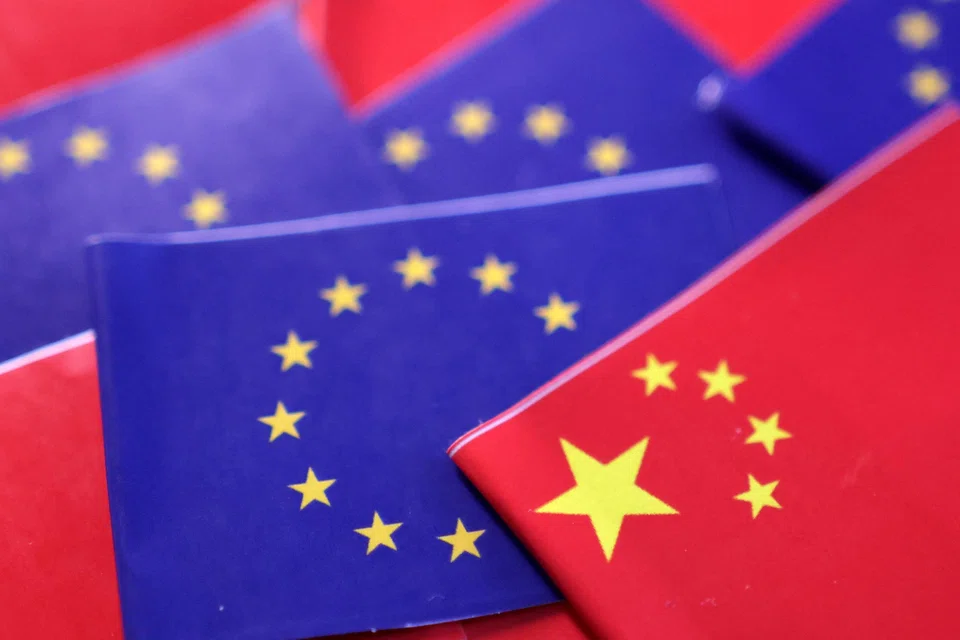
CHINA and Europe are entering a consequential window for their trade relationship.
The European Commission’s (EC) trade commissioner Maros Sefcovic will be in China on Thursday (Oct 8) and Friday to negotiate a deal to rein in Beijing’s trade surplus with the bloc.
A week earlier, on Oct 1, Denis Redonnet, the EC’s chief trade enforcement officer, warned the European parliament about sustained growth in Chinese imports across machinery, chemicals, metals and textiles.
But Beijing is pushing back against state-level export restraint, and argues that trade should be rebalanced by expanding, not shrinking, exchange.
This tension will play out in two upcoming summits.
In November, China will host Asia-Pacific Economic Cooperation (Apec) leaders in Shenzhen, China. A month later, America will chair the G20 summit in Miami, US, where structural excess capacity and global trade imbalances will be contentious topics at the meeting.
The sequence matters because the two forums foreground different policy instincts. Beijing wants to show that imbalances can be eased through stronger demand, wider market access, greater investment and deeper integration among members.
Washington argues that persistent excess capacity and non-market policies, such as industrial subsidies, create cross-border costs that justify collective responses.
Europe sits between them. It shares American concerns about Chinese industrial spillovers, but has less appetite than the US in making tariffs and economic blocs the default architecture of global trade. That makes the EU-China relationship a test of whether a third approach remains possible.
Different forms of market access
History offers some insight.
When Japanese exports surged into the US and Europe in the 1980s, Tokyo accepted voluntary export restraints in sectors including cars.
Those arrangements were distortionary and later became the kind of “grey area” measures that World Trade Organization (WTO) rules sought to prohibit.
They also reinforced a broader shift already under way: Japanese firms moved up the value chain, invested abroad and increasingly produced inside the markets they wanted to serve.
Compared with the Japan of four decades ago, China today is far larger, less dependent on Western markets and a strategic competitor rather than a US ally. Agreeing to government-to-government export quotas would also set a precedent Beijing has strong reasons to resist.
Instead, the useful lesson from Japan’s experience is: Market access can change form.
China is already moving in that direction in Europe. Trade pressure is encouraging Chinese automotive and battery companies to invest in the bloc.
Meanwhile, the EC has opened a path for Chinese companies to submit price undertaking offers, which can include minimum prices on exports, volume commitments and European investment in exchange for relief from countervailing duties.
The EU’s strongest objection is that localisation alone may not eliminate the distortions the bloc associates with Chinese industrial support. A plant assembling imported components in Europe could create jobs while leaving much of the subsidised value chain elsewhere.
Genuine localisation, to the EU, should therefore mean local suppliers, employment, research and substantial value creation, while remaining subject to normal scrutiny of foreign subsidies and competition distortions.
Beijing’s objection is equally serious. Chinese officials have explicitly rejected the idea that a trade surplus or export competitiveness alone proves overcapacity, warning that an elastic definition could turn trade defence into protectionism.
That concern deserves a disciplined response. Claims of excess capacity should be assessed sector by sector, based on evidence rather than inferred from aggregate trade balances.
China also cannot assume that competitive exports are automatically benign. Even efficient production at home can generate political and economic spillovers abroad when capacity expands rapidly but domestic demand is too weak to absorb it, causing supply to be diverted to other countries.
Beijing’s preferred strategy of “upward rebalancing” will be persuasive only if it produces material change domestically: stronger household demand, more imports, better access to European goods and services, greater transparency around industrial support and more predictable supplies of critical minerals to its trading partners.
The Apec forum gives China an opportunity to demonstrate that approach. Europe will not be at the Shenzhen negotiating table, but it will watch whether China’s language of openness, innovation and cooperation is matched by concrete measures.
A credible package would strengthen the case that trade adjustment can occur without economy-wide export restrictions.
Multilateral pressures
The US complicates the EU-China trade relationship. Washington can reasonably argue that bilateral accommodations between the two do not solve a systemic problem: subsidised or excess output diverted from the European market can flow into another.
A multilateral framework, therefore, still matters to the US.
While Washington has recently been opposed to rules-based multilateralism, it is not against international coalition building to further its own aims.
For instance, Treasury Secretary Scott Bessent used the G20 Finance Track meetings in September to build agreement around excessive global imbalances.
But that need not be protection coordinated between many countries. The G20 can improve transparency over subsidies, capacity, demand and trade flows and develop common principles for identifying cross-border spillovers.
Remedies can then remain sector-specific and WTO-compatible. Recent G20 discussions showed substantial concern on structural excess capacity in certain countries, but the group reached no consensus on a pathway for collective action.
Washington’s influence over international trade rules strengthens Brussels’ leverage over Beijing, yet broad definitions of excess capacity, weakened most-favoured-nation principles and expanding trade restrictions could also constrain European interests.
Europe therefore has reason to preserve a distinct strategy of conditional openness: safeguards where disruption becomes severe, market access where competition remains manageable, and localisation where investment can turn foreign competition into domestic production.
A workable EU-China bargain would exchange adjustment for openness. China could expand imports and access to its domestic market, encourage Chinese firms to invest in genuine European production and accept company-specific undertakings in sensitive sectors.
Europe could preserve access for compliant Chinese companies, use targeted WTO-compatible remedies and recognise meaningful localisation. Joint monitoring could identify sectoral spillovers before they trigger broader retaliation.
The road from Shenzhen to Miami will show whether that middle course remains viable. The Apec forum is China’s chance to demonstrate that integration-based trade rebalancing is credible.
By the time the Miami event takes place, it should become clearer whether Europe is preserving a strategy of negotiated rebalancing with China, or moving incrementally towards trade defence, coordinated with the US, against Beijing’s exports.
If China offers too little, Europe’s alignment with Washington becomes easier. If Europe keeps tightening trade barriers, Beijing will conclude that adjustment brings few rewards.
The fundamental question is whether China and Europe can still negotiate the terms of their interdependence on their own – or whether those terms will increasingly be set by hardening trade blocs that are not on the EU-China negotiating table.
The writer is a research fellow with the Charhar Institute
TRENDING NOW

If Europe goes to war, the fallout will be felt in East Asia
Indonesia stocks suffer worst plunge in nearly 30 years as MSCI proposes standalone status

Keppel seeks US$1 billion for Vietnam investments as it joins country’s international financial centre
Philippines’ FDI slowdown exposes uneven investment prospects across S-E Asia

