How scary is geopolitical risk? Oil price is key
Developments in the Gulf conflict are testing investors’ penchant to buy the dip

THE US-Israel strikes on Iran occurred at the most inopportune moment for markets, although you may well wonder: Is there ever an opportune time for war?
Until now, financial markets have taken the ongoing Ukraine war in stride, as well as the Gaza conflict. But strategists are much less sanguine on the war against Iran because of the impact of higher oil prices on inflation and economic growth, should the conflict last longer than expected.
It has also happened at a time when markets seemed most wobbly. First, there is the existential threat of artificial intelligence (AI) against software stocks. Then the upheaval in certain quarters of private credit. More recently, last week, a dismal US jobs report.
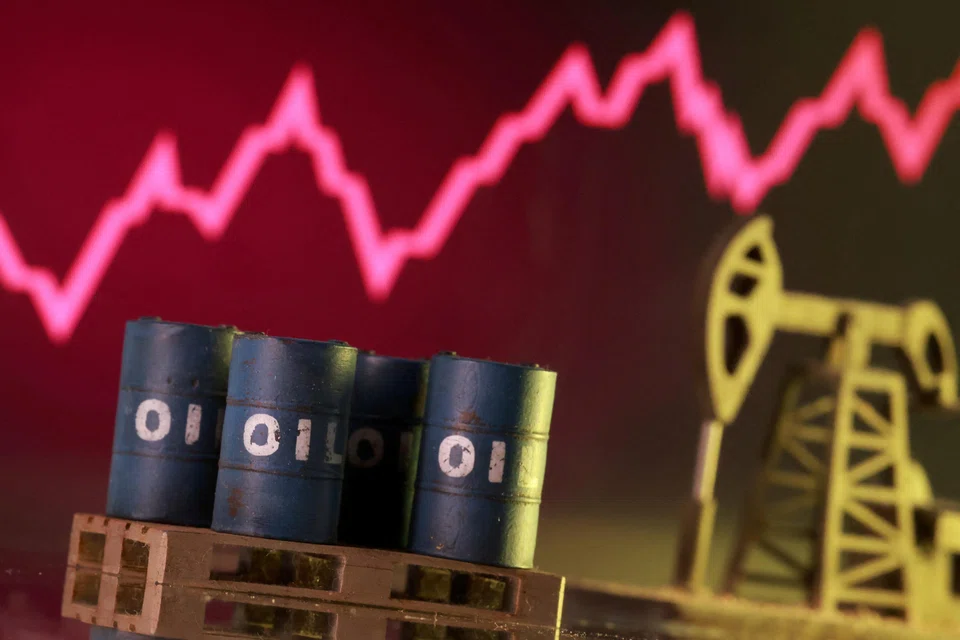
US and Israel mounted strikes on Iran on Feb 28 in what was dubbed “Operation Epic Fury”. On Monday, after 10 days of strikes, oil prices surged to their highest level since 2022, approaching US$120 a barrel, raising fresh inflation fears and dousing hopes of interest rate cuts.
But within the day, US President Donald Trump signalled that the war could be over “very soon”. The abrupt turn sent oil prices back down to less than US$91. Stocks jumped, and Treasury yields also fell back. Markets in Asia rebounded as well.
Trump, however, sent mixed signals hours later at US markets’ closing, telling lawmakers, according to The New York Times: “We have won in many ways, but not enough.”
The episode is testing investors’ penchant to buy the dip. It has also raised fresh concerns about bonds’ efficacy as a diversifier against equity risk.
The apparent turn was anticipated by Marko Papic, chief strategist for GeoMacro at BCA Research, who wrote in a Mar 2 note: “We do not believe, for a second, that Trump is seeking actual regime change.”
He added that investors should understand that the “traditional constraints” on Trump – the US’ median voter, the American economy, stock market and oil prices, among others – will “all begin to constrain US actions and steer the president towards a clear declaration of ‘victory’”.
“Ironically, the greater the risk to the future, the more likely it is that President Trump backs (down) from total warfare against Iran. As such, we reiterate that our clients should remain nimble and open-minded.”
Revisiting the basics
What should you make of these developments?
The first principle, as always, is not to let panic push your sell button. The second is to review your capacity for risk. If you are largely a passive investor and sitting on handsome profits, it is prudent to take some risk off the table.
Christine Benz, Morningstar director of personal finance and retirement planning, makes a good distinction between risk tolerance and risk capacity.
The former is how much you can lose without feeling “psychic discomfort”. “Risk capacity, by contrast, is how much you can lose without changing your plans,” she wrote in a column. “As you get closer to retirement, your risk capacity declines, even though your risk tolerance may still be that of a 30-something.”
Bank strategists have been quick to point out opportunities as markets plunged, even as they expressed caution should the war prove protracted.
Bank of Singapore said it expected a knee-jerk reaction among investors to sell. “Barring an oil shock, history shows that geopolitical events such as the Iran war typically do not negatively impact equity prices on a prolonged basis, and investors can take this opportunity to add equity exposure in the event of an over-reaction.”
DBS’ chief investment office wrote in an asset allocation note: “Strategically, this crisis reinforces and potentially accelerates key themes that we advocate… Rather than derailing the structural investment cycle, the crisis could accentuate capital allocation towards defence, energy independence and supply chain resilience.”
Diversification sounds boring, but it is key to building resilience in portfolios. Schroders’ head of strategic research, Duncan Lamont, reminded investors of the challenge of trying to time movements in and out of cash.
His research found that investors who moved into cash when the Vix index, a volatility gauge, was above its historical average, and then moved back into stocks when the Vix fell below that average, would have reduced their returns since 1990 by nearly 80 per cent.
“Even trying to be ‘disciplined’ with this turmoil-avoiding strategy – and moving into cash only when the Vix was in the top 5 per cent of its historical range – wouldn’t fare much better,” he said.
“That approach would still cut nearly in half the returns that could have been realised… The most rewarding strategy was to stay fully invested and not react to the volatility.”
Lessons from history
Meanwhile, long-run history offers additional insights. Last week, UBS released its latest Global Investment Returns Yearbook (Giry), a collaboration with London Business School academics Paul Marsh and Mike Staunton, and Elroy Dimson of Cambridge University.
Here are some highlights relevant to today’s volatile and uncertain backdrop.
On geopolitical events: The extreme global geopolitical events of World Wars I and II have caused far less damage than the four big peacetime bear markets. These comprise the Wall Street crash of 1929 to 1931; the oil price shock of 1973 to 1974; the dotcom crash of 2000 to 2002; and the global financial crisis of 2007 to 2009.
The world index fell 31 per cent in World War I and 12 per cent in World War II, compared with a 65 per cent plunge during the Wall Street crash and 59 per cent in the global financial crisis.
“Geopolitical risk… clearly matters when there are extreme events that have a significant economic impact on major nations,” the study found.
The economic impact, thanks to soaring oil prices, is precisely what worries markets.
In a note, Bank of America global research analyst Aditya Bhave said sustained oil prices above US$100 a barrel would likely shave more than 60 basis points off US gross domestic product growth.
“And a doubling in oil prices, unlikely as it seems, could cause a recession,” he noted, adding that higher energy prices could also become a bottleneck for AI capex and a headwind for GDP growth.
Gold as a safe haven: In eight of the 11 equity market drawdowns between 1975 and 2025, gold and bonds generated a positive return.
Said Giry co-author Marsh: “Bonds have also been something of a safe haven. But the average return from gold over those 11 periods was 2 per cent greater than (that from) bonds.”
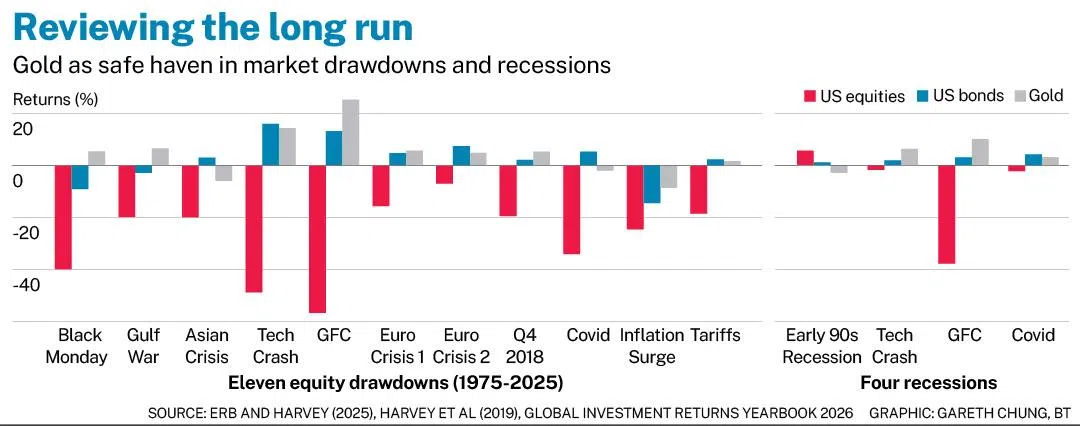
The picture is similar across four recessions. “Gold is more volatile than stocks, so it’s not safe,” Marsh added. “But it has given better protection than bonds when investors need it most. It has proved itself a safe-haven asset.”
Inflation hedges, gold and stocks: An asset may serve as an inflation hedge if its price positively correlates with inflation. As it turns out, the long-run evidence for gold and equities against inflation isn’t convincing.
Since 1900, gold has delivered bond-like real returns at 1.3 per cent over 126 years, compared with bond returns at 1.7 per cent.
But, as Marsh pointed out, gold price behaviour changed from 1971 when the US ended the greenback’s convertibility into gold. “Post-Bretton Woods, we’ve had equity-like returns from gold, but gold has been 40 per cent more volatile than stocks.”
Gold’s long-run correlation with inflation looks positive at 0.3, but the data was skewed by a single year, 1979, when gold prices surged amid an inflation crisis. Of the 28 years in which inflation exceeded 3 per cent, gold returns were negative in 13 of them.
When the outlier year 1979 is removed from the data, the correlation between gold and inflation sinks “to close to zero or slightly negative”. “While gold has kept pace with inflation over the very long run, over shorter periods, it’s not a consistent nor a reliable inflation hedge,” said Marsh.
Equities are also negatively correlated with inflation.
“Most people seem to believe that equities are a hedge against inflation. That’s because stocks have beaten inflation over the long run. They’ve beaten inflation because of the equity risk premium,” Marsh noted. “But over shorter periods, they are not an inflation hedge.”