Ice baths: Chilling proposition makes for hot business
Ice baths are fast-evolving into a multi-million dollar global industry as a result of growing demand

[SINGAPORE] Taking ice baths for health and wellness, a practice originating in colder climes, has taken off in hot and humid Singapore.
It seems barely a week has gone by in recent months without the opening of another local establishment offering cold plunges at near freezing temperatures. Apart from dedicated ice bathhouses, more gyms, spas and wellness studios are also offering cold plunge facilities.
Some of these businesses have seen rapid growth with multiple outlets opening up across Singapore, and even expanding overseas. Business consulting firm SkyQuest projects the global ice bath market to reach US$534.5 million by 2033 – up from US$365.9 million in 2024.
Prominent business leaders and celebrities including Reddit co-founder Alexis Ohanian, actor Mark Wahlberg and TV personality Joe Rogan swear by ice baths as a way to kickstart their day, build mental resilience and focus, and reduce stress.
My social media feed has also been inundated by posts of friends and acquaintances trying out ice baths, often paired with contrasting hot treatments such as saunas or hot pools. My own relationship with ice baths dates back to the late 1990s, when I was competing as a national athlete in fencing and triathlon.
Evolution of ice baths
In those days, national team athletes took their cold dips at the sports science and recovery facilities owned by the Singapore Sports Council (now Sport Singapore).

Ice baths were recognised to aid recovery from physical training. The cold causes blood vessels to contract, forcing out lactate and other byproducts of muscle breakdown, thereby speeding up recovery.
But the hardware was not terribly advanced: we immersed ourselves in either large plastic barrels or trash bins filled with ice and water.
At some point, these evolved into metal tubs with controls to adjust the temperature, but the usage protocols were basic – our trainers or physiotherapists simply told us to get in and endure the cold, with little or no sympathy for our shrieks at the initial shock, and whining to be let out accompanied by much chattering of teeth.


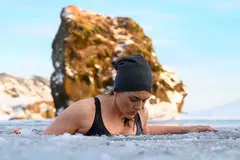
“It’s good for you,” we were told. And so we sucked it up. I did not miss this aspect of my competitive career when I retired from the national teams in 2009.
About a decade later, amid the Covid-19 pandemic in 2020, I chanced upon some information about Wim Hof, a Dutchman who had developed a training protocol that involved the use of breathing techniques and ice baths to build control over one’s mind and body.
Under the guidance of a trainer who had been taught by Hof himself, I started practising the protocol with a buddy who competes in ultramarathons. He was keen to learn how it might boost athletic performance, but also the more esoteric aspects relating to self-mastery and resilience in the face of stressors.
This is how it works: Immersion in the cold creates body reactions that typically emerge in stressful (fight-or-flight) scenarios. Using breathing and mental techniques, we learn to overcome the initial panic, lower heart rates and regain some measure of control over our bodies.
Hof formerly held a world record, having stayed immersed up to his neck in ice for just under two hours. During this time, he displayed only a marginal decrease in body temperature with no shivering or other expected reactions to the cold.
Our practice took place on the balcony of the trainer’s home, in industrial freezers which he filled with water that was allowed to partially freeze overnight to create temperatures of close to zero degrees Celsius.
After a few months of weekly sessions, I found myself dealing better with stressful situations. I also started looking forward to the early morning dips (I specifically chose to start before sunrise so that there was no ambient heat from our tropical weather to make the sensations less effective).
Modern offerings
In 2025, a friend and I decided to continue our ice baths at one of the swanky commercial establishments that had popped up around Singapore. It offered a sauna and hot pool of around 41 deg C to allow for contrast therapy, plus a cafe that served good coffee and food.
This “ice bath club”, as it was marketed, represents how the industry has evolved – a professional setting with clean and modern facilities, boasting extra amenities and a convivial setting.
Many of these businesses highlight that they not only help people recover from the stresses of modern life, but also offer environments conducive to socialising and networking.
I must confess that I have not experienced much of the latter, given our chosen timing when only a handful of dedicated and half-asleep ice bath acolytes show up. At that hour, I can barely muster up a nod or grunt by way of greeting.
A freezing future?
Given the current fervour for ice baths and the growing investment in setting up new facilities in Singapore and around the world, I wonder if a new culture of cold plunges will soon solidify.
The recent spike in global exposure and awareness has helped drive the industry’s modernisation and evolution, which has in turn boosted growth and profitability.
It seems likely that the benefits of this age-old practice will be appreciated by people for many years to come. As a fan, I view this as a positive trend. As the world continues to become ever more complex and complicated, anything that can help us keep our cool, literally or otherwise, should be given a warm welcome into our lives.
The writer is an ex-national fencer, triathlete and sports administrator. A former Nominated Member of Parliament, he is a co-founder and managing director of strategic sports consultancy Novastella.
Decoding Asia newsletter: your guide to navigating Asia in a new global order. Sign up here to get Decoding Asia newsletter. Delivered to your inbox. Free.
Share with us your feedback on BT's products and services