Is India on track to become a global economic superpower?
The country’s sheer size gives it momentum, but demography is not destiny
AS INDIA celebrated its 80th Independence Day on Saturday (Aug 15), many believe that the country’s time to become the world’s next superpower, alongside the US and China, has come.
However, the path there may be much rockier than is widely expected.
To be sure, New Delhi’s rise in recent decades is impressive and has already shifted the tectonic plates of global economics and politics.
The economic and population growth of India since the fall of the Berlin Wall has lifted hundreds of millions of its people out of poverty, and has played a role in what the World Bank called the “profoundest reshuffle of individual incomes on the global scale since the Industrial Revolution”.
India’s rapidly growing wealth has strengthened the view that New Delhi is on course to realise Prime Minister Narendra Modi’s longstanding vision of India becoming the third-largest economic superpower and securing the status of a high-income, developed country by 2047.
For instance, former UK prime minister Tony Blair in 2024 said: “By the middle of this century, you’re going to have three superpowers – America, China, and you’re going to have India. All other countries are going to be small in comparison.”
Indeed, Morgan Stanley sees India as being on a clear trajectory to overtake Germany and become the world’s third-largest economy by 2027. This is backed by the country’s middle-class consumer market that is expected to reach some 95 million by 2035, according to estimates by the UK government.
Blair’s reference to the size of India is hence apt, given that the country’s economic strengths include its large domestic market, a relatively high savings rate and the fact that the country in 2025 surpassed China to become the most populous nation in the world.
India’s population is furthermore forecast to continue growing for several decades, with some predictions that it could peak at around 1.7 billion in the second half of the century from its current number of more than 1.4 billion.
Crucially, more than two-thirds of all Indians are between the ages of 15 and 59, which means the country has a large labour force that the economy can tap – a strength that many developed countries, facing falling birth rates, cannot boast.
Obstacles still lie ahead
But demography is not destiny. For all the advantages India has, the nation’s quest for economic ascension may not be smooth sailing.
India lacks China’s manufacturing capacity and has not yet achieved the explosive export-driven growth that has made its Asian neighbour such a global economic dynamo.
It also remains reliant on China in areas like raw-material supply chains and components. On trade, too, New Delhi depends heavily on Beijing in multiple sectors, from renewables to pharmaceuticals.
Sure, India’s economy is still growing fast. It expanded by 7.7 per cent in FY2026, according to provisional estimates by New Delhi.
However, this will most probably not be enough to secure high-income status for the country by Modi’s 2047 target. This was highlighted by a 2025 World Bank report, which said India needs to maintain an average annual growth rate of 7.8 per cent, in real terms, from 2024 to 2047 to achieve its goal – a task many see as highly unlikely.
Modi has often cited India’s young people as a demographic advantage, and has urged them to contribute more to the country’s development.
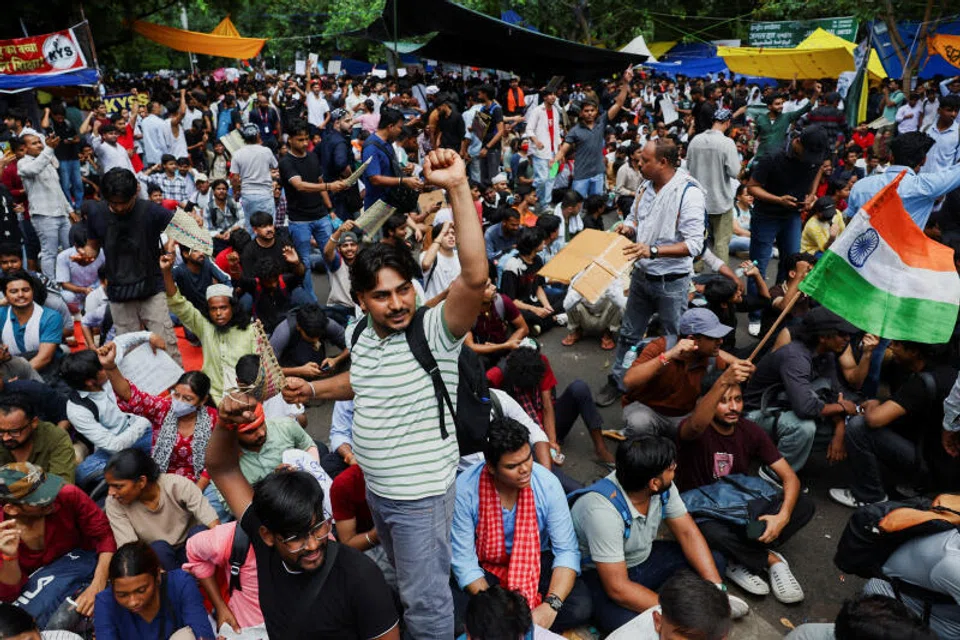
But as the recent protests, led by the Cockroach Janata Party, showed, there is significant discontent among India’s youth, with concerns centring on issues such as employment opportunities, inflation and inequality.
Policymakers cannot afford to ignore those under 25, as they comprise about two-fifths of India’s population – numbering more than 600 million people, the largest such cohort in the world.
On the political front, India has a long history of weak federal coalition governments. While Modi has brought relative political stability over the last dozen years in New Delhi, it may not hold in the future, jeopardising any economic progress that would benefit from a stable central government.
The success of the nation in delivering a demographic dividend, then, will depend in large part on whether it can overcome the challenges that have constrained economic growth in recent decades.
Some examples are scarcity of infrastructure, sub-optimal political governance and insufficient social spending.
It is likely that Modi’s vision of India becoming a high-income, developed nation by 2047 will not be realised.
However, that is not mutually exclusive with global recognition of the country as the third global economic superpower by the mid-century.
The writer is an associate at LSE IDEAS at the London School of Economics