Keppel Reit’s road to redemption
Strong office property fundamentals and asset sales may boost its sagging units

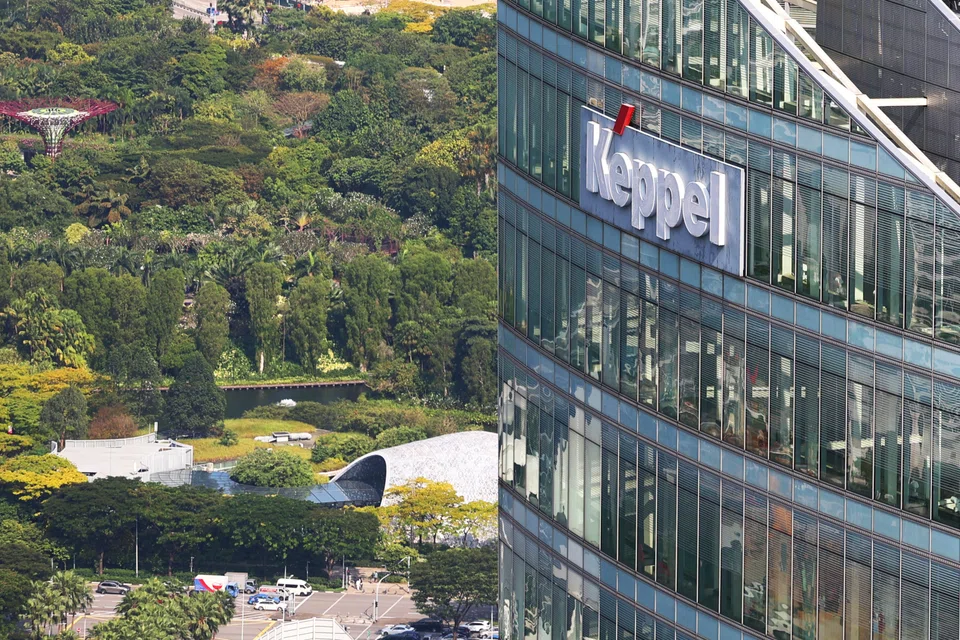
[SINGAPORE] Singapore-listed real estate investment trusts (S-Reits) have struggled in 2026, no thanks to the Iran war triggering concerns about higher global inflation and interest rates. For investors who funded Keppel Reit’s recent acquisitions, the adverse turn in sentiment may have been especially galling.
In October last year, Keppel Reit said it would acquire a 75 per cent stake in Top Ryde City Shopping Centre in Australia, funded partly by a placement of nearly 115 million new units priced at S$0.983 each.
Then, in December, it announced the acquisition of a further one-third stake in MBFC Tower 3, along with a preferential offering of 923.2 million new units at S$0.96 each.
With the MBFC Tower 3 deal expected to dilute its distribution per unit (DPU), Keppel Reit wasn’t spared when fears of higher interest rates swept across the market. Its units closed as low as S$0.84 on Jun 8, down from S$0.975 at the end of last year.
They closed last week (Jul 31) at S$0.92 – still below the level at which investors were last tapped for funds.
During the first seven months of 2026, Keppel Reit’s unitholders suffered a negative total return of 4.8 per cent, according to Bloomberg data. The iEdge S-Reit Index returned minus 1 per cent.
The strong H1 2026 financial numbers Keppel Reit reported last week highlighted a number of positive catalysts on the horizon, though – which could see it redeeming itself in the eyes of analysts and investors in the months ahead.
Rising rents, falling debt costs
For starters, resilient demand and tight supply are lifting rents for office properties in Singapore, which account for nearly 79 per cent of Keppel Reit’s S$11.8 billion portfolio.
In H1 2026, the weighted average signing rent of Keppel Reit’s office property leases in Singapore was S$13.14 psf per month – higher than the average rent on expiring leases of S$12.24 psf per month in 2026, S$11.49 psf per month in 2027, and S$12.66 psf per month in 2028.
Many S-Reits are also benefiting from softening debt costs, as interest rates have fallen significantly from their post-pandemic peaks.
Keppel Reit’s weighted average cost of debt stood at 3.27 per cent at the end of H1 2026, down from 3.51 per cent at the end of H1 2025.
The combination of rising rents, lower debt costs and recent acquisitions were plainly evident in Keppel Reit’s H1 2026 financial numbers.
Net property income (NPI) of its directly held assets increased 13.1 per cent to S$122.5 million, due mainly to contributions from Top Ryde City Shopping Centre.
Its share of results from properties held through joint ventures surged 37.2 per cent to S$83.8 million, driven largely by its additional one-third stake in MBFC Tower 3.
Even without the two recently acquired assets, its NPI from directly held properties would have increased 2.5 per cent while its share of results from joint ventures would have climbed 11.6 per cent.
For the six-month period, Keppel Reit’s distributable income rose 22.8 per cent to S$129.6 million, though its DPU slipped 4 per cent to S$0.0261.
Asset sales, unit buybacks
Analysts also noted that Keppel Reit does not appear to be planning further acquisitions for now. In fact, it said last week that KR Ginza II – an office building in Japan, in which it holds a 98.5 per cent stake – will be sold for 11.5 billion yen (US$72.8 million).
The sale price is 28.4 per cent above the price at which the property was acquired in 2022, and 9.7 per cent above its recent valuation.
Keppel Reit said the deal will reduce its aggregate leverage to 39.6 per cent, from 40 per cent at the end of H1 2026.
Keppel Reit is also expected to sell T Tower, a building in South Korea currently held in its books at 305.6 billion won (US$213.5 million) – with some of the proceeds going towards repurchasing its units.
Keppel Reit is currently trading at only 0.75 times its adjusted net asset value of S$1.22 per unit. Based on the Reit’s H1 DPU, its units are trading at an annualised yield of 5.7 per cent.
More optimism, some risks
Keppel Reit units bounced 4.5 per cent last week, versus a 1.1 per rise in the iEdge S-Reit Index, as some analysts reiterated their bullish calls and hiked their target prices after the release of its financial results.
For instance, DBS increased its target price from S$1.05 to S$1.10, to account for its improving organic growth prospects. CGS International said Keppel Reit’s fundamentals look strong, and maintained its target price at S$1.09.
On the other hand, RHB has a “neutral” stance on Keppel Reit, with a target price of S$0.99. While its H1 2026 performance was stronger than expected, the research house warned that its DPU may decline in 2026 and 2027 – due to its earlier dilutive acquisition, and the absence of “anniversary distributions” from H2 2027 onwards.
Keppel Reit said in 2022 that it would distribute a total of S$100 million semi-annually over five years. Excluding this “anniversary distribution”, its distributable income in H1 2026 would have been S$119.6 million instead of S$129.6 million.
Investors should perhaps also keep in mind that S-Reits are hardwired to expand their portfolios whenever opportunity arises. While Keppel Reit does not appear to be on the hunt for acquisitions right now, a strong recovery in the market value of its units may change its calculus.
With growing optimism among analysts and investors, the risk of another dilutive deal should not be ignored.