

Labour landslide in big UK ‘change’ election
The party intends to kickstart reforms to the planning system that will set the stage for ramping up housebuilding and infrastructure development
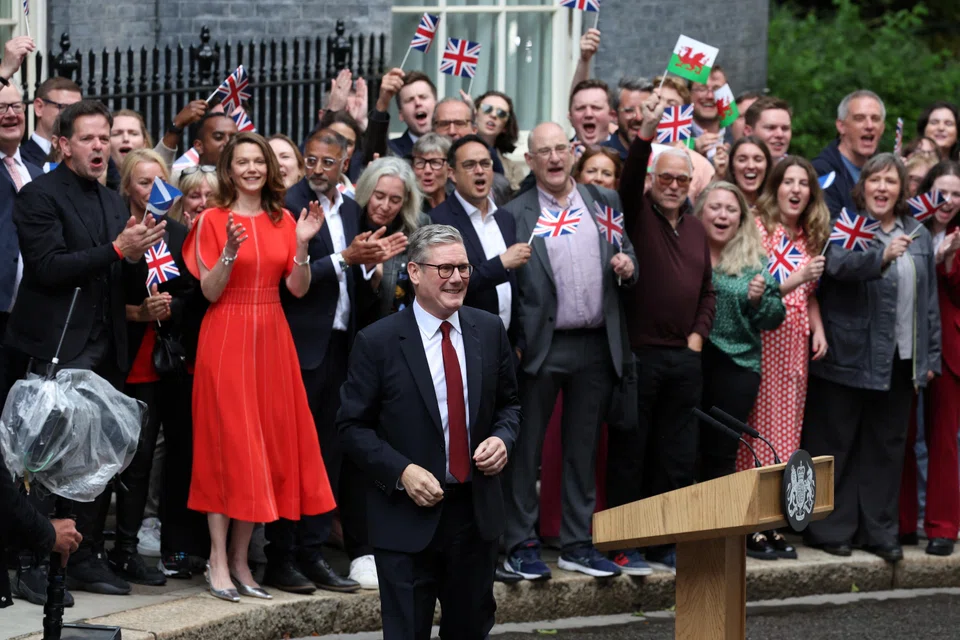
THE UK Conservatives have been called the most successful political party in the Western world. Yet Thursday (Jul 4) saw Labour winning a historic landslide that may redefine the UK’s polity, economy, and international relations into the 2030s.
New UK Prime Minister Keir Starmer, who becomes only the fifth ever Labour leader to win a general election, will have little time to catch his breath after the campaign as he will seek to quickly make his mark in international summitry in July.
Next week, he heads to Washington DC for a Nato summit to commemorate 75 years of the military alliance where he will meet US President Joe Biden and Ukrainian President Volodymyr Zelensky. Moreover, a week later he will host the European Political Community conference of European Union and non-EU leaders, engaging key figures including German Chancellor Olaf Scholz and French President Emmanuel Macron.
However, while Starmer faces no end of international dialogue on the horizon, it will be domestic politics now that occupies him mostly this summer as he seeks to make the most of his first 100 days in power. Some of the big policies which Labour has said it will move forward with, coinciding with the King’s Speech of new legislation expected on Jul 17, include kickstarting reforms to the planning system that will set the stage for attempts to ramp up housebuilding and infrastructure development across the United Kingdom.
A related part of this process will be new legislation to create “Great British Energy”, a new state-owned generator of green electricity which Labour claims will help make the country “a clean energy superpower”. The party asserts the new company will cost around £8.3 billion (S$14.3 billion) and be paid for by a windfall tax on oil and gas companies. Labour will also repeal the current UK ban on new onshore wind farms.
Labour will also move forward with fulfilling plans to, gradually, nationalise the railways. This comes more than three decades after the privatisation of the sector in the early 1990s.
One scheme that will also be scrapped is the Conservatives’ controversial, flagship Rwanda migrant deportation scheme. Labour will instead create a “border security command”, appoint hundreds of investigators and give counter-terror powers to Border Force to “smash criminal gangs”.
In seeking to move forward with this big agenda, Labour will seek to take advantage of the disorientation in the Conservatives who have suffered their worst ever election result. To put Labour’s win into historical context, the 412 seats won by the party has surpassed those secured by Labour in 1945 (under Clement Attlee’s leadership), and also the Conservatives in 1983 (with Margaret Thatcher at the helm).
It is comparable with Labour’s 418-seat victory in 1997 (under Tony Blair’s leadership), the largest number of seats won in post-war UK history. However, the tally is much less than the 470 seats won by the Conservatives in 1931 (this is the most seats proportionately ever won by any single party in a Western democratic election).
This context underlines how, by almost any standards, the Jul 4 election is a new political dawn for the UK. It is also historic in two other potentially important senses.
Firstly, the United Kingdom has now experienced back-to-back landslides, in opposite directions, in the last two national ballots for the first time in around 120 years. The year 2019 saw a big Conservative win, while 2024 is now confirmed to be an ever bigger Labour victory.
The last time this happened was in 1900, which saw a Conservative landslide, followed by a massive Liberal win in 1906. 1906 was the last time the Liberals won an absolute majority in the House of Commons, and was the last general election in which neither Labour nor the Conservatives won the popular vote.
The huge victory for the Liberals in 1906 helped catalyse an era-defining realignment that led to the modern UK electoral system dominated by the Conservatives and Labour. So it is also possible that Labour’s big win could also herald big political change on the UK horizon.
A further dimension of the historic nature of election 2024 is the vastly increased prevalence of digital campaigning which saw a huge step change compared to previous elections. On Election Day alone, UK political parties are forecast to have spent more than £1 million on online adverts. To put this into perspective, the £1 million spending exceeds, extraordinarily, the sum spent on online channels by political parties during the entire 2015 general election campaign.
Ultimately, it was Labour’s campaign message of “change” that cut through with the electorate. Fourteen years after the Conservatives won power in 2010 – and five prime ministers, four election cycles, two UK-wide referendums and a global pandemic later – a lot has happened to switch the nation off from the Conservatives.
This included the fact that some 7.6 million people are on waiting lists for hospital treatment in England (three times the 2010 figure); around 3 per cent of the UK population uses a food bank, all while the cost of weekly groceries, household bills and mortgage repayments have risen significantly since the pandemic.
A key question now for the Conservatives is how fast the party moves forwards with a contest to find a new leader. In recent years, major party leaders who lose elections badly, like Rishi Sunak has now, have tended to resign very quickly.
However, Sunak may come under pressure to stay on for a period to allow the party to have a proper inquiry into what went wrong. The goal would be to stop it rushing into a leadership election before it has had time for a period of reflection.
After losing to Blair in 2005, then-Conservative leader Michael Howard stayed on heading up the party for about six months to allow the party time to revise the leadership election process and to enable a new generation of MPs promoted to the shadow Cabinet to build a reputation. This resulted in the party electing David Cameron as leader in 2006 who went on to lead the Tories back into office at the next election in 2010.
Taken together, Labour now has a big agenda to deliver following its very big victory. While the party will dominate the political landscape the next few years, whether it wins big again in 2028 or 2029 will depend on how fast the main opposition party, the Conservatives, rejuvenate themselves in coming years.
The writer is an associate at LSE IDEAS at the London School of Economics
TRENDING NOW

Indonesia stocks suffer worst plunge in nearly 30 years as MSCI proposes standalone status
The grid is the transition: Why Asean’s next energy challenge is coordination

Firms linked to haze pledge cooperation in meeting with Shanmugam; government to table changes to haze law

If Europe goes to war, the fallout will be felt in East Asia

