

A little turbulence in a Vietnamese teacup? Or a Haiphong hurricane?
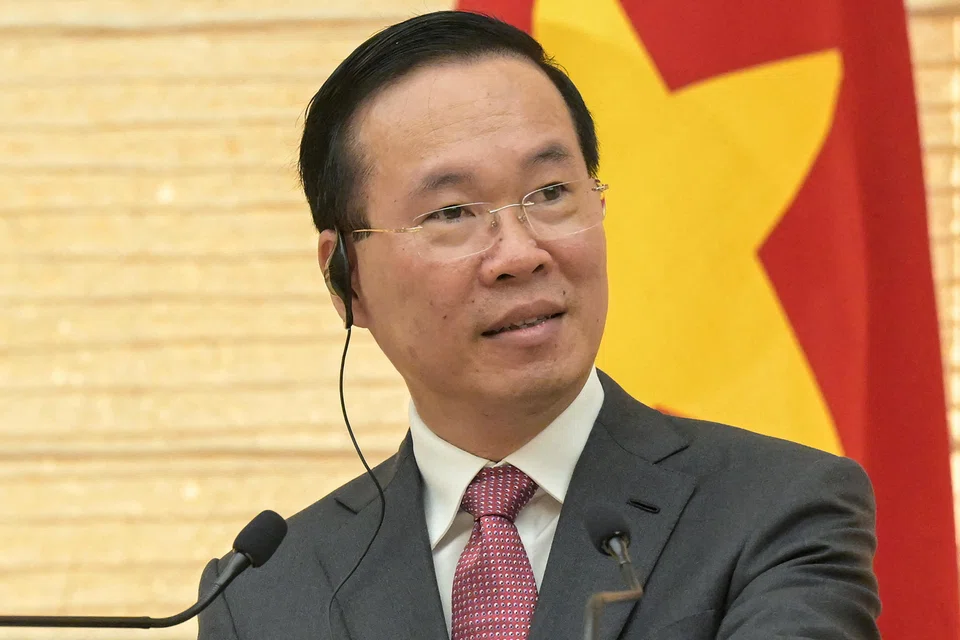
THE premature resignation of Vietnam’s president Vo Van Thuong this month after just a year in office could be read in two ways – as a signpost of escalating political instability, or as a widening reform of the troubled economic system.
The 53-year-old Thuong – once considered a blazing star and protege of the Communist Party chief Nguyen Phu Trong – was dismissed by the ruling Communist Party for wrongdoing. The state-run media stated that Thuong’s “violations and flaws have negatively affected public perception, as well as the reputation of the party and the state”.
It is alarming that Thuong is the second president in two years to resign from the largely ceremonial position in a political system where party chief Trong holds the most powerful post. Thuong’s predecessor Nguyen Xuan Phuc was forced out from the post last year for “violations and wrongdoing”, after holding the presidential office for less than two years. Both the presidents saw their downfall under a wide anti-corruption campaign.
Such high-level casualties of the campaign should have sent foreign investors running towards the exit door. They would see it as a sign of political instability that could affect economic and business policymaking.
Not in Vietnam. In Vietnam, the political culture upholds the legitimacy of institutions – the Communist Party, the government, the presidency, and the national assembly – and not personalities.
Businessmen understand that a cleaner government would eventually benefit investors. The anti-corruption campaign has led to the arrest of thousands of state officials and businesspeople.
The campaign may bring some benefit to the business community, where paying illegal fees and charges that state and provincial-officials demand is de rigueur. It is fair to say that the reforms to clean up the system will run their course.
Vietnam will benefit from the reforms. The country ranks 83rd out of 180 countries in Transparency International’s latest “Corruption Perceptions Index”. The widespread corruption has been investigated in studies such as Corruption and the Business Environment in Vietnam by Daisuke Maruichi and Masako Abe, published in Asia & the Pacific Policy Studies. The Economist Intelligence Unit’s April 2022 report on the subject was titled Corruption in Vietnam: Business as Usual.
The Maruichi and Abe report goes to the heart of the problem by surveying 79 firms in three Vietnamese cities – Hanoi, Hung Yen, and Vinh. The report suggests that “corruption undermines Vietnam’s economic performance” and hampers the growth of private enterprises. Overall, it found that corruption has a negative impact on private investment, employment, and per capita income at the provincial level in the country. It also has a harmful effect on Vietnamese firms’ strategic capability by eroding cultural integrity, demotivating innovation, and hurting their reputation.
The study finds that a firm in Vietnam may “gain benefits when it pays a bribe, but the benefits of paying a bribe are subject to diminishing returns”. As many as 80 per firms surveyed stated that they pay an unofficial charge to authorities to obtain a business registration, licence, or permit.
Corruption hurts medium-size enterprises the most, both in terms of severity and payments of unofficial charges, the report notes. Most exposed is the hotel and restaurant sector, followed by the construction, agriculture, and manufacturing sectors. The hotel/restaurant and construction sectors are more prone to corruption because they are more likely to come into contact with state officials than other sectors.
Among the three cities surveyed, firms based in Hanoi experience corruption most acutely. Businesses in the cities of Vinh and Hung Yen “exceed” Hanoi in making unofficial payments – indeed, corruption is fairly rampant in Vinh as more than 85 per cent of firms pay some amount of “under-table money”, and they may not consider corruption to be any serious issue and accept it as part of daily life. The opposite is true for Hanoi where firms tend to abhor corruption. The firms most affected by corruption are Vietnamese-owned; they are also more likely to pay unofficial charges than foreign-owned firms.
Against this dire background, economic growth in Vietnam slipped to 5.1 per cent last year from 8 per cent in 2022, as exports slowed. A slow recovery is anticipated. Vietnam’s gross domestic product (GDP) growth could reach 5.5 per cent in 2024, and 6 per cent in 2024, according to the World Bank’s Global Economic Prospects report released in January 2024.
Vietnam’s GDP reached US$430 billion in 2023, according to the country’s General Statistics Office. The 5.1 per cent growth is higher than 2.9 per cent in 2020 and 2.6 per cent in 2021 at the peak of the Covid-19 pandemic – but is down from 8 per cent in 2022, in the post-pandemic period, and 7 per cent in 2019 before the pandemic.
The World Bank has injected a note of caution: “Slower manufacturing growth in China would depress regional processing trade, particularly in economies with large integrated export sectors such as Malaysia and Vietnam.”
To return to the current political crisis, the national assembly has named Vice-President Vo Thi Anh Xuan as acting president – she is the highest ranked woman to hold the position. She had held the same acting position last year when former president Phuc quit. A new president is likely to be elected when the national assembly holds its next session in May.
The anti-corruption campaign aims to clean up the economic system, and make it easier for local and foreign businessmen to operate. In the final analysis, the current crisis denotes a little turbulence in a Vietnamese teacup, and not a devastating Haiphong hurricane. The political system is being put through a much-needed shake-up in order to ensure long-term stability.
The writer is editor-in-chief of Rising Asia Journal
TRENDING NOW
‘Wasting money, spending tokens’: Companies still in search of AI use cases with worthwhile ROI, says Broadcom’s Hock Tan

Malaysian king buys stake in Singapore-listed mining firm expanding into rare earths

Once staunchly pro-China, Malaysian Chinese businesses are now distancing themselves from Beijing
Singapore’s wealth management success should extend to everyday families

