A look at the Fed’s likely next No 2
PHILIP Jefferson, an economist who joined the Federal Reserve’s board of governors in May 2022, was nominated by President Biden on Friday (May 12) to be its vice-chair. I didn’t write about his appointment last year; his proposed elevation gives me a second chance to discuss his ideas. There’s more to chew on now: The Fed website has six speeches he’s given since joining the board on such topics as inflation, inclusive economic growth and technology’s impact on the post-pandemic economy.
Jefferson grew up in the Kingman Park neighbourhood of Washington, DC, where “the line between a future of success or struggle was thin”, he said at his confirmation hearing. He became a Fed staff economist, a professor and then the vice-president for academic affairs and dean of faculty at Davidson College in North Carolina. On the Fed board of governors, he is considered a centrist. “He has built a reputation as an inquisitive listener with an interest in staff economic research,” my news colleague Jeanna Smialek wrote on Friday.
(Biden also nominated Adriana Kugler to the board of governors. A Colombian American economist who is on leave from Georgetown University to serve as the US-appointed executive director of the World Bank, she would be the first Hispanic person on the Fed board.)
If confirmed as vice-chair, as is expected, Jefferson would become the second Black person to serve in the post, following Roger W Ferguson Jr, who held it from 1999 to 2006.
Jefferson is the kind of guy who invites his first-grade teacher to his swearing-in. “I’ve known Philip Jefferson since I tried to hire him out of graduate school,” Stephen Cecchetti, a professor of international finance at Brandeis International Business School, wrote me in an e-mail. “I was thrilled when he agreed to join the board and couldn’t be happier with this nomination. He will do an excellent job.”
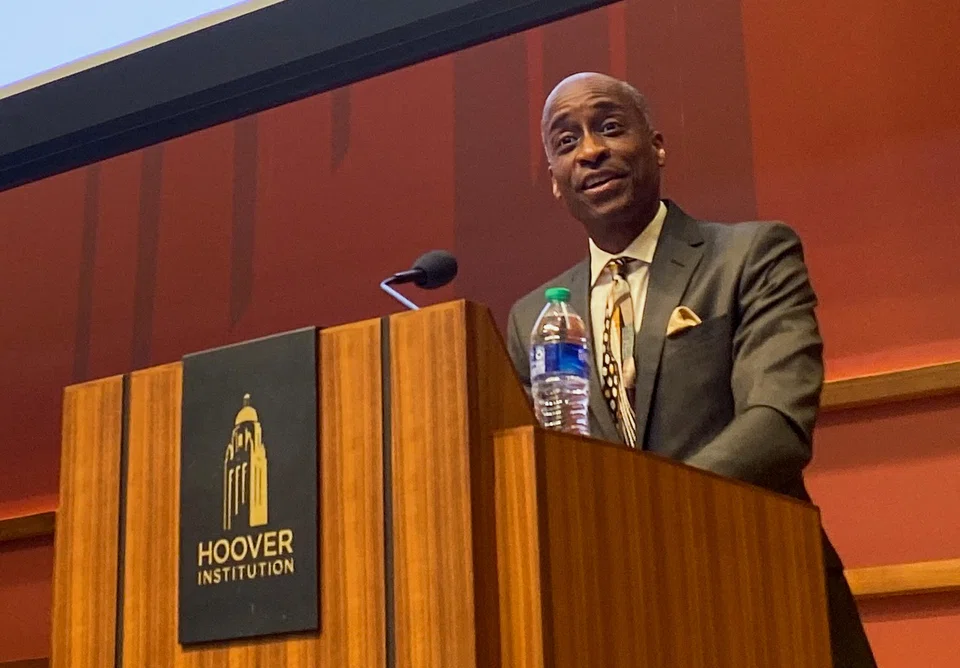
Before his nomination, the conservative Hoover Institution invited Jefferson to speak at a conference last Friday, How to Get Back on Track, which followed a 2022 conference, How Monetary Policy Got Behind the Curve. In his prepared remarks, Jefferson stood up for the central bank. He challenged Hoover’s presumption that the Fed’s monetary policy did get behind the curve or needed to get back on track.
Jefferson told the Hoover audience: “Policymakers should continuously update their priors about how the economy works as new data becomes available. In other words, it is appropriate to change one’s perspective as new facts emerge. In this sense, I am in favour of a Bayesian approach to information processing.”
Jefferson also pushed back against critics of Fed policy in a speech in February at the US Monetary Policy Forum, an annual event that brings Fed governors and Fed regional bank presidents together with Wall Street and academic economists. Jefferson was responding to a report called “Managing Disinflations”.
Disinflating is the tricky procedure that the Fed is preoccupied with right now. The report’s authors warned that “there is no post-1950 precedent for a sizeable central-bank-induced disinflation that does not entail substantial economic sacrifice or recession”. Pessimistically, they also projected that “the Fed will need to tighten policy significantly further to achieve its inflation objective by the end of 2025”. (The Fed has raised its key rate by half a percentage point since the report’s release.)
In his prepared remarks, Jefferson said that the Covid shock was so deep and unusual that the standard rules of economic modellers don’t fully apply. “History is useful, but it can only tell us so much, particularly in situations without historical precedent,” he said.
The authors of the report Jefferson was responding to, including Cecchetti, had written that the Fed “weakened its credibility for controlling inflation” when it changed its policy strategy in 2020. Jefferson responded that the Fed is more credible now than it was in the 1960s and 1970s, when inflation got out of control.
He concluded: “Economic models are important tools, but need to be used with careful interpretation and judgment when history does not speak to the current situation.” Models, he said, need to be “complemented with additional analytical tools, including careful scrutiny of real-time data”.
Kim Schoenholtz, another of the authors of the report that Jefferson responded to, told me on Monday that he still thinks that the Fed’s strategy change in 2020 weakened its inflation-fighting credibility. But Schoenholtz, a clinical professor emeritus at New York University’s Stern School of Business, said, “There’s plenty of room for thoughtful people to disagree. His presentation was a thoughtful one.”
In a nutshell, Jefferson has positioned himself roughly at the centre of Fed rate setters and has shown that he’s prepared to make a strong case for the bank’s policies. That may help explain why he’s in position to become the Fed’s vice-chair. NYTIMES