

The next chapter for Singapore’s banks: From resilience to growth
They are moving from defending earnings to a more supportive phase of wealth-led growth and stabilising margins
A record first half – but not all the growth was equal
SINGAPORE’S three local banks delivered a strong first half, with DBS and OCBC posting record net profit of respectively, S$6.01 billion and S$4.19 billion, up 5 per cent and 13 per cent. UOB’s net profit rose 3 per cent to S$2.92 billion.
But the headline numbers do not tell the full story. DBS and OCBC saw stronger growth across their core businesses, with higher fee and other non-interest income helping to offset the impact of lower interest rates on lending income.
In contrast, UOB’s profit growth was less reflective of underlying business momentum. Its total income fell 1 per cent, while profit growth was supported by lower provisions, higher contributions from associates and gains from asset sales.
The rate tide is turning
Interest rates have been a major headwind for banks over the past year. As rates fell through 2025, the gap between what banks earn on loans and pay on deposits narrowed, weighing on net interest income. Across DBS, OCBC and UOB, net interest income fell by around 3 per cent year on year in the first half, while net interest margins declined by 18 to 25 basis points.
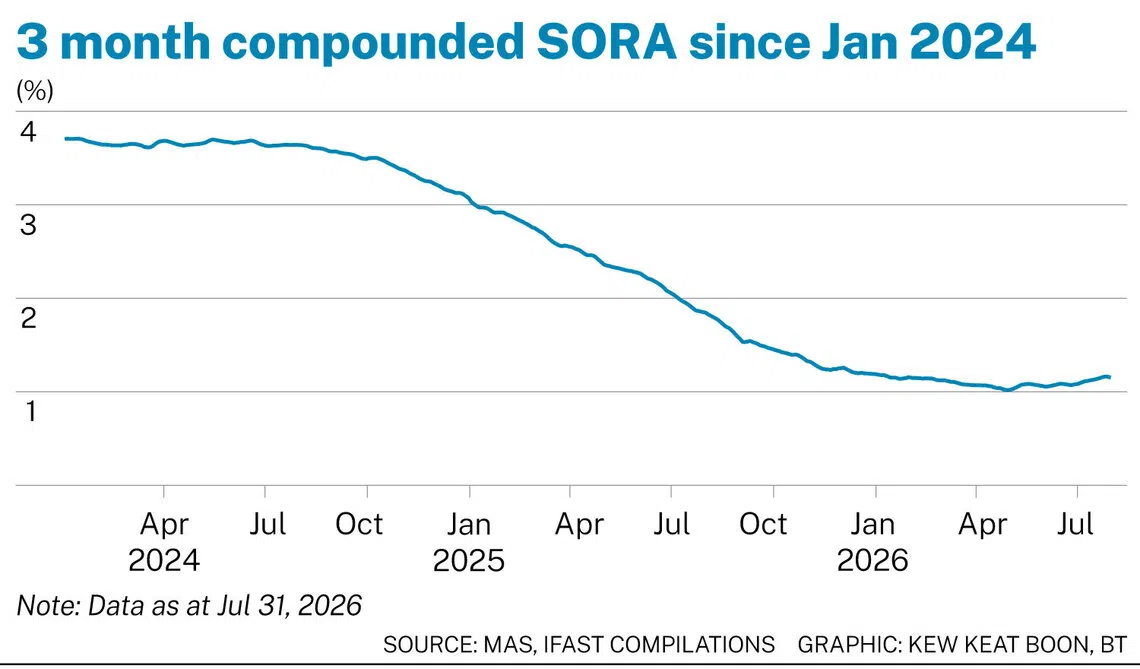
That pressure, however, appears to be easing. Singapore’s benchmark three-month compounded Singapore Overnight Rate Average (Sora) fell from above 3 per cent in early 2025 to around 1.1 per cent, but has since risen for three consecutive months to about 1.15 per cent at end-July.
Meanwhile, the US Federal Reserve’s latest dot plot points to fewer rate cuts than previously expected. Together, these developments suggest that downward pressure on domestic interest rates may be diminishing.
The shift is already starting to show in the banks’ results. Net interest income rose 2 per cent quarter on quarter at both DBS and OCBC, as loan growth more than offset the remaining pressure on margins. This marked a notable reversal after several quarters of pressure.
With margins appearing close to a floor – DBS and OCBC guiding for only a modest full-year decline in net interest income, while UOB’s margin guidance of 1.75 to 1.8 per cent also points to limited further downside – a firmer Sora could provide some upside to current expectations.
Wealth is the structural engine – and scale decides who captures it
The more durable growth story is the shift towards fee income, particularly wealth management.
Singapore’s growing role as a global wealth hub provides a strong structural tailwind, with continued geopolitical uncertainty encouraging more wealth to be placed in the city-state.
The benefits are already visible. DBS grew wealth fees 33 per cent to a record S$1.83 billion, with wealth assets under management surpassing S$500 billion. OCBC’s wealth income rose 27 per cent to S$3.29 billion, now accounting for 41 per cent of total income, with banking wealth assets reaching a record S$350 billion.
Both have large private-banking businesses and are well-positioned to capture Singapore’s growing wealth inflows.
UOB’s wealth income grew 16 per cent, but from a smaller base, while overall fee income fell 2 per cent as weaker loan-related and investment-banking fees offset record wealth fees. Management consequently lowered its full-year fee-income guidance.
All three banks are investing to strengthen their wealth franchises. DBS is using generative artificial intelligence in its digiWealth platform and targeting S$1 trillion in wealth assets by 2030.
OCBC plans to invest more than S$1 billion a year in AI and data, add 600 relationship managers and expand its Asean footprint through the planned acquisition of HSBC’s affluent-banking business in Indonesia.
Meanwhile, UOB is moving towards an advisory-led model with a broader range of third-party products following the agreed sale of its fund-management business to Allianz Global Investors.
UOB’s Greater China property exposure warrants attention
Overall, asset quality remained sound across the three banks, with non-performing loan (NPL) ratios broadly stable and credit costs within guidance.
The main area to watch is UOB’s exposure to Greater China property. UOB’s NPL ratio for Greater China property rose sharply to 4.8 per cent from 3.5 per cent in just one quarter, while the level of provisions set aside against these loans fell to 42 per cent from 57 per cent.
The deterioration followed the downgrade of a large real-estate borrower, although a release of general provisions helped cushion the impact on reported credit costs.
For now, the issue remains contained. Greater China represents a relatively small part of UOB’s overall loan book and has not materially affected group earnings. Still, it highlights that the regional property cycle has yet to fully recover.
OCBC and UOB have also guided for second-half credit costs to be slightly higher than their first-half run-rates, suggesting some caution remains warranted.
What it means for investors
The sector is in a better place than a year earlier, with earnings growing, rate pressures easing and wealth management becoming a stronger growth engine.
The main constraint is valuation: All three banks now trade above their long-term historical averages after a strong rerating in 2026.
This leaves less room for further valuation gains, putting greater emphasis on dividends and sustained earnings growth. DBS and OCBC remain ahead of UOB on earnings momentum and quality, with DBS standing out for its sector-leading 17.5 per cent return on equity and more attractive dividend yield.
The worst of the rate adjustment may be behind Singapore’s banks. The next phase will be about turning stronger wealth franchises and a more supportive rate environment into sustained earnings growth, while dividends provide a steady return along the way.
The writer is a research analyst with the research and portfolio management team at FSM Global, the B2C division of iFast Financial, which is the Singapore subsidiary of iFast


