

Optimise land use: Build 5-storey landed homes
Taller houses occupying smaller land plots won’t destroy the character of landed housing estates


[SINGAPORE] Through the years, land-scarce Singapore has had to constantly find land to house growing live, work and play needs.
The Urban Redevelopment Authority’s Draft Master Plan 2025, which sets out the city-state’s land use development blueprint for the next 10 to 15 years, includes plans and strategies for more inclusive, accessible homes and neighbourhoods; refreshed business nodes and vibrant workspaces; and a more resilient Singapore.
Certainly, more public and private homes are needed to cater to the growing number of resident households.
Between 2014 and 2024, the number of resident households in the city-state jumped 22 per cent from 1.2 million to 1.46 million. Over this period, the average household size among resident households fell from 3.43 persons to 3.09 persons.
In the push to increase housing supply, should private landed homes gradually become obsolete?
Imagine rezoning landed housing areas to allow for condo developments. Over time, land occupied by landed homes may be repurposed to house many more residents dwelling in high-rise apartments.
Nonetheless, even as Singapore transforms, keeping a range of housing typologies including landed homes enhances the cityscape and overall living environment. Also, landed homes are highly sought after by the Republic’s wealthy residents.
Perhaps, land which is zoned for landed housing should be made to work harder through raising height limits for landed homes.
Consider having taller landed homes islandwide of up to five storeys with a maximum height of, say, 22 m.
Currently, guidelines permit two-storey or three-storey landed homes with overall height of 12 m or 15.5 m, respectively.
Possibly, concurrent with allowing landed houses to be built higher, reduce minimum plot sizes for terrace, semi-detached and detached houses including those in Good Class Bungalow Areas (GCBAs).
Meeting aspirations
Between the fourth quarter of 2019 and the third quarter of 2025, the number of private non-landed homes excluding executive condominiums jumped 16 per cent from 300,159 to 348,043.
In contrast, the stock of private landed homes inched up 0.3 per cent from 73,402 to 73,613 over the same period.
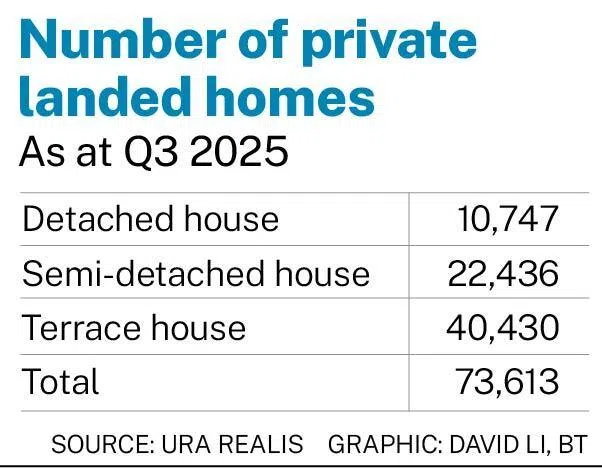
Generally, government land sales sites include various land parcels for building condos but not for landed homes. Thus, while condo inventory should continue to grow significantly, the growth in the stock of landed housing could be relatively muted.
Allowing the building of bigger structures on land plots in landed housing zones and reducing minimum plot size requirements can over time yield a substantial rise in the number of landed homes.
Take a detached house in a two-storey landed zone with a minimum plot size of 400 square metres, or about 4,306 square feet. For illustration, building a five-storey house on a plot size that is one-third smaller can yield a house with much more above-ground built-in area.
Importantly, raising the stock of landed homes here allows the aspirations of high-income earners to be better met.
Think of people who aspire to upgrade from a condo unit to a landed home because they want a more bespoke abode which offers greater privacy and is more spacious.
Landed housing ownership here is generally restricted to Singapore citizens. Applications by foreigners to own landed homes here are assessed on a case-by-case basis. Factors such as being a permanent resident of Singapore for at least five years and making exceptional economic contributions to the Republic are considered.
Better meeting the aspirations of successful local entrepreneurs, professionals and corporate executives among others to own a landed home matters. This can help anchor business leaders and top professionals as well as those rapidly climbing the ranks to Singapore, where they may make useful contributions to economic growth and tax coffers. After all, the Republic needs to draw top talent so that it has a dynamic economy to help fund rising government expenditure to care for an ageing population, among others.
Property tax
Intensifying the use of land that is zoned for landed housing can also lead to a rise in property tax revenue.
Annual property tax is calculated by multiplying a property’s annual value with the applicable property tax rate.
The annual value of buildings is the estimated gross annual rent of the property if it were to be rented out, excluding furniture, furnishings and maintenance fees. It is determined based on estimated market rentals of similar or comparable properties.
Generally, all else being equal, building a larger structure on a given land plot should translate into a property’s annual value rising and a higher annual property tax being levied on the said property.
Living environment
Strict building guidelines help to ensure a pleasant living environment in landed housing enclaves.
For example, a detached house outside a GCBA needs to have a maximum site coverage of 50 per cent and the main building should generally be set back by 2 m from common boundaries, among other requirements.
Existing landed housing guidelines on site coverage, sub-control, set back from common boundaries of the main building, car porch columns, patios, terraces, roof eaves, car porch eaves and so forth can largely remain or be relaxed slightly, while raising building heights of landed homes and reducing minimum plot sizes. In turn, the net result should be that land is more optimally used while landed housing residents continue to enjoy sufficient privacy and live in pleasant, relatively low-density estates.
Singapore has seen buildings go much taller without undermining the quality of the living environment. With good planning and sensible guidelines, existing landed housing enclaves can house more homes and taller houses without undermining the living environment in these areas.
In land-scarce Singapore, only a small proportion of households live in landed properties. Between 2014 and 2024, the proportion of resident households living in landed homes fell from 5.8 per cent to 4.7 per cent.
By boldly reimagining what our landed housing enclaves should look like, a greater share of residents may be able to realise their dreams of living in a landed house in land-scarce Singapore in the future.


