People power: Make room for Africa
The big population story for the rest of the century is predicted to be the rise in relative importance of Africa, alongside the relative declines of Asia and the West.

DEMOGRAPHY may not be destiny, as the 19th-century philosopher/sociologist Auguste Comte reputably claimed, but few doubt its importance. This helps to explain the recent spate of headlines about the earth’s population passing the eight-billion milestone and about India slipping ahead of China as the world’s most populous country (both India and China have populations of more than 1.4 billion).
Any day now, populations in Asia and elsewhere will hear about another demographic milestone: Vietnam will become the 16th country in the world with more than 100 million people. Seven of the other 15 are in Asia, by the way: India (1), China (2), Indonesia (4), Pakistan (5), Bangladesh (8), Japan (12), and the Philippines (13).
Lest Asians get overly prideful regarding their huge global demographic footprint, another, less-publicised, population issue is worth noting: We likely have reached or already passed “peak Asia” in demographic terms. This statement won’t surprise people in Singapore who have been following population matters closely.
For some time now, media here have included plenty of coverage about the extremely low fertility rates and rapidly ageing populations in South-east Asia, and especially in East Asia. The predicted relative decline of Asia’s share of the world’s population follows therefrom. This said, the projected magnitude of the decline will shock many.
To be sure, one must employ population projections with caution. The famous observation – attributed to figures ranging from the Danish physicist Niles Bohr to the American baseball hero Yogi Berra – that “it is hard to make predictions, especially about the future”, testifies to this point.
One who lives by the crystal ball must learn to like the taste of broken glass and all that. Factors such as climate change, pandemics, migration flows, and unexpected alterations in fertility levels can disrupt trends, and social scientists have warned us for decades about the problems growing out of linear extrapolation.
Reasonable estimates
Demographers are conscious of such concerns. After factoring them all in, they have nonetheless come up with reasonable estimates for world population and its distribution going forward through the rest of the 21st century. These estimates can provide us with important insights about the likely path ahead.
The best current population estimates see world population growing to about 9.7 billion by 2050 and to about 10.4 billion between 2080-2100 before stabilising, then slowly declining. The big population story for the rest of the century is predicted to be the rise in relative importance of Africa, with the relative declines of Asia and the West – North America and Europe – noteworthy as well.
In 2020, Asia comprised about 60 per cent of the world’s total population, Africa about 18 per cent, and North America and Europe combined, about 16 per cent. By 2100 these proportions are predicted to change dramatically, with Asia’s share falling to about 45 per cent, Africa’s rising to about 38 per cent, and the proportion in North America and Europe combined falling to about 12 per cent.
Europe is the only region predicted to lose population in an absolute sense over the century, falling from about 725 million today to about 588 million in 2100, despite considerable in-migration from other parts of the world.
Africa’s rise is attributable mainly to the fact that that continent alone has not yet made the so-called demographic transition to a “modern” population regime, that is, one characterised by low mortality and low fertility. The low mortality is already there for many African nations, but fertility is still high, unlike the case in other parts of the world.
The fertility rate for the world as a whole in 2021 was about 2.3 – down from 4.7 in 1950. Demographers tell us that the fertility rate needs to be about 2.1 children per adult female during child-bearing years (15-44) in order for a population to replace itself, as a small portion of those born die before reaching adulthood.
Eighty-two countries in the world are now below replacement rate – some far below, especially in Europe and East Asia, but also in parts of South-east Asia, including Singapore (1.244 in 2023).
In sub-Saharan Africa, however, fertility is still about five, with Niger the highest at about 6.8, and the 10 countries in the world with fertility greater than five are all in sub-Saharan Africa. Rates in Africa are falling, but until they come down to the levels in other parts of the world, Africa’s share of total world population will continue to grow (even allowing for significant out-migration to Europe and North America).
Africa’s demographic rise can be illustrated in other ways as well. Take a look at, for example, the United Nations projections of the world’s 10 largest countries in 2050 and 2100 in comparison to the 10 largest today (see table).
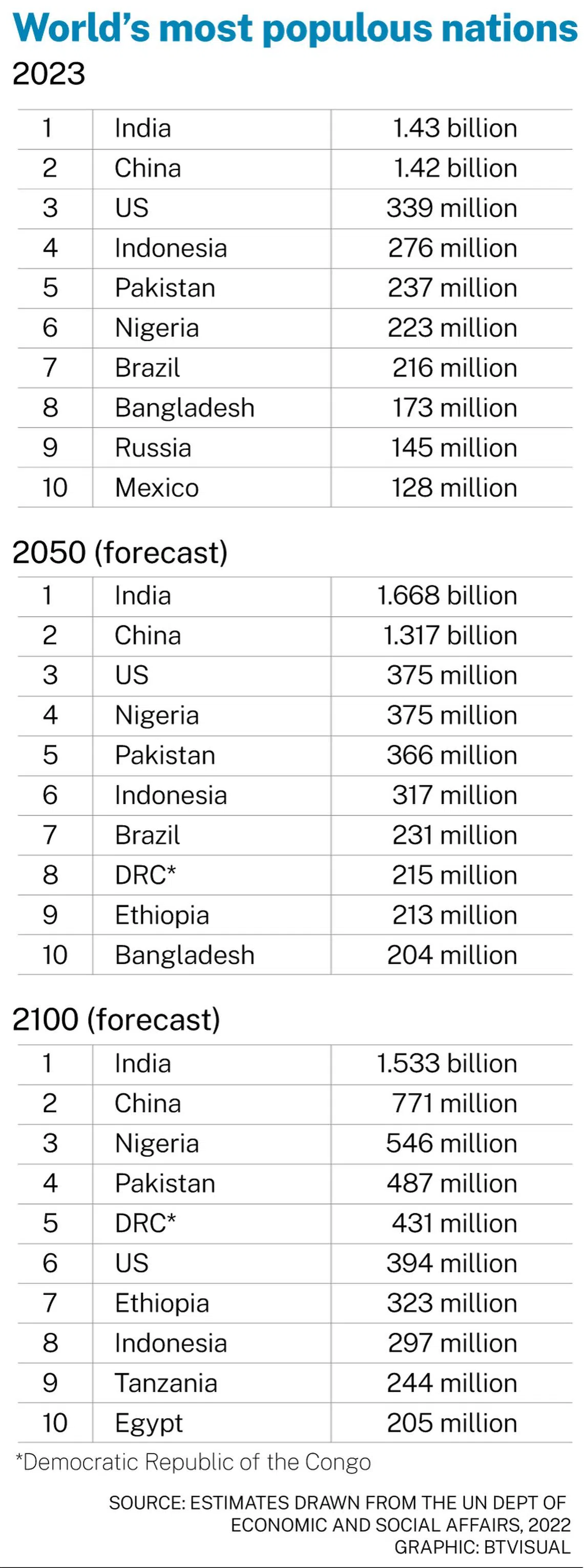
Note that while only one of the 10 largest countries in 2023 (Nigeria) is located in Africa, three of those in are projected to be in Africa in 2050, and five in 2100. Note, too, that while five of the 10 largest today are in Asia, that figure falls to four in projections for both 2050 and 2100.
Within Asia, the projected fall in China’s population is particularly striking, from 1.42 billion today to 771 million – a fall of 45 per cent – by 2100. Indeed, some projections out of China put the country’s population in 2100 lower still.
So what is the main takeaway? Acknowledging once again the contingencies involved in making long-term projections, it seems highly likely that the rest of the world is going to have to make room for Africa as the century progresses.
Asia isn’t going any place, but Africa will be increasingly important in the future, not just in terms of population, but presumably to a still-to-be-determined extent in economic, geopolitical, and cultural terms as well. Stay tuned!
Peter A Coclanis is Albert R Newsome distinguished professor of history and director of the Global Research Institute at the University of North Carolina-Chapel Hill, United States. He has lived and worked in Singapore and was Raffles professor of history at the National University of Singapore in 2005.