Planning Singapore’s industrial estates for greater sustainability
SINGAPORE stepped on the accelerator for its climate change goals when it declared net-zero emissions by 2050. Industrial estates play a big role in meeting this bold commitment, with industry and buildings collectively contributing 45 per cent to primary carbon emissions and 30 per cent to secondary emissions.
Since the 2005 launch of the Green Building Master Plan, industrial estates have made significant progress on environmental sustainability. Green Mark certifications are the norm among industrial buildings today.
This is despite the fact that such buildings present unique energy-efficiency challenges rarely seen in residential or commercial ones. Think cold rooms or server rooms that run 24/7, or cleanrooms with very high air-change rates and air filtration – all of which are energy-intensive to operate.
Achieving the highest certification in industrial buildings requires a strategic combination of technology and design solutions, such as highly efficient district cooling plants complemented by buildings designed to minimise heat transfer and optimise natural ventilation.
Substantial as existing efforts are, more is needed to drive Singapore’s pathway to net zero. For industrial estates to be future-ready, three interrelated paradigm shifts are crucial.
Three big shifts
The first shift is to adopt a whole-life carbon accounting mindset. This means looking beyond operational carbon emissions to consider both upstream embodied carbon emissions from the manufacture, transportation and installation of materials, and downstream emissions such as those from commuting, waste treatment and disposal.
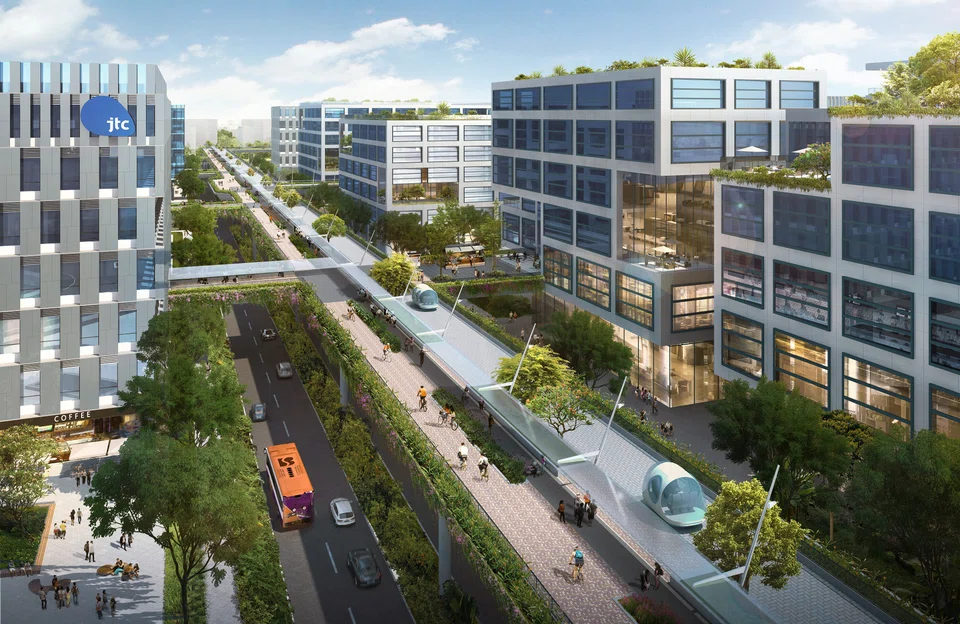
For example, JTC’s adoption of mass-engineered timber for the development of Tower 4 in Punggol Digital District meant drastic savings in embodied carbon. For buildings with higher floor-loading requirements, such as factories, scrap-produced steel could help avoid an estimated 63 per cent of embodied carbon emissions from concrete reinforcements.
We are also constructing building facades with reused materials from deconstructed older buildings. This practice could be made more commonplace in the future.
Such “waste accountability” ties in closely with the second paradigm shift: the move towards residue-to-resource circular economies.
In the city of Kalundborg in Denmark, the local power station forms the “heart” of an organically developed circular economy. Process steam generated by the station contributes 15 per cent of the city’s oil refinery’s needs, and 100 per cent of a pharmaceutical company’s needs. Gypsum residue is also delivered to a plasterboard company.
One necessary catalyst might be a matchmaker that maps out resource flows and identifies potential synergies. The matchmaker could also invest in resource conveyance – such as in South Korea’s Ulsan-Mipo Industrial Complex, where process steam is distributed via a US$90 million steam “highway” to an ecosystem of manufacturing businesses.
Quick wins in profitability will help circular economies gain traction. Perhaps Singapore’s industrial estates could develop an online estate-wide platform with a materials marketplace that serves as a “clearing house” for companies to trade residue products: from scrap metal, to construction and demolition waste, to even used office stationery.
Finally, the Internet of Things must be used to optimise sustainability performance. Sensors could be integrated with a building management system, so that air-conditioning, fresh air and lighting can be adjusted in response to occupant demands and weather conditions.
Even with these three shifts, more must be done to close the gap to net zero. Peak industrial electricity demand is one issue to be addressed.
While an industrial estate’s baseload power requirements are still drawn from the national grid, peak demands could be bridged by a combination of solar energy – stored in battery-like storage systems to eliminate intermittency even on cloudy days – and on-site ammonia or hydrogen fuel cells.
Singapore can achieve greater emissions reductions if breakthroughs are not just made technologically, but also in the master-planning of industrial estates and the ecosystem, with life-cycle thinking.
As corporate sustainability rapidly shifts from a choice to a critical necessity, the hope is that green premiums will become more widely accepted, with the aid of sustainability grants and the eventual affordability of green technologies.
The writer is a project manager at JTC