

From pros to amateurs, scalpers leave concertgoers out in the cold
From Coldplay to K-pop concerts, efforts to stamp out scalpers are far from adequate amid a post-pandemic surge in demand for live entertainment


WHEN K-pop boy band Seventeen performed in Singapore last October, Abigail (who asked to be identified only by her first name), managed to get hold of two Category 1 tickets worth S$298 each during the first round of presales.
She kept one of the tickets to the sold-out show for her friend, and resold the other for S$450 – reaping a cool 51 per cent profit with just a few clicks of the mouse. Bids for the ticket, Abigail said, reached as much as S$500.
It is not the first time she has resold tickets at a profit. Over the past few years, she has done the same for various K-pop acts such as Wanna One and NCT127, racking up profits of around S$150 to S$200 per ticket.
The process is simple: she buys the maximum number of tickets per transaction permitted by the event organiser, and posts them online for sale afterwards.
The tickets usually get swept up within three days, Abigail said. Her quickest transaction was completed in three hours.
“(I’m) placing my bets on reselling the tickets… It’s very likely that the concert tickets will be sold out, so there is extra motivation to secure more tickets to sell,” she said.
Scalpers such as Abigail are not uncommon. Some are even using ticketing bots – automated software used to purchase tickets, often in large quantities – to gain an advantage.
Industry experts noted that scalping is not a new problem. However, a post-pandemic thirst for live entertainment is driving up prices that concertgoers are willing to pay – and making it even more lucrative for scalpers.
This has also led to an increase in individuals jumping on the scalping bandwagon.
Andrew Tan, consulting partner at EY Advisory, noted that scalping has become more rampant due to an “abnormal hike” in demand for live entertainment. “There have been recent reports of scalping due to these being among the first major concerts post-pandemic, with limited concert timings,” he said.
Jennifer Pok, a ticketing consultant who was formerly senior consultant and director of ticketing for the Singapore Grand Prix, also noted a “worrying trend” of individuals – not just professional scalpers – getting into the act.
“They buy knowing they can easily resell and profit from whatever tickets are not needed, be it on reseller platforms or offline through their own private social network,” she said.
With more tickets going to scalpers out to make a quick buck, concertgoers increasingly find themselves forced to fork out more money for scalped tickets – or be left out in the cold.
Scores of disgruntled fans, many of whom were unable to purchase tickets from official channels, have taken to the Facebook and Instagram pages of concert organisers such as Live Nation, CK Star and Unusual to voice their unhappiness.
Many complained that they were in virtual queues for over an hour, only for the shows to be sold out before they reached their turn to buy. Some also noted that they were unable to cart out more than one ticket, as the system failed to allocate side-by-side seats.
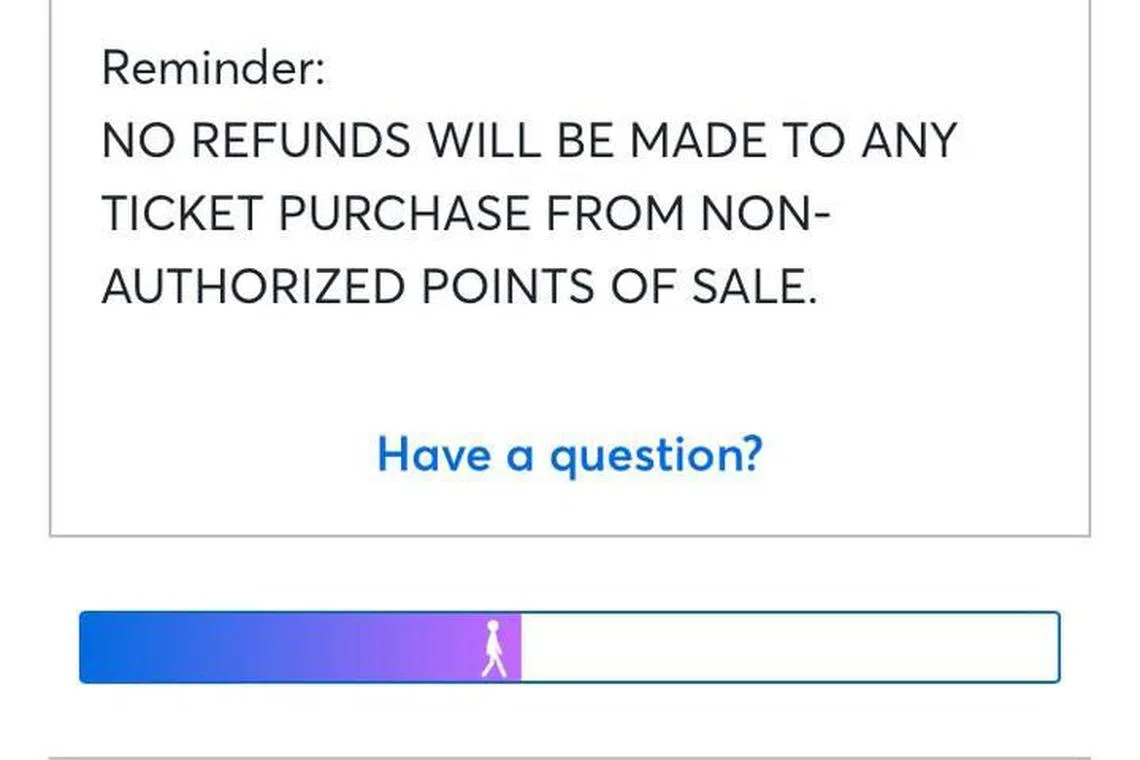
Rise of the scalpers
Joe Escobedo, adjunct professor at National University of Singapore (NUS) Business School’s department of marketing, said the increased accessibility and convenience of online platforms has made it easier for scalpers to resell tickets.
On top of this, individuals may also be incentivised to engage in scalping activities as the growing demand for popular events, coupled with limited ticket supply, result in the potential for high profits.
According to Bradley Styles, partner and head of digital trust at KPMG in Singapore, apart from ticket brokers and individual scalpers, even hospitality agencies and corporations are now turning to ticketing bots.
“There are numerous videos and articles available online on how to create a ticketing or scalping bot. Furthermore, with artificial intelligence and ChatGPT, codes can be written or even enhanced to scalp tickets,” he said.
Indeed, the rise of scalping has been fuelled by fans willing to pay a princely sum.
A 17-year-old student, who only wanted to be known as Latte, paid S$800 for a VIP ticket to Blackpink’s concert on May 14, which was originally priced at S$398.
He had already bought a Category 2 ticket, but said it was “pretty far away” from the stage. Eager for a closer view of the idols, he opted to purchase the VIP ticket from a reseller two days before the show.
Another concertgoer, who wanted to be known as Woo, also bought two tickets from a reseller to Indonesian pop singer Niki’s concert in Singapore last December for S$320 each. The tickets were retailing for S$148 apiece.
Woo said he had wanted “good” seats. But those had been snatched up before he could get to them. He eventually managed to get front row seats, and said the experience “wasn’t too bad”.
However, Woo suspects that the reseller he had purchased the tickets from had used bots to acquire the tickets, as they had multiple front row seats listed on Carousell.
“As long as there are financial incentives and a market for resale, bad actors will fill the gap to take advantage,” Styles said.
Anti-scalping attempts
Event organisers and ticketing platforms are cognisant of the harm scalping is inflicting on the industry – and are taking up different ways to prevent the practice.
For example, for some recent K-pop acts including Seventeen, Blackpink and Twice, organisers chose to hold presales reserved for registered members of the artist’s official fan club.
Ticketing sites are also able to limit the number of tickets that can be bought in a single transaction, or by a single account.
The way Sistic chief executive Joe Ow sees it, addressing the issue of scalping needs to be a collaborative effort between the ticketing platform and event promoters.
The Singapore-based ticketing platform implements a multi-layered defence system that include secure ticketing systems and anti-bot measures such as captcha verification. Sistic also employs virtual waiting rooms, and requires buyers to log in before they can purchase a ticket.
Other options that organisers can use include using dynamic barcodes, printing of names on the tickets, and delaying ticket delivery.
For Jacky Cheung’s concerts in Singapore, for example, event organiser Unusual is withholding the delivery of tickets until a few weeks before the show. This means that buyers only receive a receipt of their purchase.
This may deter buyers from purchasing from resellers as there no physical tickets yet, noted Unusual chief executive Leslie Ong.
Ong said the company also prints the buyer’s name on each ticket, so it can perform random checks at the entrance.
Ong said organisers are somewhat reliant on the technologies provided by the ticketing platform, adding: “We can only do as much, so we need the authorities to come and help us… This is getting a little bit out of hand.”

Likewise, ticketing consultant Pok, who was also the founding CEO of Sistic, noted that event promoters and existing ticketing platforms have limited capacity to stop scalping.
For example, measures like invalidating tickets on resale platforms will only work if the ticket ID can be identified, she said. Companies also have to constantly invest in system upgrades to prevent attacks by more sophisticated bots, Pok added.
But the authorities may also have their hands tied.
In a reply to a question in Parliament in 2019, the Ministry of Trade and Industry said the Singapore government should not prescribe profit margins for ticket reselling. It added that the margin which resellers can command is freely determined between willing buyers and sellers.
Consumers can lodge a complaint with the Consumers Association of Singapore (Case), but only if they believe that the sellers have engaged in unfair trading practices, such as false and misleading claims.
Elsewhere, some governments have enacted laws prohibiting scalping-related activities.
South Australia’s Major Events Act ensures that, if an event is declared as a major event by the government, it would be illegal to sell or advertise for resale tickets for more than 10 per cent above its purchase value.
Hong Kong also has anti-scalping legislation contained in the Places of Public Entertainment Ordinance.
Closer to home, a Malaysia minister noted that an anti-scalping law could be in the works after tickets to popular British band Coldplay’s first show in the country were being resold for thousands of ringgit.

But Lee Ee Yang, managing director of law firm Covenant Chambers, noted that people are still openly flouting anti-scalping rules by organisers due to the lack of robust enforcement measures in place.
Anti-scalping legislation may also not be as effective without an enforcement body that is specially set up to look into cases, he said.
“The effectiveness of anti-scalping laws largely depend on it acting as a deterrent factor and whether there is strong enforcement to curb illegal behaviour,” Lee said
Felicia Tan, a partner for litigation and dispute resolution at law firm TSMP, added that concert tickets are more like luxury goods. As such, she said, it is not unreasonable for fans to resell them at whatever margin the market will bear.
The real problem, she believes, arises when the buyers are bots programmed to scoop up the maximum number of tickets.
If legislation is put in place, it should target such bots rather than set a limit on resale pricing of concert tickets, Tan said.
Looking for solutions
Meanwhile, the furore over scalpers have led to online petitions asking for organisers to implement a “Singpass presale” – a day of ticketing reserved for Singaporean fans, verified through their Singapore Personal Access (or Singpass) accounts.
Technically, this is possible to be implemented.
Walter Theseira, associate professor of economics at the Singapore University of Social Sciences (SUSS), said: “A concert ticket is a price contract between the concert promoter and the customer, and I don’t think this prevents the concert promoter from issuing it on a restricted basis, such as to have an identification number or a name associated with it.”
KPMG’s Styles also noted that Singapore has an exceptional national identification system, thus leveraging ID tagging for tickets can be possible if certain considerations are addressed.
However, EY’s Tan said a non-transferrable ID-based purchase would create inconvenience that might dampen sales. This might be a risk that organisers may not be willing to take, he said.
This would also unduly penalise non-Singpass holders, such as foreign visitors, who may be keen to attend the concert, he added.
At the same time, TSMP’s Tan expects the logistical requirements for name-registered tickets would be onerous.
Furthermore, having the concert in high demand may not be a bad outcome for organisers, as it drives up the popularity and profile of the concert, which could potentially drive up future ticket prices, she said.
Unusual’s Ong noted that Singpass is generally used for official or government related sites, while ticketing companies are private entities. “It is hard to see this happening anytime soon,” he added.
One potential solution, said KPMG’s Styles, could be to use non-fungible tokens (NFTs) to verify ticket authenticity and ownership. This could potentially offer a less intrusive method from a privacy standpoint while effectively ensuring the integrity of ticket transactions.
EY’s Tan also suggested a three-category system for ticket purchases: one for ID-based non-transferrable tickets, one for ID-based transferrable tickets where an individual can purchase a limited number of tickets for friends and family, and an open category with variable demand-based pricing to cater to public or tourists.
Nevertheless, ticketing consultant Pok expects the battle against scalpers would require commitment and concerted involvement by all industry partners, as well as the understanding and cooperation of ticket buyers.
For example, individuals may have to register themselves on a secure platform, hold a secure and non-transferable ticket in a wallet which is accessible only by the ticket holder, and only resell to other buyers or the organiser through an authorised channel.
These are tried and tested formulae. Some South Korea-based ticketing platforms such as Interpark and Auction Ticket allow buyers to receive a full refund on their tickets if they were returned to the organiser within the first few hours of the ticket sale. The amount that is refunded to buyers decreases as the show date approaches.
In Japan, organisers also distribute some tickets through fan club ballots, where certain tickets can only be purchased if the buyer is a member of the fan club.
While Unusual continues to improve its current anti-scalping measures, Ong said the organiser is also “open to exploring” ticketing platforms with better anti-scalping protocols that may not be in Singapore now.
However, SUSS’ Theseira noted that there is little to bar the organisers from implementing solutions to limit scalping: “I think the technological and contractual options are all there. It’s just a matter of whether you want to do so.”
He noted that scalping may only affect a small number of events that the concert promoters organise, resulting in an out-of-proportion outcry of anger.
Theseira said: “Why will (the organisers) want to invest in a very potentially costly verification procedure for a tiny fraction of the events which are the ones with the problems?”
TRENDING NOW

Companies still in search of AI use cases with worthwhile ROI, says Broadcom’s CEO

Malaysian king buys stake in Singapore-listed mining firm expanding into rare earths

Once staunchly pro-China, Malaysian Chinese businesses are now distancing themselves from Beijing

Singapore’s wealth management success should extend to everyday families

