

The real shine behind Singapore’s golden ambitions is not in gold’s meteoric price increase
Investors are faring well with listed gold counters hitting fresh highs, but the Republic is also aiming to benefit with the region’s ultimate vault

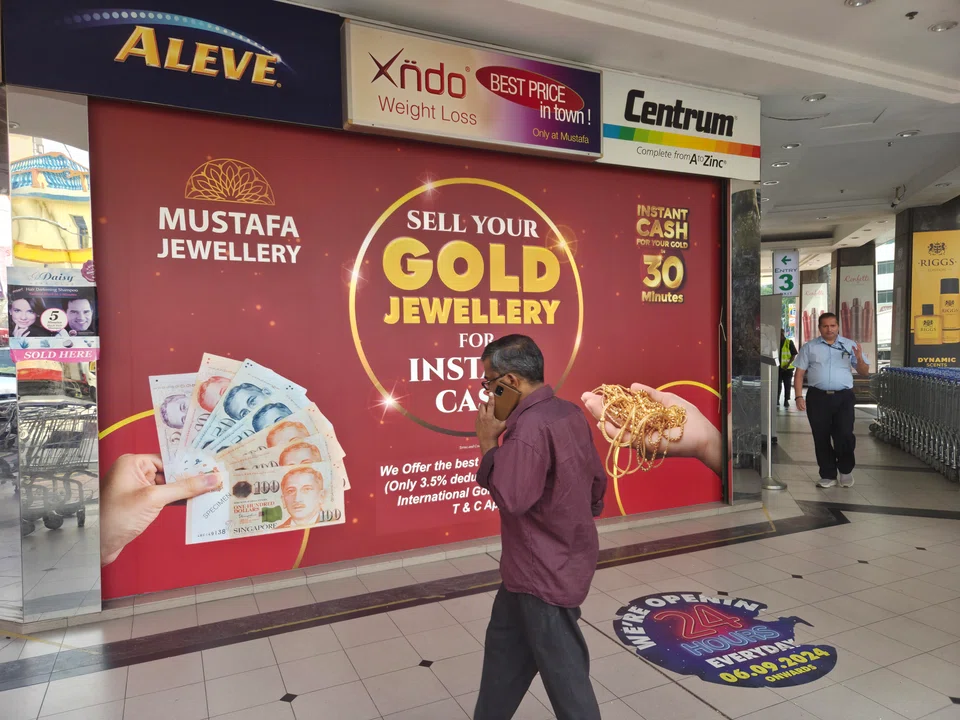
[SINGAPORE] Take a walk through Singapore’s Little India this week, and the giant billboards tell a very clear story. Pawnshops and jewellers are aggressively advertising to buy back gold, capitalising on a global boom that has retail investors cashing in their chains and bangles at record prices.
To understand why the aunties are selling, look at the maths.
Gold has been on a historic, gravity-defying tear. In 2024, it climbed steadily. In 2025, it shattered records, surging past US$4,000 an ounce. Going into 2026, it breached the psychological US$5,000 mark.
Sure, gold prices have recently pulled back on rising inflationary pressures, a stronger US dollar, and fading bets on US Federal Reserve rate cuts.
But driven by geopolitical shocks and relentless central bank hoarding, the metal has delivered returns that make traditional safe havens look tame. And the effects have rippled through the local bourse.
Gold proxies listed on the Singapore Exchange (SGX) are having the time of their lives. Look at Catalist-listed CNMC Goldmine , which digs for gold in neighbouring Malaysia. Over the past year, the miner saw its share price skyrocket by more than 322.5 per cent as its production earnings surged.
Riding the tailwind
The local pawnbrokers are also quietly cashing in. Companies such as MoneyMax Financial Services and ValueMax Group hold massive inventories of the yellow metal as collateral for cash loans. As global bullion prices balloon, the underlying value of their locked-up assets explodes.
Consequently, MoneyMax shares have surged 269.4 per cent in the past year, while ValueMax shares have more than doubled. They are riding the ultimate tailwind.
To the retail investor, it is simply a matter of selling high. Yet, step away from the bustling shophouses and into the air-conditioned boardrooms of Raffles Place, and you realise the real gold rush is not about jewellery at all.
It is about infrastructure – the quiet, high-stakes race to become the region’s ultimate vault.
The Monetary Authority of Singapore (MAS) and the Singapore Bullion Market Association (SBMA) last week laid out a blueprint to cement the city-state as a trusted gold trading centre for the Asia-Pacific region. The strategy aims to capture the growing investor appetite for vaulting and trading the precious metal locally.
The official statements hit all the right corporate notes. The focus will be on developing gold-related capital market products to facilitate price discovery and build liquidity. They want internationally aligned standards for vaulting. They are creating a secure clearing system for trading large bars and kilobars.
Crucially, MAS itself will look to provide vaulting services for foreign central banks and sovereign entities.
The machinery is already moving. Just one day before the MAS announcement, OCBC subsidiary Lion Global Investors listed the LionGlobal Singapore Physical Gold ETF on the local exchange. It is the country’s first home-grown exchange-traded fund (ETF) backed entirely by physical bullion stored securely in local vaults.
To the retail investor, the ETF looks like a convenient way to play the gold boom without having to buy a heavy home safe. But to the financial ecosystem, it is a masterclass in capital capture.
The fund debuted with roughly half a billion dollars in assets. That means half a billion dollars of physical wealth is now permanently anchored in a Singaporean vault.
Retail investors get their paper exposure, but local custodians, SGX and the fund managers lock in the fees, the trading liquidity and the physical collateral.
On paper, this all looks like standard financial hub housekeeping. But pan out across South-east Asia, and the underlying tension becomes obvious.
Hedging against geopolitical volatility
Central banks, particularly in emerging markets, are hoarding bullion at an unprecedented pace as a hedge against geopolitical volatility and US dollar dominance. Consequently, neighbouring countries are fiercely scrambling to control these lucrative capital flows.
Over in Thailand, the game is about pricing power. Major corporate dealers such as Hua Seng Heng and YLG Bullion are backing the Thailand Futures Exchange in a bid to launch a regional benchmark price. They hope to transform Bangkok into the undisputed wholesale hub.
Meanwhile, Vietnam is taking a heavy-handed approach to domesticate its notoriously unruly gold market.
Hanoi recently rolled out strict decrees that slap massive fines on unlicensed cash trades. This includes the clamping down on exchanging foreign currency at unlicensed locations such as unauthorised jewellery shops.
In this way, the country is forcing informal transactions into the formal banking sector to establish state control.
Farther north, Hong Kong is also reportedly wooing a number of China-friendly central banks to participate in its gold-clearing system as part of a push to elevate the city as a major bullion-trading hub that could serve as an alternative to London.
So, why is Singapore suddenly accelerating its own bullion infrastructure? The answer could be not just about capturing trading fees, but more about geopolitical leverage and extreme financial stickiness.
When a foreign central bank decides to park its sovereign gold reserves in an MAS vault, it is doing more than renting secure basement space. It is deeply integrating its national wealth into Singapore’s legal and financial ecosystem.
This brings massive downstream benefits to the private-sector players steering this initiative.
For domestic heavyweights sitting on the MAS and SBMA’s Gold Market Development Working Group – institutions such as DBS , UOB and SGX Group – anchoring physical gold locally means securing the ultimate foundational asset. It is the perfect pristine collateral to build complex derivatives and financing products around.
They are not competing with the pawnshops in Little India. They are locking horns with London and Hong Kong for the right to hold the world’s wealth.
Retail investors often view gold as a simple, shiny asset to trade during a crisis. But the state and the corporate giants see something far more durable. As global trade remains fractured, gold has reclaimed its status as the ultimate neutral asset.
In this new era of sovereign wealth, the real power does not belong to the people buying the gold. It belongs to the people who own the vault.
TRENDING NOW

LTA proposes combining car COE categories, adding rebate-surcharge system

StarHub to acquire MyRepublic’s mobile business amid ongoing telco consolidation

DBS, OCBC, UOB rout lops billions off STI as inflation, rate concerns spook investors

Grab CEO’s wife Chloe Tong on life with Anthony Tan and finding her purpose

