

Saying yes, for less: Why lab-grown diamonds have cornered 80% of the engagement ring market
New-age diamond ring retailers have business models that are leaner, faster and unburdened by mined inventory
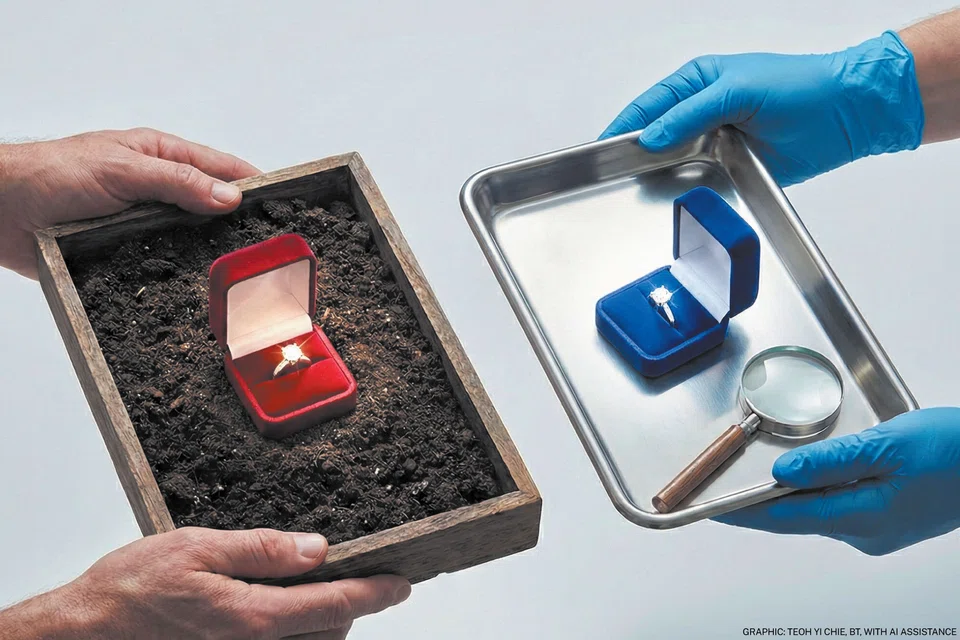
[SINGAPORE] For decades, the mined diamond was the undisputed centrepiece of a marriage proposal, including in Singapore. But pragmatic couples are breaking with tradition by opting for lab-grown stones instead.
Lab-grown diamonds now account for about 80 per cent of engagement ring sales, jewellery stores across the island tell The Business Times.
Part of a worldwide trend, the transition was helped along by the US Federal Trade Commission, which in 2018 stopped defining a diamond as strictly “natural”.
Since then, consumers seem to have agreed. Mining titan De Beers has had to slash prices in late 2024 and again this January, after reporting in 2025 that it was holding on to some US$2 billion in unsold stones.
With jewellers noting that mined and lab-grown diamonds cannot be told apart without specialised machinery, cost is the biggest differentiator. A 1-carat mined diamond typically retails for S$8,000 to S$10,000, while a lab-grown stone of identical quality can cost around S$1,500, notes JannPaul founder Paul Hung.
And while lab-grown diamonds once suffered the stigma of being artificial, unethical mining practices have caused “natural” diamonds to lose their sparkle instead.
The rise of the lab
Lab-grown diamonds hit the Singapore market in November 2019, with SK Jewellery claiming to be the “first jewellery chain retailer in the region” to sell the alternative stone.
At the time, about 50 to 70 per cent of engagement ring buyers made the switch. Today, the range is 80 to 90 per cent for SK Jewellery, says general manager Angelina Lau.
The trend is mirrored across the industry. At other retailers, lab-grown stones now account for anywhere from 80 to 99 per cent of engagement ring sales.
Some boutique jewellers do not even offer mined diamonds. Sam & J Fine Jewellery, founded in 2019, exclusively stocks lab-grown diamonds.
The aim, says co-founder Sam Png, is to offer young couples an alternative that does not require them to “spend a fortune” or worry about murky supply chains.
Lab-grown diamonds are not just growing their market share, but enabling overall growth.
Globally, the diamond jewellery market was valued at roughly US$90 billion in 2023, according to Grand View Research, with Asia-Pacific being the largest market in 2022.
Singapore’s domestic diamond jewellery market, meanwhile, is expected to surpass US$830 million in the next decade, up from roughly US$580 million today, estimates market intelligence firm Deep Market Insights.
SK Jewellery’s Lau says that one way to gauge how the sales of engagement rings are faring is to look at the number of marriages, which fell 6.2 per cent to 24,687 in 2025.
While retailers like SK Jewellery report massive lab-grown adoption, traditionalists argue the shift is overstated. Suresh Hathiramani, a 45-year industry veteran and founder of diamond wholesaler Facets Singapore, estimates that lab-grown engagement rings actually account for just 25 to 30 per cent of the local market in terms of pieces sold, and only 10 to 15 per cent in terms of value.

Value diamond
Lab-grown diamonds offer a far better value proposition for many couples, says SK Jewellery’s Lau.
For about S$3,000, couples can get either a modest 0.3-carat mined diamond, or a lab-grown stone of one-carat or greater, she notes.
Alternatively, couples can spend the same amount and get a smaller lab-grown stone but more intricate ring settings, such as bands embedded with side-diamonds.
Fancier designs are also growing more popular, notes JannPaul’s Hung, who attributes this to changing buyer demographics.
Traditionally, 90 per cent of his clients were men buying alone. Today, that number has shrunk to a mere 10 per cent.
Instead, couples often shop together – often after securing a Build-To-Order HDB flat – with women driving the decision-making.
This has increased demand for unique designs, with cuts like ovals and pears rising in popularity over the standard round cut, says Hung.
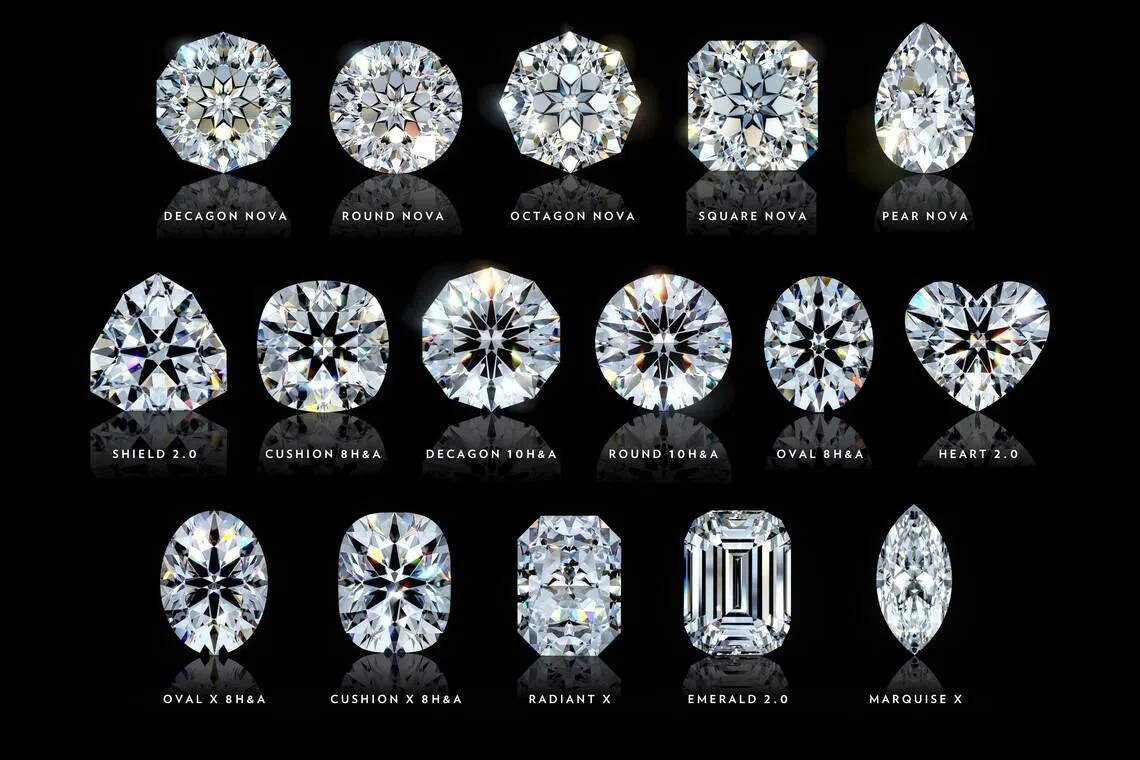
Lab-grown diamonds are well-positioned to meet this demand. Because lab-grown rough diamonds are significantly cheaper than mined ones, jewellers can finally afford the high material wastage required to cut these “fancy shapes,” indicates SK Jewellery’s Lau.
Some buyers also see the choice as an ethical one, with younger couples being conscious of the ecological damage caused by mining, said Sam & J’s Png.
Hung, however, points out that lab-grown diamonds have a sizeable carbon footprint as their production consumes immense amounts of energy.
“I think the word ‘ethical’ is being thrown around a lot as an excuse for the budget,” says Hung. “Because if you say ‘because of price’, it sounds cheap.”
Regardless, the death-knell for the mined diamond may be the shattering of the “investment” belief that such stones are worthwhile assets.
Boutique jeweller Diamond Ateliers’ founder Don Siah notes that mined diamond prices have plummeted by some 50 to 60 per cent recently.

Customers are now more “well-informed” about the lack of a secondary market for diamond engagement rings, says Hung.
The market, too, is acknowledging this reality. Long-established chain Lee Hwa Jewellery largely no longer offers trade-ins for diamonds, citing the falling prices of the stones.
With mined diamonds no longer seen as a store of value, the low cost of lab-grown stones becomes an even greater advantage.
Savings from the ring can then go towards the proposal, notes Siah.
“I know a lot of people go (to the) Northern Lights. Right now... people are spending like S$3,000 to S$4,000 on the ring, and then they’re going to spend S$3,000 to S$4,000 on the holiday proposal. We are seeing a shift in prioritising experiences.”
For Scoot pilot Jirel Yu and his now-wife, a strict budget took priority over an expensive engagement ring as he was still paying a hefty sum for his flight training.
Preferring experiences over assets, the couple also eschewed luxury brands entirely, opting to hand-craft their own silver and gold wedding bands at a local artisan workshop.
This view is echoed by Thales doctoral student Arya Chowdhury. He and his fiancee set out to buy a lab-grown diamond as the price tag of a mined ring clashed with saving for a future home, though they eventually settled on a lab-grown morganite gemstone.
The zero-inventory advantage

To ride this wave of cost-conscious customers, a new generation of jewellers has emerged.
Unlike established chains, players such as Diamond Ateliers, Sam & J, and Cherish & Co Bespoke Diamonds were born in the lab-grown era.
This has allowed them to build business models that are leaner, faster and unburdened by mined diamond inventory.
Traditional retailers are often sitting on millions of dollars of mined diamond inventory purchased years ago at high prices, explains Siah.
“Basically, everyone’s a loser in the diamond world,” says Siah, referring to the mined inventory. “The moment you hold it, you have a 50 per cent haircut. It’s like a stock portfolio... Are you going to write it off?”
Cheryl Quan, a marketing executive at Lee Hwa Jewellery parent Aspial Corporation, acknowledges this issue. The chain is still clearing certain mined diamond lines purchased years ago, sometimes at 60 per cent discounts. (*see amendment note)
This is despite the fact that 70 per cent of its clients are above 35 and prefer mined stones.
New entrants sidestep the legacy-store trap entirely by operating on a zero-inventory model. Instead of keeping hundreds of diamonds in a vault, they source stones on demand.
“We don’t hold inventory,” says Siah. “We create every single piece from scratch.”
Diamonds... a commodity?

Zero-inventory agility allows boutique jewellers to pass savings directly to the consumer. But cheaper stones have also forced a change in jewellers’ value proposition.
“People are treating the diamond as just a mere commodity,” says Siah. “It used to be like diamonds are very special – you take months to decide on a diamond, because the diamond itself can be 80 to 90 per cent of the price of the ring.”
But with lab-grown diamonds being identical and widely available, jewellers have to differentiate themselves otherwise.
Cut quality is one way, notes JannPaul’s Hung.
“What consumers want is something different,” he says. “In the lab-grown industry, everything is the same... The only way to differentiate is to produce the highest quality material yourself.”
Another frontline in the battlefield is design.
Says Siah: “As the price (of diamonds) goes down, a lot of people are focusing a lot more on the ring design. That’s where the bespoke trend is coming in really strong.”
Former cabin crew member Jovial Victoria founded Cherish & Co last May to make the “dream ring” accessible to younger couples.
Her clients often have non-traditional requests that are discouraged by mass-market chains relying on pre-set inventory. Boutiques such as hers can fill this niche.
However, new boutiques could face one significant hurdle: trust.
“They would be asking for your MinLaw (Ministry of Law) licence, they’ll be asking for all these things,” says Victoria. “I try to reassure them... I understand we cannot fight with the bigger boys, but we just try our best in terms of price point.”
Lau notes that while SK Jewellery has adapted to lab-grown trends, its primary value proposition remains stability.
“If I buy from you and I’m going to wear my ring for 20, 30 years... we are still here,” she says. “That’s the value-add a trusted retailer has.”
And just as a majority of Lee Hwa Jewellery’s clients still prefer mined stones, so do some traditionalists in the industry.
Hathiramani dismisses lab-grown stones as merely “synthetics” riding on the coattails of the “natural” diamond’s 150-year heritage.
The collapse in wholesale prices of lab-grown stones – from a high of US$2,500 per carat in 2019 to under US$100 today – may make them more affordable, but is also proof that they lack inherent value, he argues.
“Can a US$399 proposal ring, which equates to the price of a fine dining dinner for two, really be a symbol of lifelong commitment?” asks Hathiramani.
Natural selection

While legacy brands like Lee Hwa continue to serve an older demographic loyal to mined diamonds, the lab-grown revolution – coupled with soaring gold prices – is rewriting Singaporean wedding traditions.
Take the Chinese custom of “si dian jin”, or “four pieces of gold”. A traditional four-piece solid gold set cost around S$5,000 to S$6,000 a few years ago, but may now command S$20,000 or more, notes Siah.
To manage costs, families are increasingly substituting one or more heavy gold pieces with lab-grown diamond jewellery.
SK Jewellery has seen a similar shift in buying patterns. As a traditional S$5,000 budget buys a “very, very tiny” amount of gold today, brides are asking their parents for modern pieces they can wear to work, says Lau.
Cherish & Co’s Victoria echoes this, noting that heavy bridal gold is losing its appeal.
“You’ll never wear it out,” she says of the traditional sets. “So many times, you receive it and it just goes straight into your safety box.”
This budget consciousness is also prompting a paradigm shift in ring metals. With gold hitting record highs, price-sensitive buyers are migrating towards platinum.
Just two years ago, gold dominated platinum as an engagement ring choice at a nine-to-one ratio, says JannPaul’s Hung. Today, that has narrowed to seven-to-three.
Looking ahead, he sees little relief for the mined diamond sector.
“There’s nothing showing in the next two to three years… that’s doing anything significant to make a change in the natural industry,” Hung says.
With mined stones still having their loyalists, he expects the current eight-to-one ratio of lab-grown to mined diamonds to hold steady.
But the volume of lab-grown sales will likely surge, he adds. For natural diamonds to retain market share, Hung argues prices must drop to a psychological threshold of around S$3,500 per carat.
Meanwhile, off-the-shelf retail rings may lose their lustre as consumers demand differentiation, says Hung.
The desire for uniqueness has pushed the bespoke market to new heights, with clients now requesting diamonds cut specifically for their ring’s design, or copies of pieces worn by celebrities such as Taylor Swift, he adds.
For the current generation of buyers, the diamond may have evolved from a financial asset into more of an aesthetic and emotional one.
“Off-shelf stuff is not doing well anymore,” notes Hung, observing that buyers are abandoning the traditional round diamond. “Everybody wants now to express themselves differently.”
Amendment note: A previous version of the story incorrectly stated Cheryl Quan’s role as a brand manager at Lee Hwa Jewellery.
TRENDING NOW

S$8 billion wiped off OCBC value as shares slide 5.8% in heavy trade
Grab CEO’s wife Chloe Tong on life with Anthony Tan and finding her purpose

Brookfield denies accusation it cut Soilbuild out of Mapletree deal

8 public officers referred to police over property buys near unannounced MRT stations: Chan Chun Sing

