Succession in Singapore: Is the era of family empires coming to an end?
More dynasty businesses may have to hand over the reins to outsiders – but that does not have to be cause for concern


[SINGAPORE] “Popiah King” Sam Goi’s son Kenneth Goi was recently appointed chief executive of PSC Corporation , and will head it from May 5.
The listed company, a consumer goods distributor and manufacturer, is one of several in the elder Goi’s empire.
The move may be seen as part of a long tradition of family businesses being passed on to the next generation, not least in Asia.
Yet, succession does not always continue beyond the second generation. Some empires are soon handed over to non-relations, as younger heirs prefer careers of their own.
Shrinking family sizes and a greater focus on corporate governance could make it even harder to build a dynasty.
What is the future of the family business empire in Singapore? Is Goi’s recent handover a sign of a tradition still being preserved, or one of the last examples of a fading trend?
All in the family
Apart from PSC Corporation, the elder Goi’s empire includes flagship privately held food manufacturing company Tee Yih Jia, listed packaging company Tat Seng Packaging , and listed property player GSH Corporation .
The responsibility of continuing the family legacy is shared among the Goi siblings. They were immersed in Tee Yih Jia’s business from an early age, with tasks such as stocking supermarket shelves and making deliveries.
One of Goi’s daughters, Laureen, is now the general manager of Tee Yih Jia. Besides taking over PSC, her younger brother Kenneth is also the chief operating officer of GSH.
Goi’s youngest son, Ben, previously ran Tee Yih Jia before his death in 2019.
The elder sister, Lang Peng, seems to be an exception. She was a marketing manager at Tee Yih Jia from 1996 to 2002, but has since worked in education – though she also had a stint as a non-executive director at KOP , a company controlled by the patriarch, till 2023.

Another well-known local business dynasty is construction and civil engineering behemoth Woh Hup, founded in 1927 by Yong Yit Lin. The privately held group has reshaped Singapore’s landscape with iconic developments such as Gardens by the Bay.
Current chairman Kim Yong is the third generation to lead the company. In an interview in 2022, he recalled originally telling his daughter Michelle not to join the family business – though he expected his son Neil to do so.
His rationale was that he did not want to risk both children joining Woh Hup at a time when its financials were not stellar.
Eventually, when the company was making more stable profits, Yong invited Michelle on board. She now works at a property development subsidiary of the group.
Going solo
Other empires may not be handed down beyond the third or even second generation, as scions pursue very different ventures.
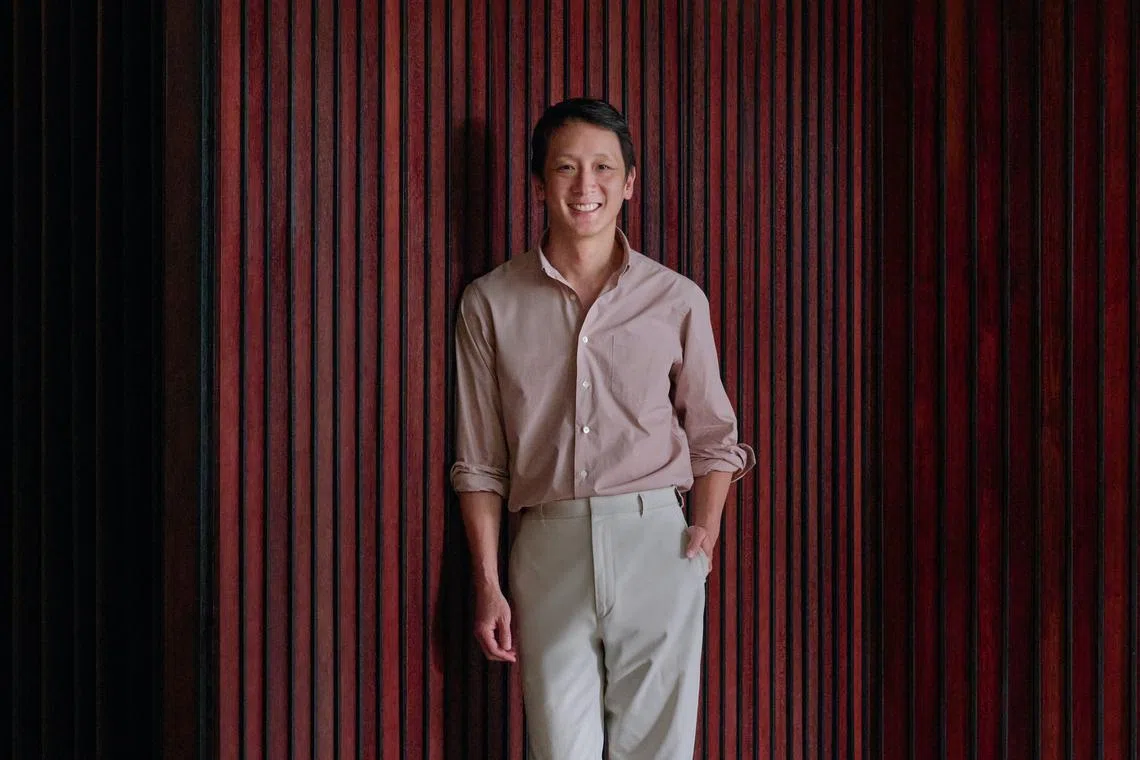
One case in point is 91-year-old banking empire UOB , now helmed by third-generation leader Wee Ee Cheong.
After the 73-year-old CEO relinquishes the role, the bank will likely be run by a family outsider. None of Wee’s three children are currently working for the listed lender.
Eldest son Wee Teng Wen is managing a company that he founded himself: food and hospitality group Lo & Behold. Younger brother Teng Chuen is an executive director of a fund manager, while youngest child Grant founded wellness company The Trapeze Group.
In a 2022 interview with The Business Times, Wee Ee Cheong said he would not make his children work at UOB if they were not interested, adding: “I want them to be happy.”
Eventually, his children can sit on the board as major shareholders, if they are keen, he said.
Succession challenges
At UOB, the fourth generation has begun to pursue their own interests. For other businesses, that shift may begin earlier – despite the founders’ wishes.
In a study by UOB, Boston Consulting Group and the National University of Singapore Business School, published last November, 91 per cent of first-generation wealth holders said they wanted business leadership to stay within the family.
Many founders resist turning over their businesses to professional management, because they fear outsiders could misuse resources or dilute family influence.
The report showed that founding patriarchs, often over 60 in age, intertwine their businesses with family identity, and favour continuity within the family.
However, nearly a quarter of respondents said that their heirs were not interested in taking over.
Rather, the next generation appear to prioritise personal ambitions – such as starting their own ventures and pursuing social impact – over preservation of the family business.
Lau Kong Cheen, an associate professor at the Singapore University of Social Sciences (SUSS) School of Business, says it is becoming harder for Asian business dynasties to continue beyond three generations.
Dynasties increasingly face succession challenges such as shrinking family sizes and lack of interest among family members.
Large families in Asia traditionally provided a wide pool of potential successors, he points out. “Today, however, family sizes are shrinking in countries such as Singapore and China, limiting the options for succession.”
He adds: “With fewer heirs, identifying a capable successor becomes more difficult. In cases where no suitable candidate emerges, owners are often forced to sell the business or transition to professional management.”
Asian family empires that have made that transition include Tata Group, Wipro and OCBC .
Founded in 1868, Tata Group is India’s largest multinational conglomerate. Family leadership lasted till the end of the fifth generation’s stint in 2012.
At Indian IT heavyweight Wipro, established in 1945, chairmanship has passed to the founder’s son – but its CEOs have not been family members.
OCBC, Singapore’s second-largest financial services group by total assets, was formed in 1932 with the merger of three local banks. Founder Lee Kong Chian handed down the CEO role only as far as his son, though his grandson is on the board of directors.
In terms of how family businesses have developed historically, Singapore’s experience is similar to that of the broader South-east Asian region, says Marleen Dieleman, a professor of family business at IMD, a business school.
Many entrepreneurs started their businesses after World War II, and family leadership is now transitioning from the second to the third generation, she says.
“The overall progression is similar: When your family grows, you will likely have to deal with fragmented voting power and more diverse opinions,” she adds.

Not dying out, but evolving
But shifting to professional management does not have to be viewed as a loss for the family.
“The dynasty model isn’t failing, but evolving,” says Ben Charoenwong, an associate professor of finance at Insead. “And that evolution may be a good thing.”
One reason that family ownership and family management were historically tied together is that “external governance” was not as good, he notes.
He also highlights an inherent tension in building generational wealth: Families want to “perpetuate an enterprise that creates wealth, value and resources”, but also give future generations the resources to choose a different life.
The latter includes granting scions the option to leave the family business. And it might well be better for unwilling heirs to do so, rather than be forced to inherit a role.
Prof Charoenwong cites a paper co-authored by Insead Visiting Professor Morten Bennedsen. Drawing on Danish data, it found that handing the CEO seat to a blood heir results in operating profitability falling by at least four percentage points, relative to a professional manager.
However, it identified the reason as nepotistic selection, not family control itself. When families select successors for capability rather than bloodline, this negative effect disappears.
“A scion who opts out of the family business is therefore not a succession failure,” Prof Charoenwong says. “It is the other kind of success – avoiding potential losses from forcing unwilling offspring into the family enterprise.”
About 30 per cent of family businesses make it to the second generation, around 12 per cent to the third, and only 3 to 5 per cent beyond that, he notes.
Meanwhile, a Chinese University of Hong Kong Business School study of 217 Chinese-run listed companies – across Hong Kong, Singapore and Taiwan – found that 56 per cent of a family company’s market value is lost in the years surrounding a succession transition.
In Singapore, there “may be very little room to absorb a generation of weak management”, he adds.
Compared with China, where “billionaires are still overwhelmingly first-generation”, Singapore is further along in the transition, he notes. Some business empires here are into their third generation and going towards the fourth, which now presents “the real test”.

“I don’t think it’s an issue about the model of family businesses as much as life-cycle dynamics across Asian countries,” the academic adds.
Today, founding families are “long-horizon anchor shareholders” through direct or indirect ownership, while professionals run operations. “This seems (to be) a value-enhancing model evolution for all involved.”
The UOB question
UOB is an example of a high-profile dynasty where leadership is likely to be passed outside the family after the current head retires. Watchers do not see this as cause for concern.
Running a bank like UOB requires advanced technical and leadership skill sets. When heirs lack the passion or the capabilities, outside management is a logical option, says Prof Dieleman from IMD.
Instead of keeping heirs in the business, owners can provide entrepreneurship and capital for family members to start new companies in promising industries, she suggests.
“This way, the family’s ownership and entrepreneurial talent is leveraged while also ensuring that the legacy business is in safe hands.”
UOB is a “solid family business” that has thrived under multiple generations of leadership, she adds – and even if the younger generation is not keen on banking, they can steward this legacy in other ways.
“The Wee family has always managed a diversified portfolio of successful businesses across three generations. Banking is an important pillar, but not the only one,” she says.
“The family also has successful hospitality and real estate businesses. I trust the family will continue to renew and build the portfolio over time.”
Investment research firm Morningstar has a positive view of Wee Ee Cheong’s preference for a successor from within UOB, says analyst Kathy Chan.
This is because of “implied familiarity with the group operations, alignment with UOB’s regional growth strategy, and established working relationships across the organisation”.
The research house’s base case is “a smooth transition in the medium term”, she adds, though there are downside risks such as prolonged leadership uncertainty due to a delayed appointment, and a pivot away from the bank’s current strategy.
For SUSS’ Prof Lau, what matters is the appointment of a competent successor who not only embraces UOB’s values, but also has a track record in leading financial institutions.
Prof Charoenwong says: “The variable that has actually mattered historically is not who sits in the corner office, but whether the Wee family stays engaged as the anchor long-horizon shareholder.”
UOB’s family-anchored nature is the reason it can trade “short-run earnings for long-run resilience on a horizon that quarterly managed institutions find difficult to commit to”, he explains.
“A board with a 90-year family stake will tolerate that trade; one whose largest shareholder is a quarterly benchmarked index fund will not. So, the governance structure may actually allow more decisive moves.”
Existing research suggests that a separation between family identity and operating roles is healthier and better for the firm, he adds.
“The real concern would be if the family sold down or left the board, because UOB would then lose the patient-capital orientation that has been its edge. Monitor the cap table and the board, not the CEO’s last name.”
Kenneth Goh, an associate professor of strategy and entrepreneurship at Singapore Management University, says shareholders should be concerned only if the succession process is weak, opaque or driven by sentiment rather than merit.
“UOB has formal governance structures, including an independent chairman, a majority-independent board and formal board-level succession oversight,” he notes.
“Members of the Wee family remain significant shareholders, so professional management would not necessarily mean the end of family stewardship.”
Keeping it together
Many Asian business families are becoming more sophisticated about governance, Prof Goh adds.
They have better structures, more ways to communicate, and better technology to coordinate and oversee businesses across geographies.
“So the future may not mean less family control, but families becoming better at governing complexity by being more intentional about how they stay aligned, make decisions, and hold things together across generations and borders.”
Prof Dieleman says the biggest danger for third-generation family businesses is not a volatile economic environment or financial crisis, but family conflict.
“Designing and implementing governance is challenging, but not doing so raises the risks of family feuds or business failure,” she adds.
“On the bright side, the trajectories of some European families such as Merck in Germany or Wendel in France show that managing a large empire with hundreds of owners is not impossible, as long as you consistently invest in organising the family and protecting the legacy.”