

Tech, tech, boom: Will fresh grads face a bust?
With the industry losing its momentum, what’s next for fresh tech grads?

DOCTOR, lawyer, engineer or accountant – these are professions that Singaporean parents stereotypically encourage their children to pursue.
But dream jobs can fall in or out of favour, and the latest addition to that list may be Big Tech.
Digitalisation of the economy, which was accelerated by the Covid-19 pandemic, fuelled interest in technology-related degrees. Yet fresh tech grads have griped about their hiring prospects.
Have universities here produced more would-be programmers than the market can absorb?
“Certain areas in tech, such as software development and data science, have seen an oversupply of graduates,” Parul Sharma, global head of human resources business partnering at a media company, tells The Business Times, adding that this trend has “intensified the job search”.
The overall supply and demand appear to still balance out. But a fast-changing landscape will keep students on their toes, according to watchers.
Whither the whiz kids
Final-year computer science undergraduate Oscar (not his real name) describes his job prospects as “looking very bleak” and cites “the tough competition for jobs” as a major factor.
He tells BT that he has “been sending in hundreds of applications since last year” and checks LinkedIn for new postings daily – but has heard back from fewer than a handful of employers.
His gloom deepens when he relates hearsay about students who are coming up empty-handed a year into the job search, despite already having internships with household names under their belt.
Despite calling himself “genuinely passionate about computer science”, Oscar, 24, now wonders whether he should apply for non-technical roles in product management or even human resources.
“It just makes life so much harder and bitter, all because thousands of people who are not even interested and are just in it for the money made the market so much more competitive,” he says.
There are signs that the demand for tech grads may be moderating from the level seen at the tail-end of the pandemic.
“If we use infocomms as a proxy for the tech sector, it does appear that 2023 saw a decline in total employment compared to additions of 14,100 each in 2021 and 2022,” says OCBC chief economist Selena Ling, who suspects the tech sector may be more vulnerable to higher interest rates.

The Ministry of Education’s (MOE) annual Joint Graduate Employment Survey showed that 88.7 per cent of information and digital technologies graduates found full-time permanent work after six months in 2023, down from 93.2 per cent in 2022 and 93.7 per cent in 2021.
Cheryl Ang, senior consultant at Page Personnel Singapore, says: “The health of tech jobs has seen a notable shift, particularly when compared to the ‘Covid-peak’ period. In terms of employment, there’s a growing trend towards contract or project-based positions rather than permanent roles, reflecting a cautious approach from employers.”
She adds: “Vacancies are largely for replacement roles, with 70 to 80 per cent of openings falling into this category, indicating a slowdown in new job creation.”
Yet, student interest in tech degrees remains elevated.
The number of undergraduates enrolled full-time in the computing programme at the National University of Singapore (NUS) rose to 3,956 in the 2023/24 academic year, up 22.6 per cent from 2021/22 and 72 per cent higher than 2019/20.
At Nanyang Technological University, full-time undergraduates in the computer science major grew by 33.3 per cent between 2019/20 and 2023/24, to 1,831.
Enrolment in computer engineering nearly doubled from 295 to 565, while data science and artificial intelligence surged from 76 to 349.
Terence Ho, associate professor in practice at the Lee Kuan Yew School of Public Policy, says that there is still strong demand for workers with tech skills across the economy, and not just the tech sector.
Prof Ho, who was formerly divisional director of manpower planning and policy at the Ministry of Manpower (MOM), adds: “Employment outcomes for tech graduates also remain strong.”
Software, Web and multimedia developers topped the list of in-demand jobs that require a degree, with a vacancy rate of 9.3 per cent as at September 2023, according to MOM data. That was well above the 3.7 per cent for budgeting and financial accounting managers.
Latest figures from MOM also reflect 6,200 vacancies in information technology (IT) and other information services in March 2024, compared with 2,900 in March 2019, before the pandemic.
NUS Associate Professor Ho Kong Chong, who researches higher education, cautions against reading too much into recent employment trends.
“Three or more years gets us into Covid. That’s not normal. So I’m a bit hesitant to say that fresh graduates are not getting the jobs in sectors where it used to be open,” he tells BT.
Still, HR professional Sharma suggests that the industry is normalising. She says: “While the demand for tech professionals remains robust, the frenzied pace of hiring seen during the pandemic has decreased.”
Money talks
Based on student feedback, Singapore Management University (SMU) Practice Professor Emeritus Pang Eng Fong believes that “the market is more competitive” for fresh grads now.
“Students are more selective, preferring high-paying tech and finance offers,” notes Prof Pang. And, though only a “very few” will net five-figure salaries, “starting pay is critical for many”.
Information and digital technologies graduates still had the highest gross monthly median salary among all fresh graduates, at S$5,500 in 2023, according to MOE’s annual Joint Graduate Employment Survey for graduates of Singapore’s six autonomous universities.
Still, this was a decrease of 2.2 per cent from the year before. The only other course clusters reporting year-on-year dips in salaries were engineering and Yale-NUS liberal arts graduates.
Typically, graduates from local universities are expecting S$5,000 to S$6,000 a month, says Page Personnel’s Ang. That’s even though market offers now fall between S$4,000 to around S$5,500, depending on the industry.
The muted salary scene “points to a more conservative market outlook in Singapore, where companies are prioritising cost efficiency over aggressive expansion”, she tells BT.
The average change in tech starting salaries for fresh grads dipped by around 3 per cent year on year in 2023, according to Aon data on industry compensation, shares Rahul Chawla, a partner and head of talent solutions for Aon in South-east Asia. This was a reversal from the annual growth of between 3 per cent and 4 per cent from 2020 to 2022.
“Fresh graduates entering the tech sector often expect high starting salaries, influenced by the lucrative packages offered during the pandemic,” Sharma says.
Sharma estimates that starting pay has decreased by about 5 per cent from pandemic levels, even as joining and retention bonuses dry up.
Separately, Ang also estimates that 10 to 20 per cent of companies are mulling moving certain tech roles out of Singapore, which she says “has reduced local demand” for employees. Sharma similarly adds that functions such as Web development, data analytics and full-stack engineering are being outsourced to countries such as India, the Philippines and Indonesia, which offer “untapped talent” and lower costs.
Still, Chawla tells BT that, even as clients are offshoring some IT functions, “job relocation is uncommon among fresh grad roles”.
Grads gone wild
Policymakers are no strangers to the question of balancing graduate output with economic needs.
During the Budget debate in Parliament 2014, Tan Chuan-Jin, the then-acting manpower minister, pointed to a “glut of graduates” in South Korea and Taiwan, which led to underemployment in those societies.
Warning the House that “we cannot take for granted that we will not face these problems in future”, he added: “It is important for Singaporeans to make informed educational choices.”
In recent years, mainland China has offered a cautionary tale of graduate glut.
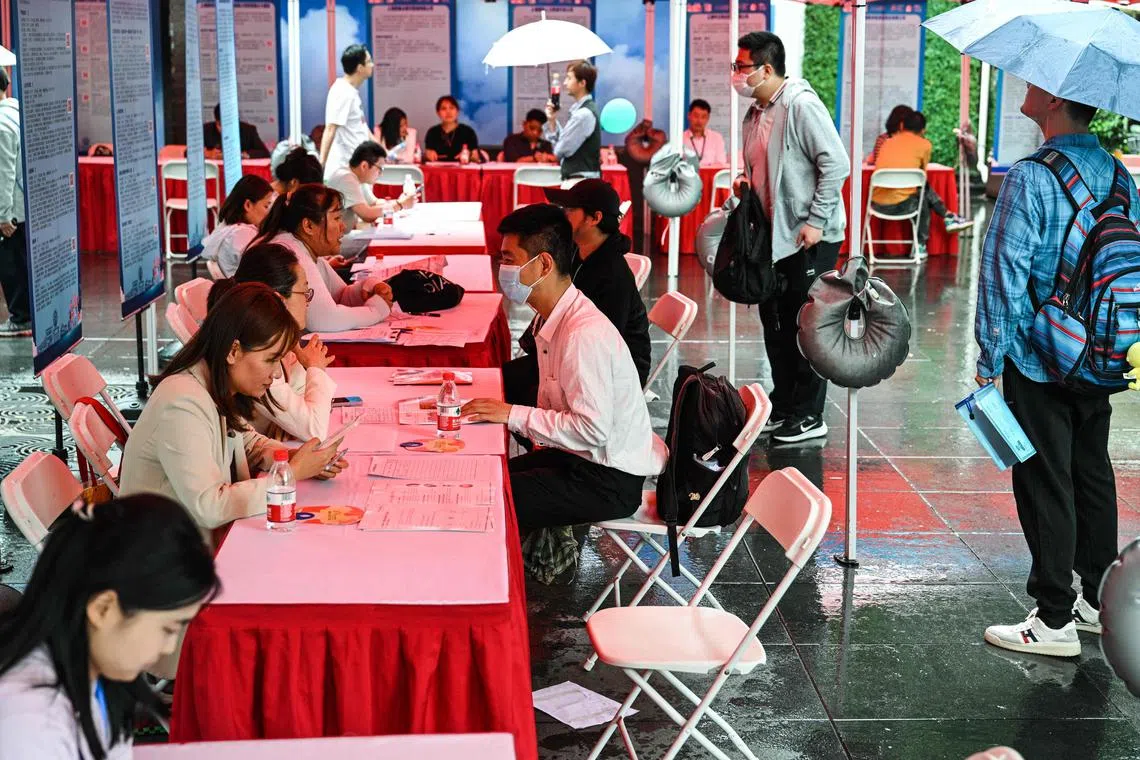
China’s Ministry of Education reported a higher education enrolment rate of 60.2 per cent in 2023 – up from single digits in the 1990s. The figure covers universities, colleges and vocational schools.
Now, record numbers of graduates are flooding the labour market – outstripping job creation.
In Singapore, the share of degree holders has also risen in recent decades.
The crucial difference is that market demand here has kept up with graduate supply so far. Cohort participation, which refers to the share of each class entering the autonomous universities, rose markedly after 2010.
Enrolment was increased at NUS, Nanyang Technological University and SMU, and new universities were opened.
The participation rate has grown from 24 per cent in the late 2000s to 40 per cent in 2020. Places are also set aside for adult learners who did not progress directly to undergraduate degrees.
Just last year, MOE announced that the lifetime cohort participation rate for publicly-funded degrees – which includes both fresh school leavers and adult learners – would be raised from 50 per cent to 60 per cent by 2025.
But planners here have signalled that they are responding to market demand, with Education Minister Chan Chun Sing saying at the time that the planned increase “takes into account the demand for degree-level manpower across the economy in the medium term”.
Job outcomes for the first batch of enlarged cohorts seem to bear out his point.
“The increase in the relative supply of university graduates… was matched by a rise in the relative demand for these graduates,” Ministry of Trade and Industry economists concluded in a report in May.
At the same time, the team suggested that the higher demand for university graduates “could have been driven by skill-intensive sectors such as the finance and insurance, and information and communications sectors”, which saw the biggest changes in vacancies in that period.
This development might mean that individual sectors can well influence the bigger jobs picture.
Hot or not
In fact, certain industries have had close brushes with the oversupply problem in the past.
In 2014, Law Minister K Shanmugam identified a “lawyer glut” as a result of Singaporeans studying law overseas, then returning home to compete for training contracts and to practise here.
His ministry went on to drop eight schools from the list of overseas universities recognised for Bar admission.
In 2019, the Singapore Medical Council and the Ministry of Health announced plans to slash the number of approved overseas medical schools from 160 to 103.
A joint statement at the time said that local medical school intakes had increased, such that “we expect our need to recruit overseas-trained doctors to moderate and stabilise in the coming years”.
Prof Ho Kong Chong points to “the role of the professional associations” in controlling the supply of graduates, for fields such as law, medicine, and possibly accountancy.
But, noting that Singapore has “a very small labour market”, he also adds: “If the Economic Development Board continues to do its role and continues to attract new industry sectors into Singapore, then that kind of planning in terms of manpower needs to be done, whether it is through a formal education, or through shorter-term kinds of courses.”
With enrolment intakes locking in a three to four-year pipeline of graduates to meet future demand, it’s no secret that the authorities take a proactive role in managing the supply.
“The government continues to direct university admissions to ensure the output of graduates matches projected skilled manpower needs,” Prof Pang and economist Linda Lim jointly wrote in a 2005 journal article on manpower planning and university enrolments.
“As the main provider of funds, the government provides guidelines for graduate output in different fields,” Prof Pang tells BT.
Still, his earlier article also called for “a market-based system of allocating university places” where students funding their own undergraduate education can vote for degree courses with their wallets.
“If employers do not hire the graduates… or if the salaries they offer are too low, students and parents will shift their demand (and tuition revenues) to other universities and courses whose graduates are better rewarded in the job market,” the researchers explain.
In an e-mail to BT, Prof Pang says that “universities have some flexibility” to make “incremental changes” to their intakes as well, while “both employers and jobseekers will make supply and demand adjustments by modifying requirements or expectations”.
Ready for change
Over the years, HR professional Sharma has seen boom-bust cycles in engineering, “where high demand periods were followed by candidate saturation during hiring slumps, which led to a surplus of talent”.
In contrast with engineering, however, “the tech sector presents a different dynamic due to its rapid pace of change and innovation”. Despite the potential for elevated headline numbers of tech graduates, “the skills required for the roles are constantly evolving”, she says.
Similarly, OCBC’s Ling suggests that the hiring outlook may reflect churn in certain functions that now face restructuring.
Naming artificial intelligence, cloud services and cybersecurity as some “segments which are still booming”, she tells BT: “I don’t think there is a cyclical oversupply of tech graduates.”
Rather, observers believe students and universities alike will have to adapt to rapid industry shifts.
In the last five to eight years, Prof Ho Kong Chong has noticed more university students taking up internships under their own steam, which he describes as “adopting the polytechnic route” towards learning.
“The economy has changed so much, more so now… The pace of change is faster,” he says. “The challenge is not the basic degree. The challenge is ongoing retraining. Reskilling is the key here.”
Prof Terence Ho, the former MOM director, urges breadth and flexibility in workforce planning, which should take into account that most courses “equip students with multidisciplinary skills so that they are employable in more than one sector”.
He still dubs a tech education “a no-regret move” in general, but notes: “Much depends on the specific content of the tech-related programmes as specific skills – for example, programming languages – may fall out of favour or decline in importance.
“So I think the broader takeaway is to ensure that curricula are broad enough with a focus on analytical and soft skills.”


