

Think twice about rebuilding that old landed property into a super-big house to max out GFA
Mind the high construction and recurring costs of building a gigantic home for owner occupation

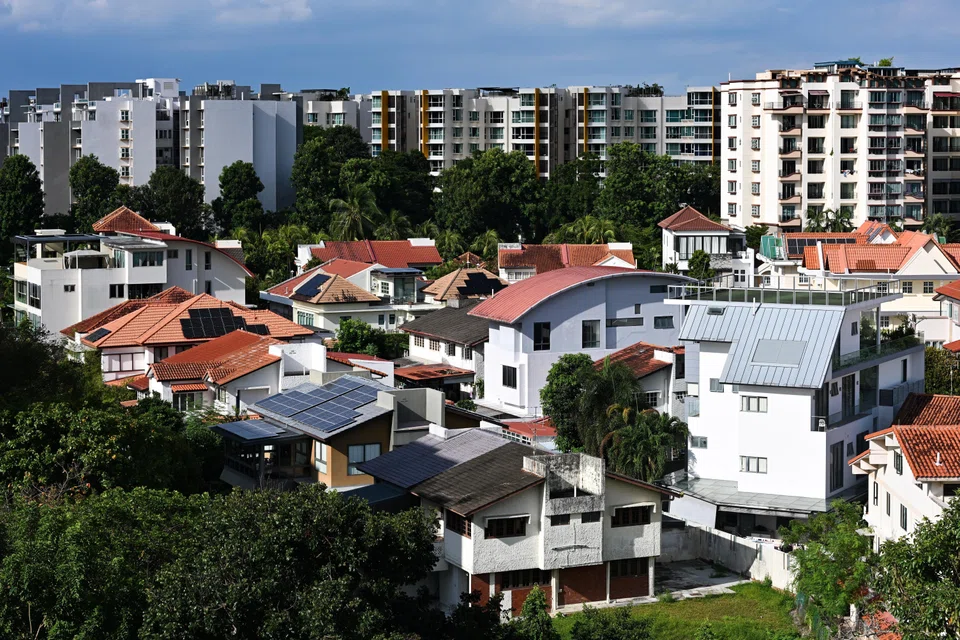
[SINGAPORE] Private landed homes typically sit at the apex of Singapore’s residential property market. Given their relative scarcity and limited new supply, landed houses are seen as good stores of value.
As at the first quarter, the private housing stock comprised 73,662 landed homes and 350,503 condominiums and apartments, excluding executive condominiums.
Landed homeownership is generally restricted to Singapore citizens. And such homes are often bought for owner occupation.
Besides their investment value, many buyers are drawn to landed properties by the chance to create something bespoke.
Think of demolishing an old house and erecting an entire new building or carrying out extensive addition and alteration works to create one’s dream home.
While ideas of what an ideal rebuilt landed house can differ widely, many owners opt to build a house to the maximum permissible floor area when rebuilding.
Price psf of floor area
Numbers-wise, maxing out the floor area of a house on a particular plot makes sense. The cost per square foot (psf) of floor area of a new-built house is lower when a larger structure is built on a land parcel.
Take a buyer who pays S$3.4 million for an old freehold intermediate terrace house sitting on 1,700 square feet (sq ft) of land.
Assume the old house is torn down and a new structure with three storeys plus an attic and total floor area of about 4,600 sq ft is built for S$2.5 million.
In the above case, the total cost of the new-built house works out to S$5.9 million or S$1,283 psf of floor area.
Contrast the above with spending S$1.6 million to demolish the old house and build a smaller new structure with 3,000 sq ft of floor area.
The total cost of this smaller new-built house amounts to S$5 million or S$1,667 psf of floor area.
In the above example, the cost psf of floor area of the smaller new-built house is about 30 per cent higher versus that of the larger new-built house.
Across landed housing enclaves islandwide, huge new structures have been sprouting out to replace old buildings which were constructed decades ago.
Is building to the maximum floor area based on what is permitted by the authorities optimal for owner-occupiers of landed homes? Arguably not.
Capital expenditure
One, the costs of transforming an old landed house are high as highlighted in a recent report by The Business Times.
And building costs could escalate due to the energy crisis caused by conflict in the Middle East.
Even if an owner can afford to spend over S$3 million to rebuild an old semi-detached house into a large new structure with seven bedrooms, might it make more sense to act prudently and spend closer to S$2 million for a smaller new-build with say four or five bedrooms?
The substantial savings from spending less on rebuilding an old landed house can be channelled into investing to generate financial returns. This is especially as many owner-occupiers generate zero cash inflow from their landed homes.
Importantly too, when a rebuilt house is put up for sale some years later, potential buyers may not factor in the costs that the owner incurred in rebuilding the house.
After all, a potential buyer might envisage undertaking extensive building upgrading works to create his bespoke dream home.
Recurrent costs
Two, recurrent costs will likely rise according to a house’s floor area and amenities.
For example, repair and maintenance costs could be high for a house with a large floor area and amenities such as a swimming pool or a lift.
Crucially, the property tax bill may jump substantially after a small old landed house is transformed into a gigantic new-built property.
Property tax rates on homes are applied on a progressive scale, with higher rates applying to homes with higher annual values (AVs).
The AV of buildings is the estimated gross annual rent of the property if it were to be rented out, excluding furniture, furnishings and maintenance fees.
Owner-occupier tax rates range from 0 to 32 per cent. The rate of 0 per cent applies to the first S$12,000 of AV while the rate of 32 per cent applies to AV above S$140,000.
Smaller household sizes
Three, while many owners rebuild landed houses to provide the best for their household members and cater extra space for contingency, might owners end up over-providing for household needs and building structures that are too big?
Perhaps owners building their dream landed homes can learn from leading condo developers. With good design and layout, many new condo units can serve buyer needs effectively despite compact sizes.
Household sizes are generally getting smaller. Think of children moving out to have their own homes when they are adults and fewer three-generational households.
The average household size of resident households living in landed properties was 4.13 persons in 2025, down from 4.3 persons in 2015.
Is there a need for landed homes to have increasingly large built-in areas when the size of households living in the properties is not growing?
For one thing, there may be loads of under-utilised space in a house with over 5,000 sq ft of floor area that is occupied by a family of four.
Moreover, as people age, getting around and maintaining a house with a smaller built-in area may be more practical.
In a world battling resource constraints, let’s also consider how the environment gains from a reduction in the use of materials in home building.
Of late, I have been involved in rebuilding an old landed family house, where the new structure that replaces the original one built in the 1970s will have floor area that is under half of what is permitted for the site.
Is this folly? I think not as the new-built house can adequately serve the needs of the household members. The new-built abode will be spacious yet cosy.
Building super-big is often the guiding mantra when rebuilding old landed houses in Singapore. Nonetheless, small can be beautiful.
Ultimately, building a new landed house that is smaller than what is allowable has financial merits and can provide a great space for a household to enjoy and build memories in.
TRENDING NOW

DBS, OCBC, UOB rout lops billions off STI as inflation, rate concerns spook investors

Grab CEO’s wife Chloe Tong on life with Anthony Tan and finding her purpose

OCBC sheds S$8 billion in value as shares close nearly 6% down; analysts cautious on banks
Deal between tycoon friends sparks scrutiny of Philippine power sector

