

Thrifting is trending, but there’s more than meets the eye
Rising eco-consciousness and the desire for unique fashion items have fuelled the growth of thrift stores in Singapore. But how sustainable is thrifting, both environmentally and as a business?

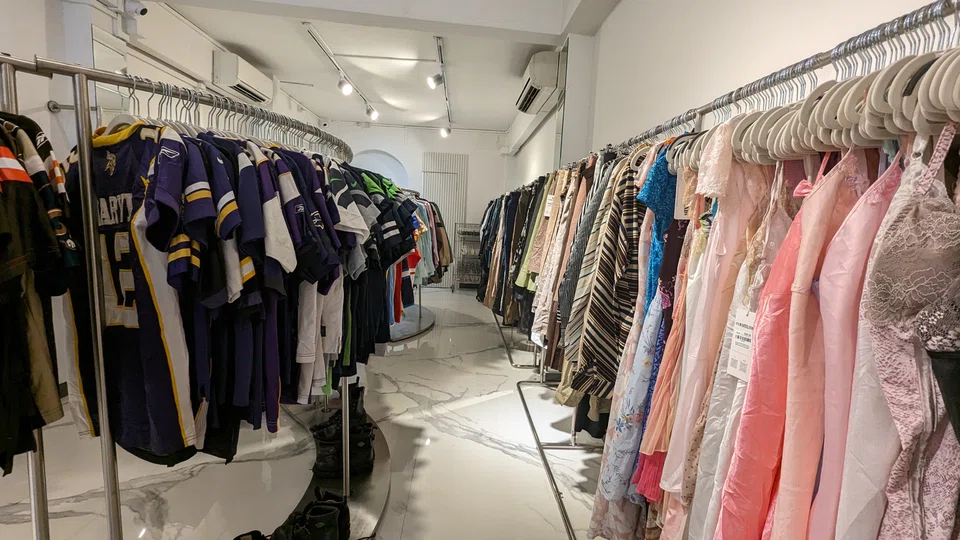
ADRIANA Rahman is a convert to second-hand fashion.
The 25-year-old used to buy her clothes from well-known fashion labels, including fast-fashion brands. But that all changed when the Covid-19 pandemic hit. She lost her part-time job during the ensuing economic crisis, and had to find ways to cut her expenses.
That was when she chanced upon the realm of second-hand fashion online. While her initial motivation was to find cheaper sources of clothing, she realised that buying second-hand goods – also known as “thrifting” – was not only more environmentally sustainable, it also allowed her to purchase unique items that could not be found elsewhere.
“Until now, I try my best not to shop for (new) items,” says Rahman, who is a retail employee.
While there is no official data on the number of thrift stores in Singapore, industry players have noticed a surge in interest in second-hand fashion businesses, fuelled by eco and cost-conscious consumers like Rahman.
Of the eight thrift store owners who spoke to The Business Times, five opened their physical shops just last year. Almost all of them started their businesses online during the pandemic. Within the last month, at least two more thrift stores have opened at Peninsula Shopping Centre, suggesting that the sector is still expanding.
But despite the burgeoning boom, how sustainable – environmentally and economically – is thrifting, actually?
Shaking off the stigma
While second-hand fashion is not new in Singapore, the difference is that many of these new thrift shops are for-profit businesses – the pioneer players tended to be non-profit models run by charities such as the Salvation Army.
Motivations vary among thrift store owners. Some started their business out of a desire to do their part for the worsening climate crisis. Portia Tan, founder of Kaeru in Haji Lane, sets aside a portion of her revenue to plant trees in Africa. Then there is Aloysius Sng, the founder of second-hand fashion chain Refash, who wanted to solve the problem of overflowing wardrobes in many Singaporean households.
Others did it simply because they themselves enjoy thrifting. Pandemic restrictions had not only kept buyers like Rahman at home – many Gen Zs and millennials started turning to online platforms during that time to sell their second-hand wares. What started out as a hobby gradually grew into a business.
Vishal Salunkhe, head of commercial at online marketplace Carousell, says the platform’s “Y2K” fashion listings have grown by eight times since 2020. The term refers to trends that were popular at the turn of the millennium.
There was also an uptick in the sale of second-hand fashion items on the marketplace in 2023 when restrictions were fully lifted.
Thrift store founders say the long-standing stigma around buying second-hand goods has improved over the years. In the online space, Carousell’s Circular Economy Impact Report found that 55 per cent of its surveyed users reported an increase in the buying and selling of second-hand items in 2022, compared with 2021.
Besides Covid pushing the growth of re-commerce – which refers to the selling of used goods online – thrift store owners and industry observers cite social media content on thrifting, cost savings, increasing environmental consciousness, and the desire for unique fashion pieces as expressions of identity among younger consumers as other factors contributing to the sector’s expansion.
This is complemented by business owners coming up with educational campaigns on social media, as well as deliberate efforts by them to make second-hand items look less like used goods, such as opening stores in high-traffic locations like shopping malls and curating the items on display.
It is not just consumer behaviour that has changed. The greater focus on environmental sustainability among countries and corporations over the last few years, amid a global push for governments to hit their net-zero targets, has also increased the visibility of second-hand fashion.
Sng of Refash highlights how corporations are increasingly looking to partner his company on sustainability-related activities.
“In the past, corporates (would) not work with Refash... Post-Covid, especially in the last two to three years, you see that urgency to want to be associated, one way or another, with sustainability.”

The growing acceptance of buying second-hand goods has kept these thrift stores financially viable.
Sng shares that Refash sold more than 200,000 items in 2022, and after being acquired by Carousell that same year, the number of items sold in 2023 went up by 200 per cent.
Huynh Baolong, co-founder of Furimaketto, says that his team has achieved an average profit margin of 20 to 30 per cent over the last nine months since opening a physical store in Queensway Shopping Centre.

Freddy Tan, founder of Tasstore, which has two locations, says that sales improved between 60 and 70 per cent from 2022 figures after the business moved fully to a brick-and-mortar model.
With the exception of a one-off post-pandemic “revenge shopping” spree which led to a 20 per cent year-on-year revenue jump, The Fashion Pulpit has seen its sales rise by 8 to 12 per cent on average each year, says Raye Padit, founder of the second-hand retailer located in Jalan Besar.
A billion-dollar regional market
With such growth figures, it is probably no surprise that industry experts assess the second-hand apparel market in Singapore to be worth between US$200 million and US$300 million.
For South-east Asia as a whole, the market size is estimated to be around US$1 billion, says Jason Moy, managing director, partner and head at Boston Consulting Group (BCG) Singapore.
This, however, is just a sliver of the global second-hand fashion market, which is valued at between US$100 billion and US$120 billion. Asia takes up about US$30 billion to US$40 billion of the share, with China and Japan accounting for around 60 per cent of that.
While markets in the United States and the European Union are more mature, the ones in South-east Asia are still in the early stages – which means that there is greater potential for growth.
Moy notes that the second-hand fashion segment’s gross merchandise value is growing at a rate of 11 per cent per year, compared with the overall apparel market’s 6 per cent, with Singapore as the biggest driver of that growth. However, he pointed out that this faster growth rate is due partly to its relatively small base.
The market share of second-hand fashion in Singapore is, in actuality, similar to that of other mature markets such as Japan and the EU at around 20 per cent. But the penetration in markets like Indonesia and the Philippines is less than 5 per cent.
“I think what has happened in South-east Asia specifically, is the emergence of a younger generation coming into their own with enough money and with enough interest in fashion (to) say: ‘How do I find something that I can sort of make my own, that fits into where I am at this point in my life?’” says Moy.
Economic sustainability
While the low levels of capital required to set up a second-hand clothing store have facilitated the sector’s recent growth, Tan Huey Chyi, sustainability director at the Singapore Fashion Council (SFC), observes that these businesses also shut quickly when they are unable to hit the volumes needed to pay for their overhead costs.
Despite technological and consumer trends favouring the growth of the thrifting economy, the nature of the business makes it inherently difficult to scale.
It is precisely the uniqueness of each thrift item – one of the main draws for consumers – that limits the inventory turnover. For all the labour that goes into sourcing, sorting, curating and putting up that piece of clothing for sale, only one of it can be sold. In addition, this extremely tedious process of assessing and pricing each item individually cannot be automated, notes Tasstore’s Tan.
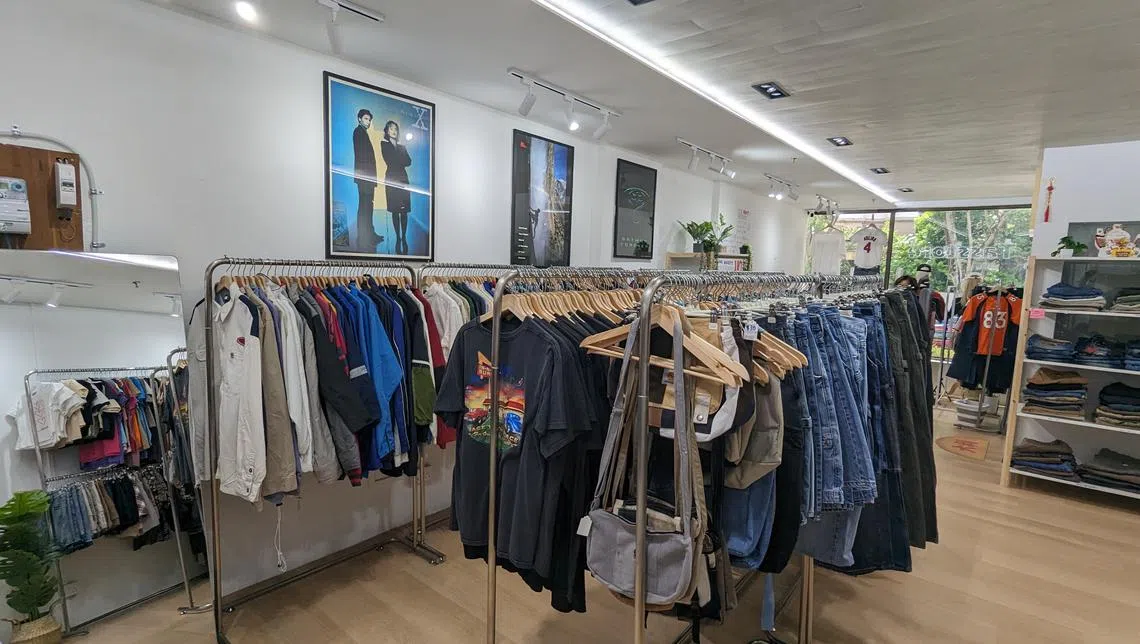
“That element has always been the limitation for these players. How do you go and curate and find these items at enough scale, so that you can offer the product at the right price and still have enough (of a) margin? It is hard to make it super profitable as a business model,” says Moy.
Several thrift store owners are aware of the scalability challenges. For Huynh, he is unsure if he wants to continue the business in the long-term despite turning in a profit margin of at least 20 per cent.
One reason is that cash flow is inconsistent due to slower business in some months. Then there is the question of whether there will be enough demand if he attempts to scale by opening another shop, given the increasing number of competitors.
Second-hand fashion stores are also limited by the stock they can get from their suppliers, and they may not be able to get clothing items that are trending at that time, says Audrey Hong, who runs Un.Wastelands.
It is also difficult to differentiate one second-hand store from another and establish a unique selling point. The low barriers to entry mean that competitors may end up sourcing goods from the same suppliers.
“In 10 years, will the brand still be around? I won’t be able to tell you confidently... If it does get more competitive, the challenge will be in staying relevant,” says Hong.
Even though her business has been doing well enough for her to open three physical stores over the course of 2023, her concerns have led her to continue holding on to her full-time salaried job. She runs her business on the side with help from her family.
Nonetheless, thrift store owners believe that the Singapore market has not reached a saturation point yet, and there will be some years to go before the market matures.
Environmental sustainability
In addition to scalability challenges, second-hand shopping – albeit a net positive for the environment – is not perfectly circular.
That is because a carbon footprint still arises from the collection and transportation of second-hand clothes, especially if the inventory comes from warehouses overseas, which is the case for several thrift stores here.
SFC research found that Singaporeans throw away at least nine pieces of clothing every year. Assuming that these clothes are resold and purchased by just 10 per cent of the city-state’s population of 5.8 million, this could generate potential carbon savings of about 30,000 tonnes of carbon dioxide equivalent. This is similar to the amount sequestered by 650,000 mature trees.
However, this is predicated on the items being supplied and resold domestically, instead of being imported and exported, says SFC’s Tan.
Importing stock from overseas also increases the amount of waste thrown in Singapore if these items are not sold.
At the end of the day, while buying second-hand does help reduce the production of new clothing items, that alone does not solve the sustainability challenges of the fashion industry, notes Moy.
Currently, this segment accounts for only 3 per cent of South-east Asia’s US$30 billion overall apparel market – hardly posing a threat to major fashion brands.
But, threat or not, some major fashion houses have started responding to the second-hand shopping wave.
Uniqlo Singapore, for example, has introduced repair and upcycling services as well as clothes-swopping activities for its customers, says Hwee Lee, senior director of sustainability at the Japanese company.
Moy adds: “It is a nice niche that caters to a certain demographic and has growth potential. But at the core of it, fashion retailers who want to reduce carbon emissions and improve their sustainability have to think about (the) supply chain elements of their business (models), whether that’s using sustainable materials or more advanced factories that have less pollutants.”
Scaling to stay
For thrift stores to be able to continue championing sustainable fashion, they need to first be profitable and stay in business.
SFC’s Tan says that thrift store owners can consider collaborating with others in the wider thrifting community to overcome limitations in scalability.

To this end, Padit from The Fashion Pulpit is setting up a circular fashion hub, where multiple sustainable fashion businesses are housed in one physical space. There are currently seven such brands on board.
The idea is for their efforts to be amplified when customers visit and see multiple brands at once, or when marketing campaigns by one brand help to increase the visibility of others in the hub.
Another way to increase scalability is by simply going online. Reco Buddy, a relatively new player in the scene, aims to get thrift stores to do just that. The mobile application houses various second-hand fashion businesses in a single marketplace.
Its founder, Iman Jumahat, found that there was a disjuncture between where buyers were looking for second-hand clothing and where sellers were plying their wares. More than 60 per cent of buyers were on Carousell, while only 10 per cent of thrift stores were on the platform.
By getting second-hand buyers and sellers together on Reco Buddy, Jumahat hopes to maximise the impact of the thrifting economy. The marketplace is essentially an upcoming competitor to Carousell, though it focuses on second-hand fashion products.
Jumahat’s goal is to get every second-hand fashion business in Singapore on the app by 2025, and expand regionally in 2026. She is currently in talks with investors to raise funds.
The ability to scale is also what investors are interested in, when looking for attractive investment opportunities in the second-hand fashion economy.
“If you look at (where a lot of) the money has gone in this space, it’s not to the guy who’s trying to open three stores – it’s to the one who’s trying to sell to an entire country off of a digital platform,” says Moy of BCG.
However, some thrift store owners believe that there is still some hesitation over buying second-hand items due to quality concerns. Overcoming this necessitates prioritising a physical store over an online presence, as consumers would then be able to touch and feel the second-hand clothes before deciding to make a purchase.
While industry players and observers believe that there are several positive tailwinds supporting the growth of the second-hand clothing market, issues around authenticity and quality, finding the right price point to effectively compete in an increasingly congested space, as well as high rental costs are key impediments that could hold the sector back.
“There is potential. But to get there, it’s going to be a hard and long road, and we don’t know if we can sustain (ourselves) until we see that light (at the end of the tunnel),” says Padit.
TRENDING NOW
Prima to move out of historic Keppel Road flour mill building in 2028

Temasek-related Azalea, SeaTown, Seviora Capital to merge in 2027
Family offices see more tailored products, leverage ‘collective firepower’ for direct deal access

Singapore room rates soar, but hotels seeing mixed demand from F1 race and events

