

Trade warriors’ real fears about Beijing’s industrial overcapacity
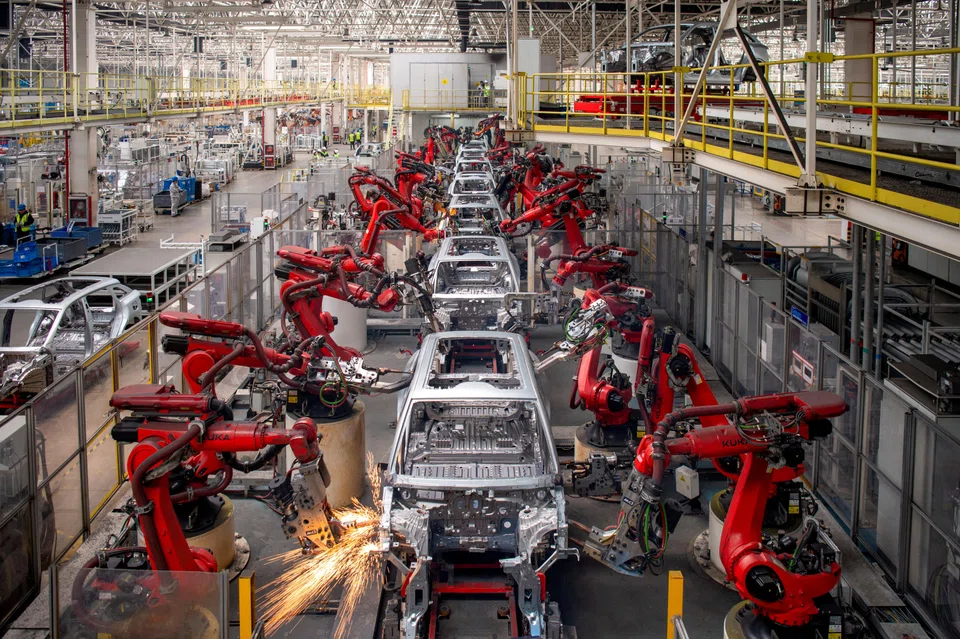
US TREASURY Secretary Janet Yellen was frank about the purpose of her four-day visit to China last week: to persuade Beijing to stop investment in more factories for making electric vehicles (EVs), solar panels and other clean energy goods.
She claimed that China’s production capacity threatened competing firms in the US. Beijing rebuffed her, saying it would be better all round if America fostered innovation and competition within its own borders, rather than worry so much about Chinese investment in its own economy. So far, so predictable.
Western alarm at Beijing’s intention to build up its technology industries has been rising for a while now. Late last year, European Commission chief Ursula von der Leyen cited Chinese overcapacity as the primary reason for ordering an anti-subsidy investigation into EV subsidies.
The EU has form. About a decade ago, Brussels took anti-dumping and anti-subsidy measures against the import of Chinese solar panels and telecommunications equipment.
It needs to be noted that despite this current display of consternation, the EU already imposes a 10 per cent duty on all imported EVs, while Washington imposes a levy of 27.5 per cent on similar goods. Both the US and EU have indicated they would have no qualms about raising tariffs even further.
So what does the West really want from China? A look back into recent history may hold some clues.
In the 1980s, as imports of Japanese cars and steel threatened American businesses, the putative free-trader president Ronald Reagan imposed a series of deals that came to be known as “voluntary restraints” on Tokyo.
There was a “Voluntary Export Restraint” pact that cut exports of better engineered and cheaper Japanese cars into the US market. For the buyer, this amounted to a tariff hike of more than 60 per cent on Japanese cars. Then there was a “Voluntary Import Expansion” agreement that forced Japanese industrialists to use US semiconductors rather than their own.
There was also something called the “Structural Impediments Initiative”, in which each side asked the other to reform sectors of the others’ economy. For instance, Washington demanded that Tokyo repeal its Large Scale Retail Store Law, which enabled small shopkeepers to prevent giant retailers from opening outlets in their neighbourhoods. In turn, Japan wanted the US to take steps that would improve household savings and reduce the use of credit cards.
Subsequent analyses have shown conclusively that none of these measures had an effect either on US trade deficits or on Japan trade surpluses. It should also be recalled that those kinds of accords were only possible because the Cold War was raging and Washington had considerable leverage over Tokyo, its military ally.
If indeed they hope to reprise something similar, both Yellen and von der Leyen should realise that neither of them has that kind of clout over Beijing.
At best, they can protect their own markets with high tariff walls, given that the World Trade Organization has been all but neutered.
Unfortunately for them, Beijing’s ambitions are global; indeed, it is looking for markets in the rest of Asia, the Middle East, Latin America and Africa for its EVs and other clean-tech goods. It is probably the realisation that the West is going to face fierce competition to hold on to their own share of these export destinations that is keeping trade warriors awake in Brussels and Washington.
TRENDING NOW

Once staunchly pro-China, Malaysian Chinese businesses are now distancing themselves from Beijing

Cliff Tan has 7 million followers and a 4-month waitlist. Why won’t he expand his business?

Could stablecoins be the future of money?

Grab CEO’s wife Chloe Tong on life with Anthony Tan and finding her purpose

