

Trump and crony capitalism: When state power meets corporate favouritism
The entire economy becomes less productive when businesses succeed through political manoeuvring rather than innovation and efficiency
IN AMERICAN capitalism, political power and business interests have always existed in a delicate balance. Under President Donald Trump’s current administration, however, this balance appears to be shifting towards what economists and critics increasingly characterise as crony capitalism – a system where business success depends more on favourable government ties than on competitive market performance.
Crony capitalism represents a departure from the competitive free-market ideals that theoretically underpin the US economy.
In a truly competitive system, businesses succeed or fail based on their ability to serve consumers efficiently and innovatively. By contrast, crony capitalism fosters an environment where political connections, favourable regulations and government subsidies become the primary drivers of success.
Consequently, companies invest as much – or more – in cultivating political relationships as they do in research, development or operational efficiency.
This system creates several problematic dynamics. First, it distorts market signals, allowing inefficient companies to survive through political favour rather than market merit. Second, it erects barriers to entry for new competitors who lack established political connections. Finally, it encourages rent-seeking behaviour, where businesses focus on extracting value through political manipulation rather than creating value through genuine economic activity.
Recent developments in the semiconductor industry provide a particularly stark illustration of these dynamics.
The administration’s approach to major tech companies like Intel and Nvidia has drawn sharp criticism from observers across the political spectrum. Walter Isaacson, the renowned biographer and former chief executive officer of CNN, recently characterised Trump’s semiconductor strategy as a “scattershot method of crony capitalism”.
The most concerning examples involve direct government intervention in corporate operations. The administration has reportedly pushed for government stakes in major companies, with Intel being a notable target.
Additionally, deals with companies like Nvidia and AMD that involve the government taking a percentage cut of certain sales transactions represent a fundamental shift from traditional US business-government relationships.
These arrangements go beyond typical regulatory oversight or even industrial policy. They create a system where the government becomes a direct financial beneficiary of corporate success, creating perverse incentives for both political leaders and business executives.
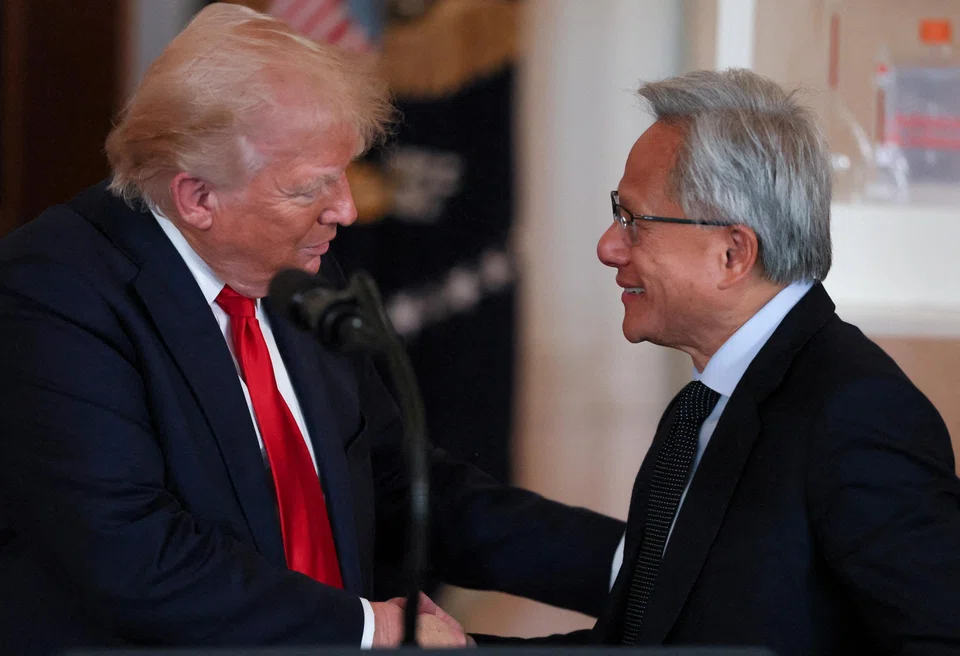
When Nvidia CEO Jensen Huang’s frequent meetings with Trump coincided with policy shifts favourable to his company, followed by the announcement of revenue-sharing arrangements, it created the appearance of a quid pro quo relationship that undermines confidence in the integrity of both government and business decision-making.
The shift toward crony capitalism carries significant long-term risks for US economic competitiveness. When businesses can achieve success through political manoeuvring rather than innovation and efficiency, the entire economy becomes less productive.
This is particularly problematic in high-tech industries like semiconductors, where US companies face intense international competition. Resources flow not to their most economically valuable uses but to politically connected entities, representing a fundamental misallocation of talent and capital that could weaken America’s competitive positions.
Moreover, crony capitalism tends to be self-reinforcing. Once established businesses gain political advantages, they have both the resources and incentives to maintain those advantages through continued political engagement. This stifles new entrants and innovative challengers, ultimately reducing the dynamism that has historically been a source of American economic strength.
From a conservative economic perspective, the current trajectory is particularly troubling, as it represents the antithesis of foundational principles like free markets, limited government and competition. Instead of allowing market forces to operate freely, this system allows the government to pick winners and losers.
The irony is stark: an administration that came to power promising to “drain the swamp” has instead created new forms of government-business entanglement that may be more problematic than what came before. Rather than reducing the role of government in economic decision-making, these policies expand government influence while channelling the benefits towards politically connected actors.
Perhaps most concerning is the impact on America’s ability to compete internationally.
While the US political system becomes increasingly focused on distributing economic advantages based on political relationships, competitor nations can organise their economies around genuine competitive advantages. China’s state capitalism, while problematic in many ways, at least maintains a focus on national economic competitiveness. The emerging US version appears more focused on distributing benefits to political allies.
If US companies become accustomed to succeeding through political favour, they may find themselves unable to compete when political protection is insufficient to overcome genuine competitive disadvantages.
The current trajectory raises fundamental questions about the future direction of American capitalism. Will the US maintain its historical commitment to competitive markets, or will it continue evolving towards a system where political connections determine economic outcomes? The answer will likely shape not only domestic prosperity, but also America’s position in the global economy.
The semiconductor industry developments represent more than isolated policy decisions – they signal a broader philosophical shift towards viewing government and business as partners in wealth extraction rather than as separate institutions. This shift, if continued, could fundamentally alter the character of American capitalism and undermine the competitive advantages that made its economy so dynamic.
The challenge for policymakers and business leaders is to recognise these dynamics and reject the comfortable arrangements of crony capitalism, in favour of the more challenging but ultimately more productive world of genuine market competition.
The stakes are high. The choice between crony capitalism and competitive capitalism is ultimately a choice about what kind of economy – and what kind of country – America will become in the 21st century.
TRENDING NOW

Philippine power giant First Gen rebuffs foreign offers, plans up to US$2.6 billion in expansion

Cliff Tan has 7 million followers and a 4-month waitlist. Why won’t he expand his business?

Could stablecoins be the future of money?

From finance aspirant to Asean CEO: TUV SUD’s Jonas Strahberger on finding people who believe in you

