Trump came, danced and left, leaving Asean (and Anwar) to carry on
The group must keep its focus as it weathers a choppy year of tariffs, political tensions, escalating costs and slowing trade

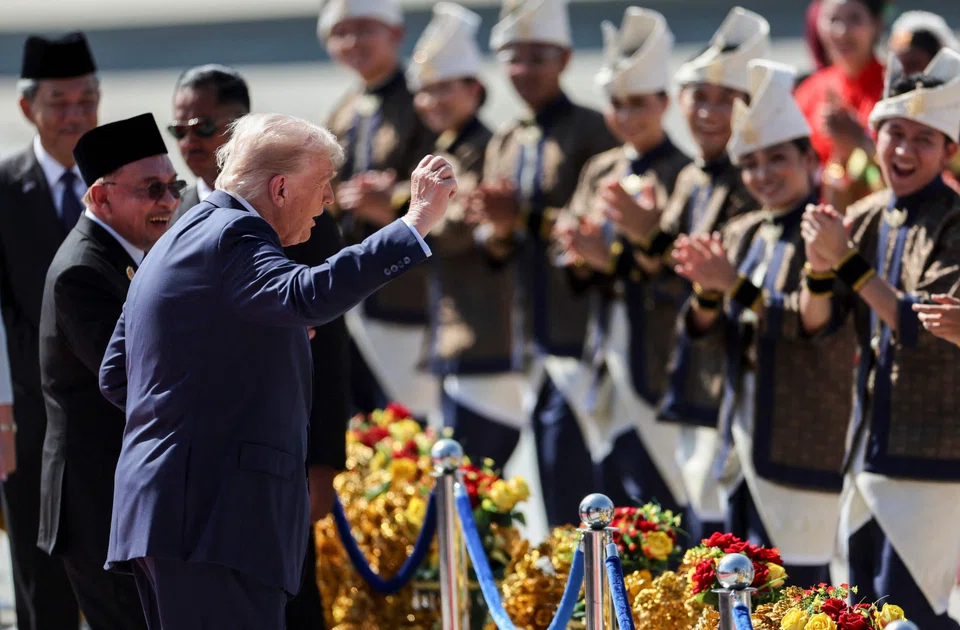
US PRESIDENT Donald Trump’s diplomatic meetings tend to be memorable. From Kyiv to Pretoria, they show how quickly diplomacy can turn into performance.
In Kuala Lumpur – no stranger to spectacle – the 47th Association of Southeast Asian Nations (Asean) Summit opened on Sunday (Oct 26) as motorcades swept through closed roads and highways, security personnel lined the streets, and leaders from the regional bloc and beyond filed in.
This time, Trump came and went peacefully, without awkward optics and with a bit of groove – his trademark dance was even dubbed Joget Penumbuk (Boxer’s Dance).
For Prime Minister Anwar Ibrahim, who chairs the summit, this is his first major outing since taking office. And he appeared firmly in his element, playing host to world leaders.
In the 1990s, as Malaysia’s finance minister, Anwar was seen in Washington and other capitals as a reformist who spoke the language of markets and modernisation – a contrast to his mentor-turned-rival, then prime minister Mahathir Mohamad, whose suspicion of Western institutions was legendary and, at times, justified.
Anwar’s ease and wit were a reminder of his trademark affability. He told Trump, “We share a lot in common. I was in prison, but you almost got there”, before switching seamlessly between English, Malay and regional banter.
Still, Asean must keep its focus. The bloc is weathering a choppy year of tariff turmoil, political tension within several member states, escalating costs and slowing trade. Growth across Asean economies is forecast to cool to 4.1 per cent in 2025, down from an estimated 4.6 per cent last year.
Even so, Malaysia’s chairmanship has delivered milestones. For one thing, Asean just welcomed its 11th member, Timor-Leste, after two decades of holding steady at 10. This is a huge breakthrough for the bloc, and for Malaysia, which as chair, shepherded the region’s poorest nation into the fold.
The Kuala Lumpur Peace Accord between Thailand and Cambodia, witnessed by Trump and Anwar, is a major achievement whose significance goes beyond optics as it ends the worst border clashes in more than a decade. But it does raise one question: Whose diplomacy truly made it happen and does it still count as Asean centrality if it relied on outside leverage?
At the summit, Washington inked a series of trade accords across South-east Asia, including with Malaysia, Thailand, Cambodia and Vietnam, underscoring how this year’s chairmanship has had to play both host and deal-maker. For Singapore, the gains in digital-economy talks and clean-energy connectivity are more than symbolic as they promise real integration with neighbours’ markets.
If 2024 under Laos was a year of quiet consolidation, 2025 under Malaysia has been one of high-stakes management. Laos presided over a relatively calmer external environment, and hence was able to focus on resilience and road maps, steering discussions on sustainable infrastructure and tourism recovery.
By contrast, Malaysia has had to navigate a tougher landscape characterised by geopolitical turmoil, simmering maritime frictions in the South China Sea, rising protectionism, escalating tariff-led trade tensions and, not least, investor jitters over macroeconomic headwinds.

In April, as Washington’s punitive tariffs rattled regional markets, Malaysia convened an emergency meeting of Asean’s top economic officials to craft a collective response. The outcome was a renewed pledge among member states to look inward – strengthening intra-Asean trade, expanding cross-border payment systems and accelerating supply-chain integration to cushion against external shocks. These were re-affirmed at the summit.
This shows how each chair inherits a very different Asean. One year it’s about road maps, the next, firefighting. Who knows what it will be for next year’s chair, the Philippines?
That is why the Kuala Lumpur summit matters. High-profile guests aside, the most consequential stories are within. The real headline may already have been written: the region’s leaders are charting a surer course, and the bloc is doing what it has always done – surviving the spectacle.