With Trump mulling stakes in big AI firms, will the tech become a public utility?
Questions remain about the ways a government shareholder may exert its influence in the sector
[LONDON] Left-leaning US Senator Bernie Sanders and Republican President Donald Trump have found a surprising common ground: The US government should take stakes in artificial intelligence companies, so that the public could share in the rewards.
Investors are getting giddy about upcoming public share sales by the AI boom’s leading names OpenAI and Anthropic.
However, more than a little anxiety exists about the ways the government is coping with potentially seismic changes to the economy and society from the rapid automation of both white-collar and blue-collar jobs.
In a New York Times op-ed on Jun 1, Sanders advocated for the government taking 50 per cent stakes in the big AI companies.
The Vermont independent senator said he planned to introduce legislation creating a sovereign wealth fund to hold those stakes.
He added that the fund would give the public a role in determining the future of the technology and secure some of the profits comprising trillions of US dollars for the workers most affected by it.
In times past, that idea might have ended up as a trial balloon by a firebrand politician – calculated to excite debate and little else – while private enterprise and free-market thinking drowned it out.
Except Trump, and possibly even the bosses of one of the AI companies, might be thinking along the same lines.
Digital news outlet Notus reported on Jun 4 that senior US officials held preliminary discussions with major AI companies about the government possibly buying shares in their companies.
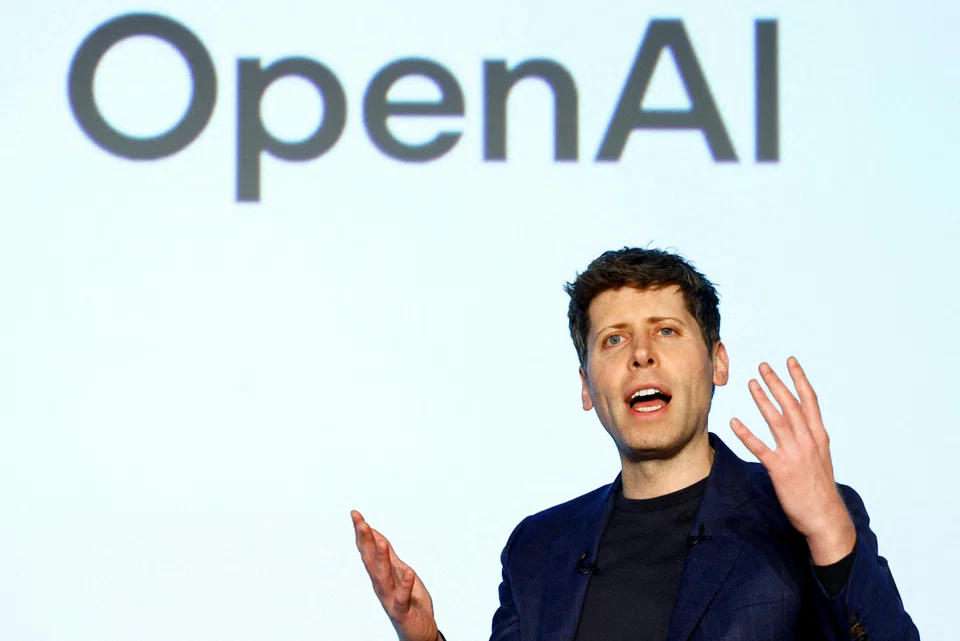
The talks, which included OpenAI CEO Sam Altman, centred around having the companies voluntarily cede shares to the government.
Returns on investment could then be directed to public purposes and possibly given in dividends to American households, the report added.
By Jun 5, Trump seemed to be on board with that plan.
“There’s something very interesting about it, where it almost becomes a partnership with the American public,” he told reporters aboard Air Force One. “We’ll look into that.”
On the specifics of the Sanders idea, he was also quoted as saying he has been considering government investment in AI companies for more than a year.
“Where economics are concerned, (Sanders and I) have things that aren’t that far apart,” he added.
And if you thought that was all feel-good bluster, the tactic has already been a reality for an administration that has pushed an unusually large role in the corporate sector.
It took a 10 per cent stake in US chipmaker Intel in 2025, followed by stakes in a handful of rare-earth companies and then quantum-computing companies, including IBM, in May.
Whether any of this fits into Trump’s executive order in 2025 on creating a sovereign fund to house these investments is not yet clear.
Prospects of government stakes in AI
However, the prospect of AI stakes is far from fanciful now.
Whether that should encourage prospective shareholders or spook them is an open question.
The government stake has not done Intel’s stock any harm.
Since the 10 per cent stake was taken in August 2025, Intel has quintupled in value, transforming Washington’s US$10 billion investment into one worth US$50 billion.
Some might argue that a government stake makes these companies too big to fail and underscores their success.
Others would see the opposite risk: that state ownership deters private capital, politicises AI governance and leaves taxpayers exposed if public investments underperform.
But questions have remained about the ways a government shareholder might exert its influence, either as a significant minority investor or by expanding its stake over time to wield greater control.
In May, Trump told Fortune, a global business magazine, that he “should have asked for more” from Intel.
The Sanders plan sets an ambition.
If AI and quantum-computing companies are considered vital to national economic and military security, might they not eventually be seen as state-run utilities?
As both Sanders and OpenAI’s Altman have insisted, AI is a summation of collective human experience.
The senator wrote: “AI was not created out of thin air. The data and language used by generative AI tools didn’t just pop into Altman’s head or Elon Musk’s imagination.
“AI is built on our collective intelligence: our books, songs, artwork, journalism, computer code, scientific research, videos, conversations, images and ideas spanning generations.”
But in a post-pandemic world of greater rivalry, supply chain anxieties, trade tensions and national security concerns, government control of strategic industries has become much more compelling.
AI and quantum computing: critical national resources
AI and quantum computing are increasingly being viewed as critical national resources that need protection and investment.
Cornell’s Assistant Professor Nicholas Mulder has argued that we are in the fourth wave of nationalisation in a century.
This wave has consisted of governments taking half a trillion US dollars in assets worldwide since 2020, in the first such surge since the 1970s.
Beyond America’s borders, the push for governments to take stakes in fast-moving tech companies might turn panicky, forcing catch-up investment in regional tech ecosystems that would not be necessary in more globalised times.
Ken Rogoff, the former International Monetary Fund chief economist, wrote on Jun 2 that governments which failed to secure a place in the AI supply chain might find themselves confronting mass job displacement.
They might not have the tax revenues or state capacity needed to contain the social and political fallout.
“No one really knows what such a world would look like, let alone how to keep it from tearing itself apart,” he warned.
That uncertainty might be enough to push governments from regulating AI to owning a piece of it. REUTERS