

The West’s Turkey dilemma
Safeguarding a vital alliance is likely to come at the expense of democratic credibility
[WASHINGTON] The rapid rise of China, Russia’s invasion of Ukraine, and the US-Israel war with Iran have made geopolitical rivalry the main force shaping the global economy.
US President Donald Trump’s reversal of long-established policies has compounded that uncertainty, forcing governments and businesses alike to navigate an increasingly complex strategic landscape.
The recently concluded Nato summit in Ankara reflects this new reality, demonstrating how geopolitical and security imperatives can trump other important policy objectives.
Nowhere is that trade-off clearer than in the West’s relationship with the summit’s host country.
Turkey has long been an underappreciated Nato ally and a vital economic bridge between Europe and the Middle East.
Although its ties with Nato and the West have weakened in recent years, the country’s unique strategic position makes it indispensable to the alliance.
Straddling Europe and Asia, it occupies one of the world’s most consequential geopolitical crossroads.
Its control of the Bosphorus, a strait that links the Black Sea to the Mediterranean, makes it the gatekeeper of Russia’s main warm-water maritime route to the wider world.
Turkey also borders Armenia, Azerbaijan, Bulgaria, Georgia, Greece, Iran, Iraq and Syria, while sharing the Black Sea coastline with Bulgaria, Georgia, Romania, Ukraine and Russia.
With a population of nearly 88 million and Nato’s second-largest military, it is a major regional power. Economically, it has emerged as one of the region’s leading manufacturing and logistics hubs.
After remaining neutral for nearly all of World War II, Turkey firmly aligned itself with the West by joining Nato. It later became an associate member of the European Economic Community – the precursor to today’s EU – and eventually applied for full membership.
The accession process gained momentum after Recep Tayyip Erdogan’s Justice and Development Party won the 2002 election, but negotiations dragged on for years and effectively stalled after 2017.
Much of the delay can be attributed to the EU’s reluctance to move forward, as concerns about democratic backsliding under Erdogan intensified.
Strategic ambiguity
Erdogan’s increasingly authoritarian rule has also strained relations with the US, although Trump appears far less troubled by it than his predecessors were.
In 2019, Trump’s first administration blocked the sale of American F-35 fighter jets to Turkey after the country acquired Russia’s S-400 air-defence system, because American officials feared that Turkey’s possession of both systems could give Russia valuable intelligence about the F-35.
The second Trump administration has taken a markedly different approach, moving ahead with plans to sell more than US$700 million worth of jet engines for Turkey’s Kaan fighter programme, while signalling its willingness to reconsider the F-35 sale.
The S-400 purchase epitomised Turkey’s independent foreign policy, and its willingness to maintain close ties with both the West and its principal rivals.
As relations with the US and the EU grew increasingly strained, Erdogan continued to cultivate ties with Russian President Vladimir Putin, while also supplying drones to Ukraine.
More recently, he has sharply criticised the Iran war and, according to Trump, even considered entering the conflict against Israel.
This strategic ambiguity, together with Erdogan’s unconventional economic views – most notably, his repeated assertion that interest-rate hikes cause inflation – has coincided with a marked decline in Turkey’s economic fortunes.
Two decades ago, the country was widely regarded as one of the world’s most promising emerging markets, especially following the sweeping reforms introduced by former economy minister Kemal Dervis, after the financial crisis of the late 1990s.
Under Erdogan, however, economic performance has been decidedly uneven.
Growth has generally been robust over the past two decades, supported by major infrastructure improvements and the rapid expansion of the defence industry and other manufacturing sectors.
But that growth has been accompanied by repeated boom-and-bust cycles, bouts of very high inflation and recurring macroeconomic instability.
While inflation has fallen sharply since peaking at 85 per cent in 2022 following a major stabilisation programme, the economy remains burdened by persistent challenges, including exchange-rate volatility and weakening exports.
The Ukraine and Iran wars have been both a boon and burden for the Turkish economy.
While the country has benefited from business diverted from other parts of the Middle East and from rising exports of military equipment, disruptions to global energy markets and heightened commodity-price volatility have made inflation harder to contain.
Growing importance
In the years leading up to this month’s Nato summit, the EU and other Western allies had remained wary of Turkey because of Erdogan’s attacks on democratic institutions, his close relationship with Putin and his dubious economic policies.
But as Turkey’s strategic importance grew, many Nato allies began placing greater emphasis on security and defence cooperation.
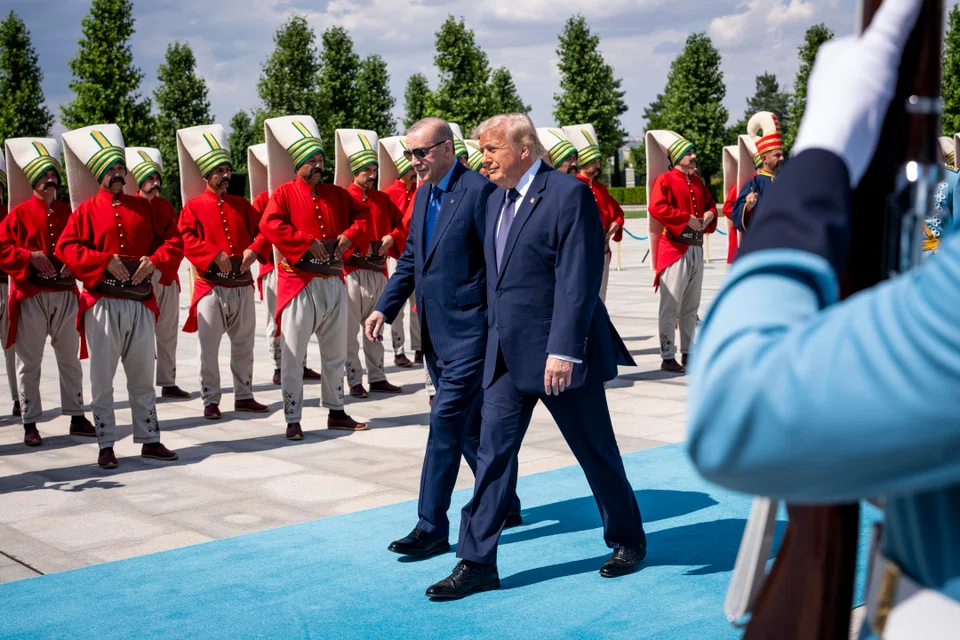
The summit brought that shift into sharper focus, with Trump heaping praise on Erdogan, while European allies largely refrained from publicly criticising the Turkish leader’s domestic record.
These shifts underscore the recognition of Turkey’s strategic importance and pivotal economic role in an increasingly unstable region.
They also encapsulate the dilemma confronting Western democracies: Some of the countries that are most critical to transatlantic security are among those drifting the furthest from democratic norms.
Press them too hard, and they may move into the orbit of rivals such as China and Russia.
Press them too little, and the erosion of democratic institutions can accelerate, undermining both the values the West seeks to defend and its credibility in defending them.
Reconciling these competing imperatives is extraordinarily difficult, as EU and Nato leaders are discovering.
Yet, doing so will be crucial to not only preserving the West’s credibility, but also realising Turkey’s full potential as both a strategic ally and an economic partner. PROJECT SYNDICATE
The writer, a former World Bank chief economist and former first deputy managing director of the International Monetary Fund, is senior research professor of international economics at the Johns Hopkins University School of Advanced International Studies and senior fellow at the Center for International Development at Stanford University.
TRENDING NOW

Malaysian king buys stake in Singapore-listed mining firm expanding into rare earths

Grab CEO’s wife Chloe Tong on life with Anthony Tan and finding her purpose

Once staunchly pro-China, Malaysian Chinese businesses are now distancing themselves from Beijing

Longer wait times expected as S’pore healthcare institutions report system disruptions

