

Why Italian PM Meloni’s trip to North America matters
Italy is not always seen as a top-tier global power, but it has systemic importance
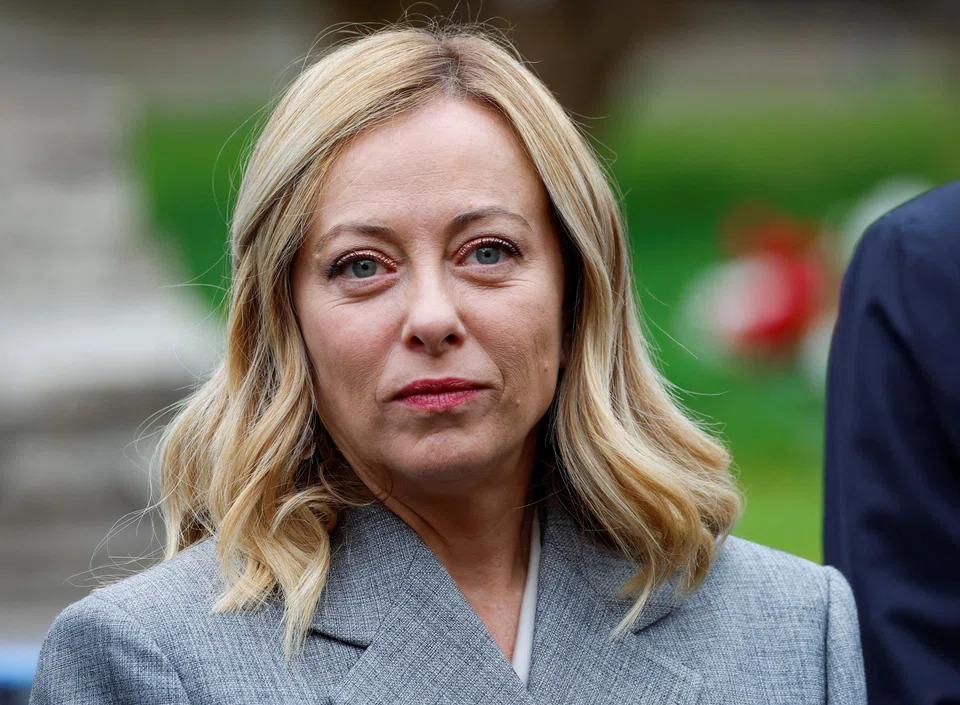
PRIOR to becoming Italian prime minister in 2022, Giorgia Meloni faced widespread reservations in the West about her suitability for high office. However, her foreign policy actions since have surpassed initial expectations in key Western capitals, including her strong support for Ukraine.
The latest indication of this will come on Friday (Mar 1) and this weekend with Meloni’s trip to North America to see US President Joe Biden and Canadian Prime Minister Justin Trudeau, partly in her capacity as this year’s chair of the G7. She is expected to get a warm welcome in both Washington DC, and Toronto, despite her previous spats with Trudeau.
In Canada, the agenda is economic, not just strategic. Italy and the wider 27 European Union (EU) member states see in the vast North American country a huge partnership opportunity to help diversify supply chains, especially on natural resources and green technologies, in the wake of the Ukraine war. Late last year, the two powers announced a new “Green Alliance” – the most comprehensive form of bilateral engagement under the European Green Deal.
Notably, there are several areas in Atlantic Canada where companies are vying to build massive wind-powered hydrogen and ammonia plants. The goal for most of them is to transport hydrogen – in the form of ammonia – to Europe, where there is a significant market for greener energy.
Hence the importance of the Canadian deal, which helps with the wider European goal of diversifying from the Chinese and Russian economies to boot. Canada is one of the key western allies that the EU would like to build stronger green economy supply chains with.
There are wider plans too for much greater cooperation in areas like carbon pricing and trading. Take the example of carbon pricing, where both Canada and the EU have a shared interest in rolling out carbon markets internationally. Europe was the first power in the world to introduce such a system – the EU Emissions Trading System – in 2005.
Moreover, Europe has welcomed Canada’s carbon pricing system, and announced it will become a partner of Trudeau’s Global Carbon Pricing Challenge. This challenge seeks to increase explicit carbon pricing coverage of global emissions to 60 per cent by 2030.
Meeting with Biden
Important as the Canadian leg of the trip is for Meloni, however, top of the bill is her Friday White House meeting. She has built up a good relationship with Biden, who initially had significant concerns about her far-right political roots.
Yet, she has more than surpassed his expectations with her strong support, so far, for Ukraine, despite Italian public opinion being more sympathetic to Russia than much of the rest of Europe.
The US president is also aware that within Rome, anti-establishment political parties like The League – which forms part of the Italian Government coalition – had, prior to the Ukraine conflict, sought a re-evaluation of Rome’s relationship with Moscow. This included calling for the lifting of pre-2022 EU sanctions.
However, on Feb 24, the second anniversary of Russia’s invasion, Meloni chaired the first meeting this year of the G7 leaders confirming strong unity in supporting Kyiv as well as the determination to continue providing Ukraine with assistance and to strengthen sanctions against Moscow.
Moreover, she asked that the Russian authorities shed light on the circumstances surrounding the death of Alexei Navalny, condemning the repression of political dissidents in Russia.
Beyond Ukraine, Meloni has also moved to terminate Rome’s membership of the Chinese Belt and Road project. Italy’s original decision to join this huge infrastructure scheme, in 2019, sent seismic shockwaves across the western world and saw a strong rebuke from the then Trump administration.
The rationale for U-turning on this issue is not just related to Western security. There is little evidence that Italy has benefited economically from the deal. Over the last four years, Italian exports to China have risen only modestly to around 16.4 billion euros (S$23.9 billion) in 2022, from a baseline of some 13 billion euros in 2019.
While Italy is not always seen as a top-tier global power, the reason why Biden cares so much about the relationship is Rome’s continued systemic importance in Europe and the wider West.
This includes its chairing of the G7 year in this critical period, with the conflict in Ukraine still underway, and key elections in multiple nations in 2024, including Russia, the US and the UK.
Italy’s structural importance in the West is also illustrated by the fact that it is the third-largest eurozone economy, and poses perhaps the biggest threat to the single currency area’s future. The country has the second-biggest debt load in the eurozone at well over 100 per cent of gross domestic product, and its banking sector is under significant stress with massive under-performing loans.
Taken together, Meloni’s important trip therefore has a significant economic dimension, but it will be strategic issues – with Ukraine at the top of the list – that dominate.
The writer is an associate at LSE IDEAS at the London School of Economics
TRENDING NOW

Inside Singapore’s government team that kills its own products

Once staunchly pro-China, Malaysian Chinese businesses are now distancing themselves from Beijing

Cliff Tan has 7 million followers and a 4-month waitlist. Why won’t he expand his business?

Grab CEO’s wife Chloe Tong on life with Anthony Tan and finding her purpose

