At the World Cup final, Fifa looks more American than ever
The football association is squeezing more revenue from eyeballs
THE World Cup was supposed to change the US. That was the common consensus for decades. Show Americans soccer at its highest level, the thinking went, and a nation devoted to its own football might finally embrace the world’s game.
Instead, America changed the World Cup.
Spain’s testy 1-0 win over Argentina on Sunday (Jul 19, early Monday morning, Singapore time) closed a tournament increasingly shaped by an American sports playbook – and that may be exactly what the competition needs to grow as a business.
Would a more profitable World Cup enrich Fifa, whose governance has earned scepticism? Yes. But it would also create more resources throughout the soccer ecosystem, from the academies and federations to the competitions themselves.
That is a worthy cause, especially following a report from Deloitte earlier this month that found a troubling trend.
While European soccer, the sport’s best and most valuable set of leagues, generated more than US$46 billion in 2024-25, the business model that has fuelled soccer’s growth is faltering.
The Premier League still earns the biggest revenues in club soccer. But its wage bill and losses are growing. Other major European leagues are seeing slowing or plateauing broadcast income, along with rising wage costs and operating losses of their own.
How it got to this point is hardly a mystery. European soccer’s decades-long boom depended on television rights that grew richer every renewal. The problem is that younger fans increasingly consume highlights, not matches, and soccer competes with a bottomless supply of digital entertainment.
As a result, rising rights fees, once an engine of growth, are not a sure thing anymore. It is a reality that threatens the investments that support talent pipelines and Europe’s high level of competition long-term.
New revenue streams
For Fifa, this is not somebody else’s problem. The World Cup finances much of the association, and Fifa still provides major funding for global soccer – from youth development to the small national federations that featured prominently at this summer’s tournament.
If the old growth model is weakening, Fifa needs ways to make the World Cup – and soccer in general – more valuable. One solution is simply to squeeze more revenue from the attention that you already have.
The National Football League transformed the Super Bowl half-time show from a marching-band snooze-fest into an Apple-sponsored entertainment spectacle that sometimes outshines the game itself. Television timeouts expanded alongside broadcast deals over the years, creating more opportunities for advertising.
Even rulebook changes intended to improve a game cannot escape commercialisation. This season, Major League Baseball introduced automated ball-and-strike reviews, then promptly sold the sponsorship rights to T-Mobile.
Of course, every business innovation comes with trade-offs, proving that nothing in modern sports is sacred. The Super Bowl half-time now lasts far longer than it once did. The breaks interrupt the flow of games. Something is undeniably lost when every pause in the action becomes an opportunity to sell more stuff.
American sports commissioners and executives are fine with the compromise because the job is not to preserve sports like museum pieces. It is to leave sports stronger than they found them. Regardless of what one thinks of America’s pro sports leagues, there is no denying that they are economically healthier than ever.
Fifa has begun to embrace that American approach to survival. Fox, its US broadcast partner, will reportedly make as much as US$600 million selling ads during mandatory hydration breaks implemented to protect players’ safety.
It is a windfall for the network that should make World Cup rights more valuable in the future, though at the expense of a more free-flowing match.
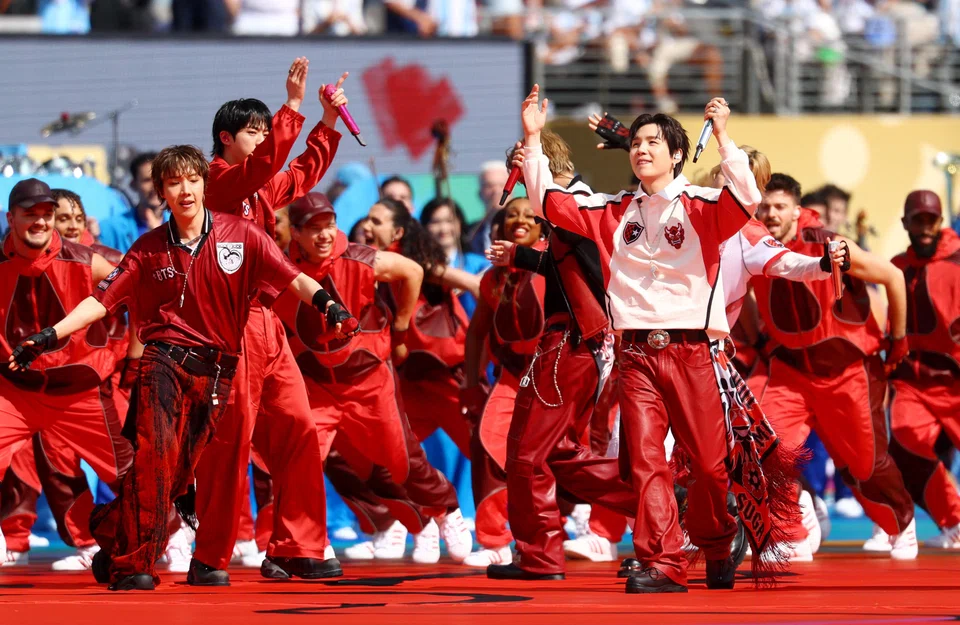
In another commercial leap forward, Sunday’s final featured the tournament’s first Super Bowl-style half-time show. BTS, Madonna and Shakira, were among the headliners, likely drawing an audience well beyond sports fans interested in the final (social media was filled with instantaneous commentary).
But it came at a cost: the spectacle ran nearly twice a standard 15-minute half-time intermission, forcing athletes with highly regimented routines to simply sit and wait.
Can’t afford restraint
Off the field, Fifa president Gianni Infantino has embraced the same market logic. Defending dynamic ticket pricing, he argued that if fans are willing to pay those prices on the secondary market, Fifa should capture more of that value itself.
It is the same philosophy that leads American professional sports leagues to welcome dynamic pricing and official resale platforms.
It is a money grab, for sure, and fans who remember Fifa’s corruption scandals are right to bristle.
They, more than Fifa, seem to recognise that soccer has remained unique among major sports because it has not monetised every dead space. Restraint has made the sport distinctive. But as the global media landscape fractures, soccer cannot afford restraint.
Soccer lovers can object to the interruptions and spectacle, but the economics are harder to argue with. If Fifa discovers a more profitable version of the World Cup that audiences still embrace, every major soccer competition will face pressure to follow.
So far, the association is projecting record revenues of US$10 billion. But more importantly, Fifa’s money chase is not costing it viewers. Over the course of the tournament, it has enjoyed record-setting broadcast audiences, and not just in the host countries.
Norway, Sweden and Australia, among the handful of nations reporting numbers, had all-time broadcast audiences during the group stage rounds.
Maintaining that global game is not easy; it requires constant evolution. At Sunday’s match, that evolution was on full display, thanks to an American playbook. Fifa would be wise to keep following it. BLOOMBERG