

CICT’s Tan Choon Siang marks first year with billion-dollar deal streak
Acquisition of Paragon and divestment of Asia Square Tower 2 follow CapitaSpring deal and ION Orchard acquirement

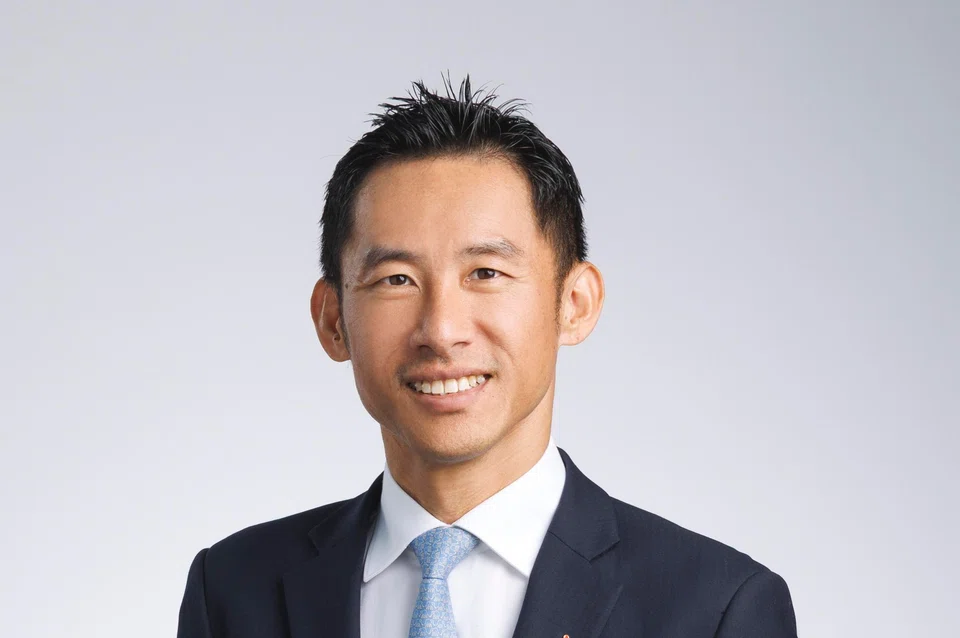
[SINGAPORE] Since taking the reins a year ago, Tan Choon Siang, chief executive of CapitaLand Integrated Commercial Trust’s (CICT) manager, has kept the real estate investment trust (Reit) firmly in motion, stepping up its capital recycling game with a string of mega deals as it reshapes its portfolio.
Its latest moves – the S$3.9 billion acquisition of Paragon and divestment of Asia Square Tower 2 for S$2.5 billion – come on the heels of last year’s CapitaSpring deal and its ION Orchard acquisition in 2024. CICT purchased the remaining 55 per cent interest in the Grade A office building for S$1 billion, and the 50 per cent stake in ION Orchard and ION Orchard Link at S$1.85 billion.
Over the past year, CICT units have risen about 10 per cent to S$2.36 as at market close last Thursday (Apr 30). The largest Reit in Asia-Pacific markets, its market capitalisation now stands at around S$18 billion. Distribution per unit (DPU) in FY2025 was up 6.4 per cent at S$0.1158, from S$0.1088 the previous year.
“(But) three years is not a pattern,” Tan said with a chuckle.
“If we do see an asset that we like, and we are able to fund it and buy it at a price that makes sense for unitholders, we will definitely take a look,” he said in an interview with The Business Times.
“It just happens the environment is conducive and in the right market cycle (with interest rates easing). And I think sometimes, you have to be lucky.”
In the case of Paragon, “the whole thing came about firstly because we were able to unlock value from Asia Square Tower 2 and monetise the asset”, said Tan. Proceeds from the divestment, together with a private placement that raised around S$750 million and some S$700 million in debt, will fund the acquisition.
The manager approached Cuscaden Peak with an “unsolicited offer” earlier this year, after it had some interest in divesting the office building. “Without that, the second part of the equation would not have happened.”
For one thing, Tan noted that acquiring “valuable” freehold assets in Singapore is challenging as they typically trade at tighter yields.
Strong interest in core Central Business District (CBD) offices also supported the divestment.
Asia Square Tower 2 is a “very high-quality (core) asset” that has always performed “very strongly” for the Reit, with stable income and high occupancy.
“We’ve owned it since 2017, (adding) value along the way, and this is an opportune time to unlock value,” said Tan.
The trust’s last three acquisitions have been for “very rare, high-quality prime Singapore commercial assets”.
At Paragon, around 30 per cent of space is for office use, of which roughly 83 per cent comprises medical suites. “That medical space is a very strong and defensive sector,” said Tan, citing Singapore’s ageing population and rising medical tourism.
After raising CICT’s private placement to S$750 million, the Paragon deal is now expected to be 1.7 per cent accretive to DPU, down from the earlier forecast of 2.1 per cent.
This is “still very healthy”, Tan said, given that it is from a single transaction. Gearing eased to 38.7 per cent, from the previously projected 39.2 per cent.
“Generally, if you’re able to get anything north of 1 to 1.5 per cent, actually that’s very good accretion,” he added. “So we are quite happy with (the accretion). It is sufficient without sacrificing balance sheet strength.”
Balancing disruption and value
When Cuscaden Peak proposed privatising Paragon Reit in 2025 – when the mall was held as a 99-year leasehold property by the trust – it cited plans for a major overhaul needed to improve the mall’s standing in order to compete with other prime retail assets.
The asset enhancement initiative (AEI) was expected to take up to four years, with capital expenditure of S$300 million to S$600 million.
Whether such a major AEI is still on the cards will be subject to fresh evaluation, CICT has said.
While Paragon is seen as a trophy asset with its current full occupancy and strong luxury tenants, its greater value lies in the freehold title of the prime Orchard Road site on which the mall stands.
With other asset owners on the retail strip such as Frasers Property and Hotel Properties Ltd eyeing redevelopments in line with a government plan to rejuvenate Singapore’s shopping street, is a rebuild in the pipeline?
“Redevelopment is the optionality… because when the tenure dwindles down to, say, 50 or 60 years, that’s when you will be really thankful that you own a freehold title,” he said.
Any AEI would require careful consideration. As the new owner, CICT has yet to have established relationships with Paragon’s tenants, and the works would be disruptive.
“It disrupts not just ourselves in terms of cash flows, (but also) tenants’ operations,” he said, especially those who have already invested “significant capital expenditure” into their stores.
Over the past year, several of the mall’s luxury brand tenants have significantly expanded their footprint in the property. Bottega Veneta in December 2025 opened a two-storey Singapore flagship, while Balenciaga and Tom Ford opened new duplex spaces earlier.
Potential AEIs would therefore be phased, focusing on improving internal and external connectivity, visitor flow and overall efficiency, said Tan.
CICT has also said that with 30 per cent of leases up for renewal by the end of 2027, there will be the possibility of positive rental reversions as leases roll over, and the Reit will look at refreshing the tenant mix.
“We have to go in and take a look (once the transaction completes),” he added. “We can’t say that Paragon is not doing well as it is, so I don’t necessarily think it requires an overhaul… We’re probably tweaking at the margins.”
While the Reit’s major acquisitions over the last three years have brought inorganic growth, CICT is undertaking AEIs across several properties to drive organic growth.
On Apr 24, the manager announced a S$160 million asset enhancement at Plaza Singapura and The Atrium@Orchard. The works will be carried out in phases from Q3 this year to Q4 2028, with the mall remaining open and operational throughout.
Most of its existing tenants will not be affected, though “there will be some turnover” in areas affected by the AEI, Tan said.
The manager has also secured “good commitment” from new tenants, with the revamp also aimed at bringing in new brands.
All in, the Reit manager has announced AEIs for seven properties. Three have been completed at a cost of around S$325 million, while another four are under way or will start this year, costing a total of S$246 million.
At Clarke Quay, however, a S$62 million AEI completed in April 2024 has not quite had the desired effect. The rebranded CQ@Clarke Quay has seen occupancy fall to 80-plus per cent recently, with business said to be slow for tenants as the property pivots from a nightlife hub to a “day and night space”.
“Clarke Quay is tough,” Tan acknowledged, due to ongoing construction taking place around it, but it may be “premature to think Clarke Quay at its current state is the norm”.
He sees footfall improving in the near future with the completion of the nearby Canninghill Piers integrated development. The City Developments Ltd and CapitaLand mixed-use project holds almost 700 residential units as well as two hotel properties.
Growth drivers
Over the past year, the trust’s average rental reversion was about 6 to 7 per cent. This was even higher in the prior year in the high single digits.
With rental reversions calculated based on the average incoming rent of a new lease versus the outgoing rent of expiring leases, “if I have a rental reversion of 6 to 7 per cent, I can still benefit from a yearly growth of around 2 to 3 per cent every year for the next three years”, Tan said.
This is “very reasonable” in a market with inflation of around 1 to 1.5 per cent, and these are “hardly numbers that will drive someone out of business”, he added.
What else might be in the pipeline for CICT? For one thing, its sponsor’s development arm CapitaLand Development owns a 49 per cent stake in Jewel Changi Airport, a showcase mall that draws both tourists and local shoppers.
While Jewel is a “great asset” that is “doing very well”, Tan said it is unclear “if it’s immediately ready for injection into the Reit, or even eventually”.
“We believe in the Singapore growth story,” he said, pointing to the Republic’s ever-growing population and tourism industry. The real estate market also remains limited.
“It’s complicated,” he quipped.
As a fund manager, CICT is always evaluating whether to hold or sell its assets, said Tan. “If you have a need for capital, because you need to buy something, then that gives you an even greater incentive to execute a divestment. But if you have no immediate need for funding… then you don’t have to rush these things.”
Currently, CICT has a debt headroom of about S$700 million to S$800 million.
Bukit Panjang Plaza was divested since the manager prefers to be the “dominant mall” in a given area.
Also in CICT’s pipeline is an upcoming mall within a massive mixed-use development at Hougang Central. The trust will develop and fully own the commercial component, spanning about 300,000 square feet in net lettable area. An 835-unit residential component is being built by UOL and CapitaLand Development.
Total development cost is estimated at around S$1.1 billion.
Tan said undertaking such a large and complex greenfield project was not in CICT’s “natural DNA”. But the Hougang parcel was “very unique” given its sizeable retail component and strong connectivity, with two MRT stations and a bus interchange, alongside private residences.
In comparison, the retail portion of most integrated developments is typically limited to a podium. “So it’s not so interesting for us,” he said. “But (this) is a real mall that is bigger than Junction 8.”
“I don’t think it’s something that we will repeatedly do,” he added. “Buying completed core assets is something that is more in our DNA.”
Although the manager will definitely “look at things that come to the market”, including the array of prime CBD office assets now up for sale, Tan said it will remain disciplined in its acquisition and funding approach, stressing that any deal must be accretive and enhance the trust’s overall portfolio without “adding stress to (its) balance sheet”.
TRENDING NOW

If Europe goes to war, the fallout will be felt in East Asia

COE review: Motor traders suggest using vehicle length, engine size and power to classify cars

Firms linked to haze pledge cooperation in meeting with Shanmugam; government to table changes to haze law
Indonesia stocks suffer worst plunge in nearly 30 years as MSCI proposes standalone status

