

EC prices hit new highs amid rising land costs, fierce developer competition
Median prices of new and resale units are more than double 2015 levels, hitting their highest since 1996


[SINGAPORE] Executive condominium (EC) prices have climbed to new highs in 2025, with new sale prices crossing S$1,700 per square foot (psf) for the first time.
Analysts attributed the rising prices to growing land and development costs, as well as stiff competition for EC land among developers, as fewer sites have been released for tender in recent years than before.
Caveats data showed that the median price of new EC units stands at S$1,754 psf in the year thus far, 14 per cent higher than 2024’s S$1,538 psf and more than double the S$797 psf recorded in 2015.
Resale ECs fetched a median price of S$1,389 psf in 2025, up slightly from S$1,337 psf in 2024; this is also nearly twice the 2015 level of S$720 psf.
Current levels of both new sale and resale prices are now the highest recorded since data was available in 1996.
Resale transactions studied by property consultancy Cushman & Wakefield found EC transactions to be among the most lucrative, with sellers reaping profits of more than 100 per cent.
Statistics from PropNex showed that resale projects completed in 2019 had an average profit of S$805,805. The average holding period was 7.7 years, and the average annualised profit was 9 per cent.
EC projects completed in 2016 posted an average profit of S$624,327, with a holding period of 8.4 years and 6.6 per cent annualised profit. Profits for projects completed in 2014 averaged at S$545,828, with a holding period of 9.2 years and 6.4 per cent annualised profit.
Lee Sze Teck, Huttons Asia senior director of data analytics, attributed the recent price increases to higher land and construction costs.
“From 2021 to 2024, land prices for EC developments increased by almost 20 per cent while construction costs also spiked by almost 20 per cent,” he said.
Average selling prices grew almost 32 per cent over the same period.
Lee added that land price hikes were fuelled by stiffer developer competition for EC land.
“Developers had sought to add this asset class to their portfolio following cooling measures on the private residential market,” he said. “This asset class offered developers stable returns, albeit with a narrower profit margin.”
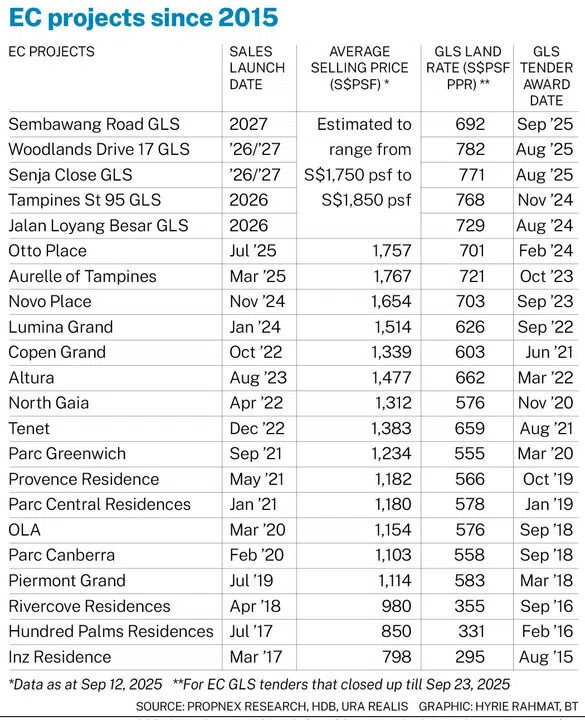
In August 2025, two EC sites under the government land sales (GLS) programme drew five bids each. City Developments Ltd set a new benchmark for one of the two in Woodlands, with a land rate of S$782 psf per plot ratio (ppr).
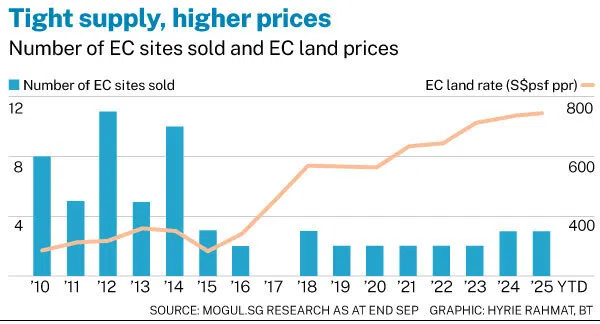
Supply of EC sites has tightened in recent years.
Nicholas Mak, Mogul.sg chief research officer, said that between 2010 and 2014, the government – the sole seller of EC land – released an average of 7.8 EC sites for sale each year.
A total of 4,227 units were built on the 39 sites that the government sold in that period.
“The significant supply of EC units contributed to keep the lid on the prices of EC land to below S$400 psf ppr,” said Mak. This was especially because EC buyers were barred from purchasing another property during the five-year minimum occupation period (MOP).
Mak noted that since 2015, the number of EC sites released for sale has averaged just 2.2 each year. “As a result, the land rate of the EC sites began to rise steadily from S$284 psf ppr in 2015 to an average of S$748 psf ppr in the first nine months of 2025.”
Rules on harmonised gross floor area (GFA) definitions have also nudged psf prices higher, said Wong Siew Ying, PropNex Realty’s head of research and content.
Under the new rules, all strata areas will have to be included as GFA, which is controlled by a site’s Master Plan plot ratio. This results in greater transparency for buyers on the amount of usable space a unit has, but a higher psf rate.
Firm demand
Cushman & Wakefield research head Wong Xian Yang said that despite higher prices, demand for EC homes continues to hold strong, with most new projects drawing strong take-up.
The latest EC launch – Otto Place in Tengah – sold 351 units, or 58.5 per cent of its 600 units, when it hit the market in July. The average price of its units sold under the normal payment scheme was S$1,700 psf.
Novo Place, also in Tengah, had a take-up rate of 57 per cent – or 286 units – over its launch weekend in November last year. Prices averaged at S$1,654 psf, a new benchmark for EC projects then.
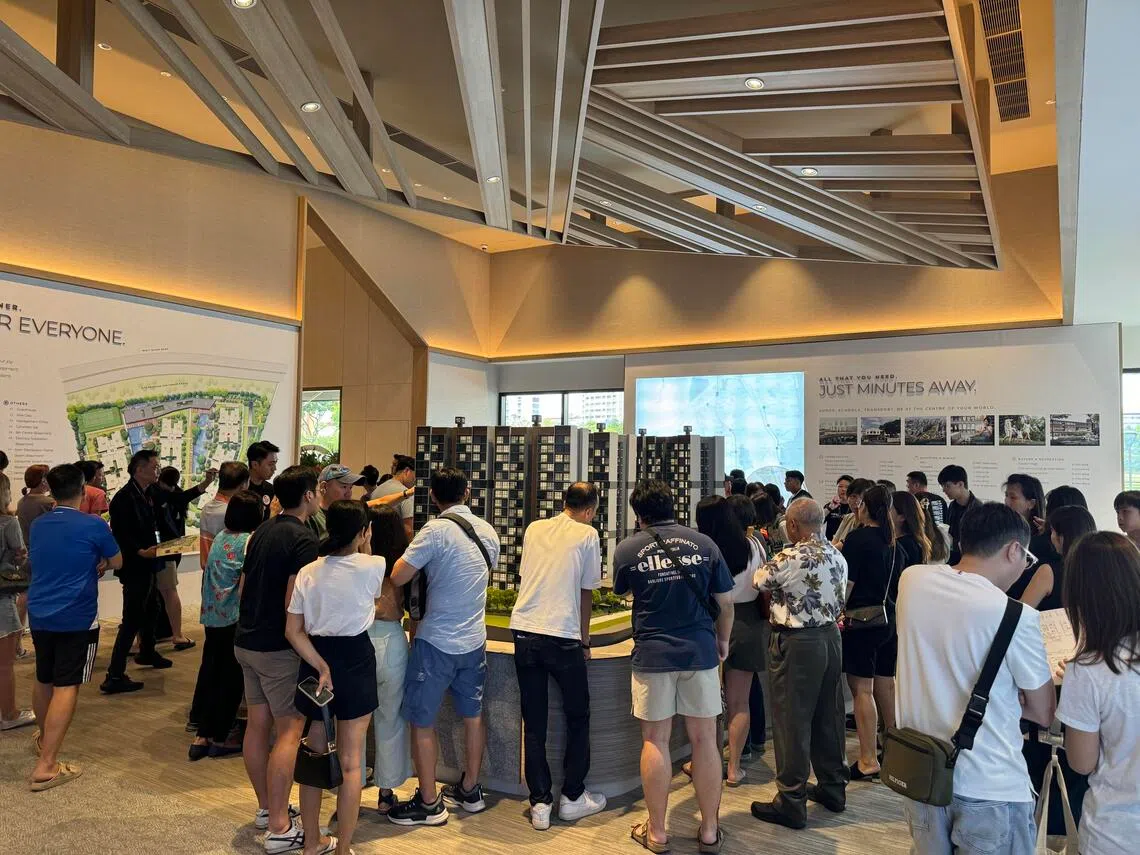
Wong of PropNex noted that, as at end-August 2025, there were only 73 unsold new EC units on the market. Of these, 59 were at Otto Place.
Singaporeans dominate resale EC demand, accounting for nearly 84 per cent of buyers in the year to date, up from 75.2 per cent in 2020, noted Huttons’ Lee. Permanent residents (PRs) made up the remaining 16 per cent of buyers in 2025, from 24 per cent in 2020.
More Singaporeans could be buying resale ECs due to policy changes, said Lee, citing the “sharp jump” in additional buyer’s stamp duty (ABSD) of 60 per cent for foreigners.
Older ECs are also larger, and PRs are restricted from buying a public resale flat within three years of their PR approval, diverting demand to the resale EC market, he said.
With EC prices catching up with suburban condominium prices, PropNex’s Wong thinks some buyers could favour the latter.
“However, it is also important to point out it is not just pricing that makes ECs stand out,” she added.
Subsidies and policies such as the Central Provident Fund Housing Grant of up to S$30,000, deferred payment scheme, and ABSD remission help keep new ECs attractive to buyers, she noted.
Cushman’s Wong added that median prices of new ECs remain significantly lower than those of comparable non-landed private homes in the Outside Central Region (OCR).
In the year to date, the price gap between the two stands at 29 per cent, with a new sale median price of S$1,762 psf for ECs and S$2,275 psf for OCR condos.
Since 2019, the price gap has ranged from 25 to 47 per cent.
Prices of mass-market condos may climb even further, as private housing state land sites draw record bids, said Wong of PropNex.
For instance, the Bayshore Road GLS site fetched a record land rate of S$1,388 psf ppr for an OCR plot in March, while a Lakeside Drive site drew a S$1,132 psf ppr land rate in June. Another two GLS sites in Chuan Grove saw land rates of above S$1,300 psf ppr.
Going forward, Mak from Mogul.sg expects EC prices to remain elevated, given the limited land supply.
While there are five sites on the GLS confirmed list this year, this is still below the average of 7.8 sites sold per year from 2010 to 2014, he said.
He added that calls to raise the income ceiling for new ECs may fuel prices further, as it could open up the EC primary market to buyers with higher purchasing power. This could allow developers to raise new EC prices, which tends to act as the “floor price” for the private housing market, said Mak.
Instead, he proposed ramping up EC supply to more than seven sites annually, as well as a subsidy clawback and longer MOP of 10 years, in line with public homes under the Prime and Plus models, to rein in EC prices.
Otherwise, Mak believes the EC programme risks benefiting only a narrow group of buyers who benefit from “significant tax-free capital gains”, while doing little to stabilise prices – and widening Singapore’s housing inequities.
TRENDING NOW

If Europe goes to war, the fallout will be felt in East Asia

Indonesia stocks suffer worst plunge in nearly 30 years as MSCI proposes standalone status

Keppel seeks US$1 billion for Vietnam investments as it joins country’s international financial centre
Philippines’ FDI slowdown exposes uneven investment prospects across S-E Asia

