Frasers Hospitality repositions portfolio with move into premium rental apartments
China anchors company’s premium rental push with launch of Modena by Fraser Shenzhen


[SHENZHEN] Frasers Hospitality is undertaking a group-wide repositioning across its portfolio, extending beyond its core serviced apartment business into the premium rental apartment segment as it adapts to shifting demand trends.
The process kicked off with the launch of Modena by Fraser Shenzhen – a 325-unit premium rental apartment for young working professionals – on Jan 22.
The shift reflects changing living patterns and growing demand for premium rentals in China. Travellers and relocating residents are increasingly younger, while fewer senior professionals move with their families.
Companies are increasingly deploying project teams for six to 12 months, said Frasers Hospitality’s chief executive officer Eu Chin Fen.
Homeownership has long been a key milestone in Asia, but a decade of low or negative interest rates has pushed property prices beyond the reach of many younger buyers, making renting more common.
Meanwhile, alternative investments such as stocks and bonds offer liquidity and flexibility, reducing the need to buy property for wealth accumulation, said Jason Leong, executive director and head of investment and asset management at Frasers Hospitality.
Thus, renting gained traction even before Covid-19 – driven by lifestyle preferences and convenience – with the pandemic accelerating this trend and clarifying demand patterns.
Long-term rental segment
Launched in 2010, the Modena by Fraser brand was originally positioned a notch below the company’s branded residences such as Fraser Suites and Fraser Residence – catering to short and medium-term stays.
Older Modena properties, such as in China’s Changsha or Wuhan, featured high-end finishes and amenities like swimming pools. “They don’t really cater to the mid-tier,” said Frasers Hospitality’s chief operating officer Chew Hang Song, adding that the overlap with luxury residences meant missed opportunities in a key segment.
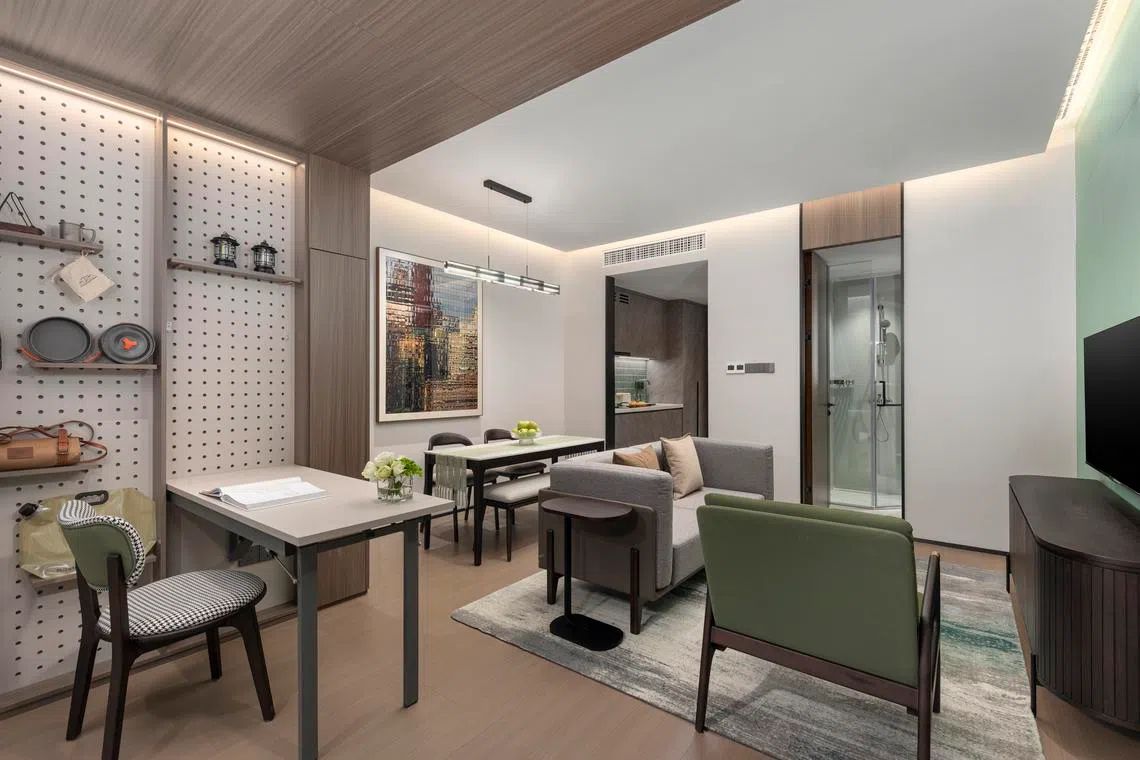
Modena by Fraser Shenzhen offers nine room types, from studios of 25 to 31 square metres (sq m) to two-bedroom executive apartments of 88 to 103 sq m, designed for long-stay young professionals.
Occupancy is near 70 per cent and set to exceed 80 per cent in 2026, said Chew. Locals, Hong Kong students, Japanese expatriates and white-collar professionals account for a majority of rental enquiries.
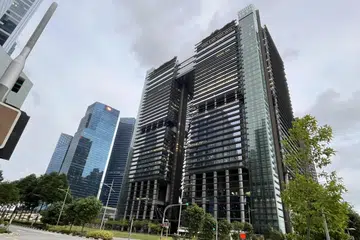
The 16-storey building sits within the 54-storey Shennan 1001 building and has a 40-year lease expiring in 2057. It was jointly acquired with developer Tishman Speyer in May 2023.
Frasers Hospitality also manages Tishman Speyer’s 307-unit property in Wujiaochang, Shanghai, which soft-opened last May. The US developer had acquired a majority stake in the hotel and converted it into premium rental apartments.
Frasers Hospitality said it evaluates each opportunity individually, considering investment and operational factors, capital intensity, and risk-return alignment before deciding on a joint venture.

China strategy
Beyond the Shenzhen project, Modena by Fraser is central to the company’s long-term China strategy.
“China used to be a key growth engine, and while growth has slowed, the country remains rich in resources and innovation. It is still producing business for us,” said Eu.
Chew noted that China’s vast rental market is shaped by its nearly 1.5 billion people, and the increasing number of younger buyers priced out of owning homes.
While government-led housing provides affordable options, a gap remains for premium rentals, he said. “We don’t compete with mass-market rentals, but we’re also less expensive than full-service apartments.”
Currently, the asking rent for a one-bedroom apartment of 41 to 76 sq m at Modena by Fraser Shenzhen ranges from 12,000 to 16,500 yuan (S$2,190 to S$3,000), including services such as housekeeping. Two-bedroom units of 75 to 103 sq m range from 20,000 to 28,800 yuan, including services.
Rents for mass market one and two-bedders in the Luohu District – where Modena by Fraser Shenzhen is located – range from 3,000 to 6,000 yuan per month.
Frasers Hospitality plans to expand the brand to Chengdu and Dalian in the next 12 to 18 months, with openings expected in the first half of the year and late 2026, respectively.
The company’s China strategy focuses on first-tier and 1.5-tier cities such as Chengdu, Wuhan and Hangzhou, which have strong gross domestic product, high incomes and expatriate populations, said Chew.
Frasers Hospitality will also strengthen its presence in existing cities and target different customer segments across various locations.
The repositioning applies to new developments, while existing properties will be updated gradually according to lifecycle, commercial and market considerations. Frasers Hospitality currently operates 11 Modena properties with over 2,300 keys.
While some observers noted a perceived decline in Frasers Hospitality’s China presence, the company attributed it to ownership factors.
For example, it used to manage Fraser Suites Top Glory Shanghai, a serviced apartment that catered to senior expats, before the third-party owner – a subsidiary of Cofco Group – decided to sell the property.
It also no longer manages Fraser Place Shanghai Xintiandi and Fraser Suites Nanjing, after owners decided to exit at a high between 2020 and 2023.
Product choice varies by markets, said Eu, noting that Fraser Suites, for instance, is popular in the Middle East for larger units.
“We still want to grow and we are still profitable, but we are not just chasing numbers. For every product that we do, we must ensure that it is in the right location, city and has the right business model.”
Said Leong: “Real estate is getting expensive everywhere, so you must refine the business model. At the end of the day, you ask: for S$100, why should I build this versus other options?”
Other refreshes
Outside China, Frasers Hospitality is focused on refining its core brands.
The next brand in line for repositioning is Fraser Suites, marked by the scheduled opening of Fraser Suites at One Bangkok in Thailand by year end. The new property will feature a “more sophisticated and uplifted version” of the brand.
The company operates 22 Fraser Suites properties with over 3,300 keys. Older Fraser Suites may also be refurbished.
“Whether it’s Fraser Suites or it’s Modena, we’re taking a hard look at all our brands across the portfolio and refining them up to the expectations of consumers’ evolving needs, post-Covid especially,” said Chew. Other core brands – Fraser Residence, Fraser Place and Capri – are under review and work is in progress.
These repositioning efforts come against the backdrop of Frasers Hospitality Trust’s (FHT) privatisation last year, which Eu described as a capital-focused exercise. To do well, the previously listed trust needed to grow its asset base and net asset value.
So, when growth became constrained, the sponsor group, Frasers Property Limited, decided to take it private to “unlock value and return a premium to stapled securityholders”.
“Hospitality as an asset class remains strategic for Frasers Property,” said Eu, adding that the group continues to invest selectively in segments where it has strong operating capabilities and brand strength.
Following the privatisation, FHT assets are now under Frasers Property and Thailand-based TCC Assets*, giving the company greater flexibility to unlock value without the near-term distribution pressures typical of a real estate investment trust structure. (*see amendment note)
“At the end of the day, every business comes down to the P&L (profit and loss) and the balance sheet,” said Eu.
“The operator’s role is to drive earnings, while the real estate side stewards the balance sheet. Everything has to be contextualised around value creation – and in real estate that means generating returns that justify the capital invested.”
*Amendment note: An earlier version of this article incorrectly stated that FHT assets are now under Thailand-based TCC Group. This has been corrected to Thailand-based TCC Assets.