

Should the prime Raffles Town Club site be earmarked for HDB homes?

SINGAPORE’S various social and recreation clubs offer their members use of a wide range of dining and sports facilities as well as opportunities to network and participate in curated events. I enjoy being a member of two such clubs.
Still, there are doubts over the long-term viability of clubs as dining, entertainment, wellness and leisure options abound in Singapore.
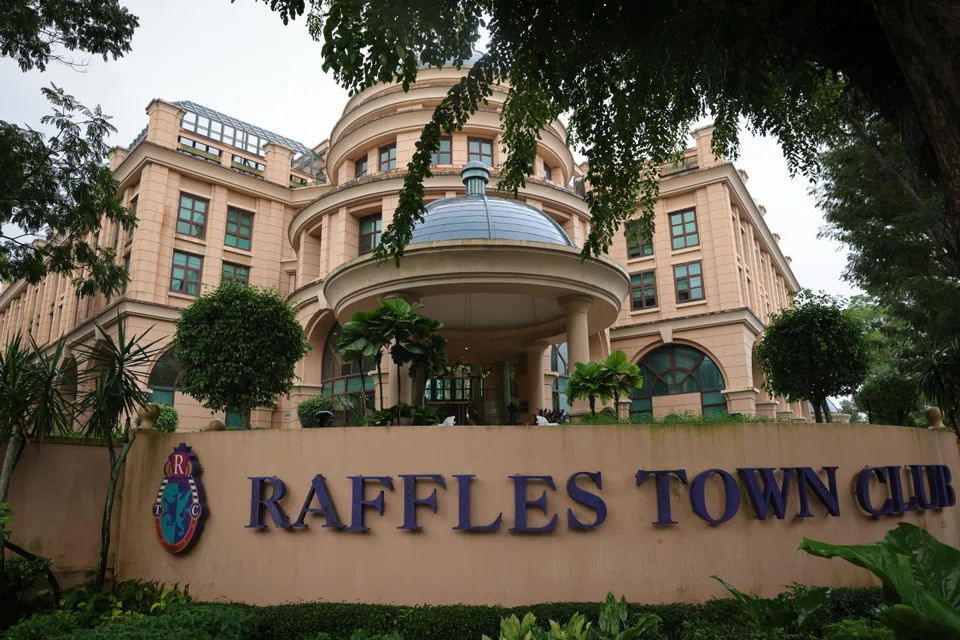
While clubs in general grapple with staying relevant over the longer term, members of Raffles Town Club (RTC), located at 1 Plymouth Avenue in the heart of Bukit Timah, face a pressing problem in the short term.
The lease of the site in District 11 occupied by RTC will not be renewed when it expires on Oct 17, 2026. The 12,318 square metre plot of land is slated for future residential development. RTC will have to find new premises to continue operating as a club after the return of its current site to the state.
The Singapore Land Authority and Urban Redevelopment Authority said in a joint statement on Nov 20 that the move to redevelop RTC is in line with Singapore’s focus of redeveloping brownfield sites as much as possible to meet future demand for land, including housing,
Certainly, land should be put to optimal use in land scarce Singapore. As the population grows and household formation rises even faster, more land will be needed for homes.
Public housing option
Perhaps the best use for the RTC site is to build Housing and Development Board (HDB) flats.
First, having a mix of public and private housing across all neighbourhoods islandwide is desirable. This facilitates interaction among residents of HDB and private homes instead of having HDB and private home dwellers live in distinct enclaves.
The Bukit Timah area, with its many landed homes and condominiums, is overly represented by private housing. Constructing new HDB homes in the area can create a better mix of housing options in the neighbourhood.
Building new HDB flats at the former Bukit Timah Turf City site, near Swiss Club Road, and the RTC site will lead to a welcome infusion of public housing into the Bukit Timah area, which is a sought-after residential neighbourhood.
Second, the RTC site, which is located near Tanglin Community Club and the Singapore Botanic Gardens, lends itself well to building HDB homes. As the site sits at the corner and intersection of Whitley Road and Dunearn Road, a taller development may be built there.
Moreover, the RTC site is well served by public transport. Residents of future homes to be built on the site will enjoy easy access to many buses as well as the Stevens MRT station.
Third, families with young children will be keen to live in new HDB flats that might be built on the RTC site.
Living in such homes will place families within one kilometre (km) of popular primary school Singapore Chinese Girls’ Primary School, for instance. A child who is a Singapore citizen, with no alumni or other connections to the school, may be able to secure a spot by virtue of living within one km of the school.
In short, building HDB homes near popular Bukit Timah area primary schools can help improve the diversity of the student population at such schools.
Fourth, the HDB is boldly building new HDB homes in central locations including the Greater Southern Waterfront. At the same time, the HDB has measures, which will be further strengthened, to ensure build-to-order (BTO) homes in popular locations, are affordably priced and that owners of such BTO flats do not make windfall gains.
Currently, buyers of BTO homes under the Prime Location Public Housing model enjoy higher subsidies but face tighter restrictions.
Starting from the second half of 2024, new BTO homes will be offered as Standard, Plus or Prime homes. Buyers of BTO Plus and Prime flats – located in choice and the most prime central locations respectively – will receive more subsidies but face tighter restrictions including longer minimum occupation period, stricter rental restrictions, the clawing back of proceeds upon selling the home, and re-selling to a more restricted pool of buyers.
Any new HDB homes to be built on the RTC site can be classified as Plus or Prime flats, resulting in unit pricing that is affordable to many applicants and limitations on windfall gains to the BTO owners.
Private housing option
Bukit Timah is an established private housing area. Expect developers to show healthy interest for the RTC site should it be redeveloped for private housing.
If the RTC site is sold as a 99-year private housing site with a plot ratio of 2.1, the site may fetch close to S$420 million, based on price per square foot (psf) per plot ratio of S$1,500.
New private homes to be built on the RTC site could be marketed as luxury units with selling prices exceeding S$3,000 psf. Such homes might attract interest from homebuyers who are familiar with the Bukit Timah area and/or enjoy the bragging rights of owning a home in the area.
Many Singaporeans own their homes. HDB homes, which house close to 80 per cent of residents, are affordably priced and of a high quality. Generally, HDB estates are well served by transport and other amenities.
Nonetheless, dealing with inequality is a constant challenge in a global city that draws the wealthy as well as creates good opportunities for the talented.
Managing inequality well can in turn boost Singapore’s competitiveness. After all, investors with long-term horizons value putting large sums of money to work in places where people are united and socially cohesive.
Government coffers suffer if the RTC site is not used for private housing. And enriching the government coffers is vital as higher public spending is needed to deal with an ageing population.
However, combating inequality matters. Earmarking the RTC site for building new HDB homes supports efforts to manage inequality.
Locals should not hold unrealistic expectations of staying in prime districts for reasonable prices. Still, opening up prime districts to HDB homes helps in achieving the invaluable goal of building a cohesive society.
TRENDING NOW
Once staunchly pro-China, Malaysian Chinese businesses are now distancing themselves from Beijing

New launch or resale unit? Here’s a guide for homebuyers
The lesser-known prospects in the Asian chipmaking supply chain

Cliff Tan has 7 million followers and a 4-month waitlist. Why won’t he expand his business?

