

Singapore residential rents stabilising after correction as leasing activity recovers in Q2
Rents are expected to stay broadly flat in 2025; smaller units face pressure as new supply comes online while larger homes remain in demand

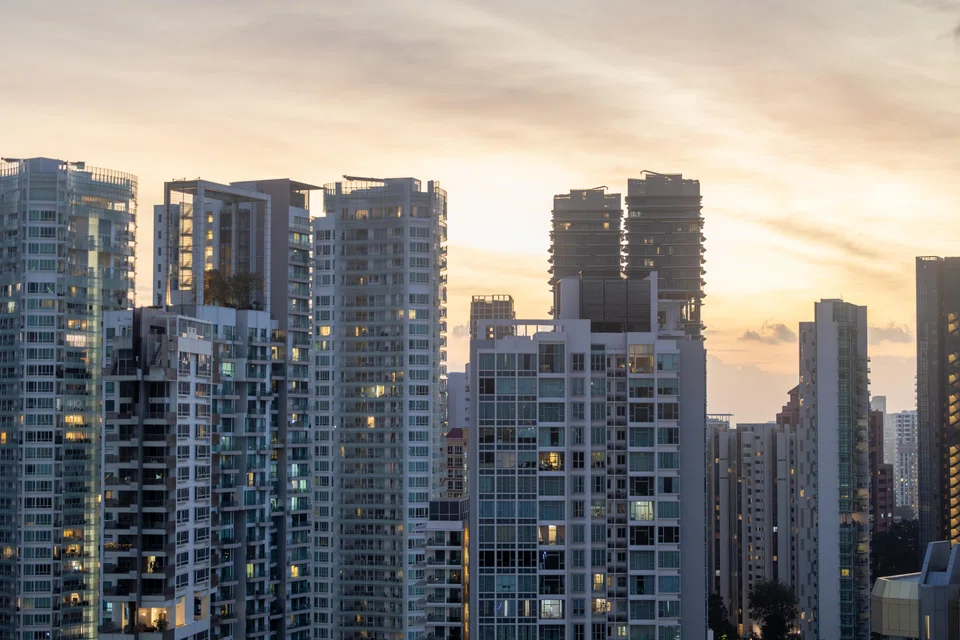
[SINGAPORE] The private residential rental market is showing signs of stabilisation after a recent correction, with leasing activity picking up and overall rents edging higher, though gains are uneven across regions and unit types.
Rental volume, excluding executive condominiums, rose 2.8 per cent on quarter to 21,330 units in the second quarter. This was 3.2 per cent higher than the year-ago quarter and 1.2 per cent above the five-year Q2 average from 2020 to 2024, according to a report by Savills Singapore.
The rental index of private homes rose 0.8 per cent on quarter in Q2, extending from the 0.4 per cent quarterly increase in Q1, data from the Urban Redevelopment Authority (URA) showed.
“With a cumulative 1.2 per cent increase in H1 2025, rents are recovering after the 1.9 per cent correction in 2024,” said CBRE’s head of research Tricia Song.
However, the recovery is mixed, with the increase in rents largely supported by the landed segment and prime Core Central Region (CCR) condos, she noted.
Landed property rents rose 0.7 per cent despite a 2 per cent decline in volumes, while non-landed rents in the CCR increased 1.8 per cent on quarter, compared with 0.1 per cent in the Outside of Central Region (OCR) and flat rents in the Rest of Central Region (RCR).
Leasing activity in Q2 was driven by the start of new financial cycles in many businesses and continued commitment to expat housing, said JLL Singapore’s head of residential research Chia Siew Chuin.
Rents hold steady
Average monthly rent for high-end non-landed projects tracked by Savills rose 0.7 per cent to S$5.99 per square foot (psf).
The top three areas with the highest average median rents for three-bedders were District 4 (Harbourfront/Telok Blangah) at S$8,500, District 1 (Boat Quay/Marina/Raffles Place) at S$8,475, and District 9 (Orchard/River Valley) at S$7,500, said Savills.
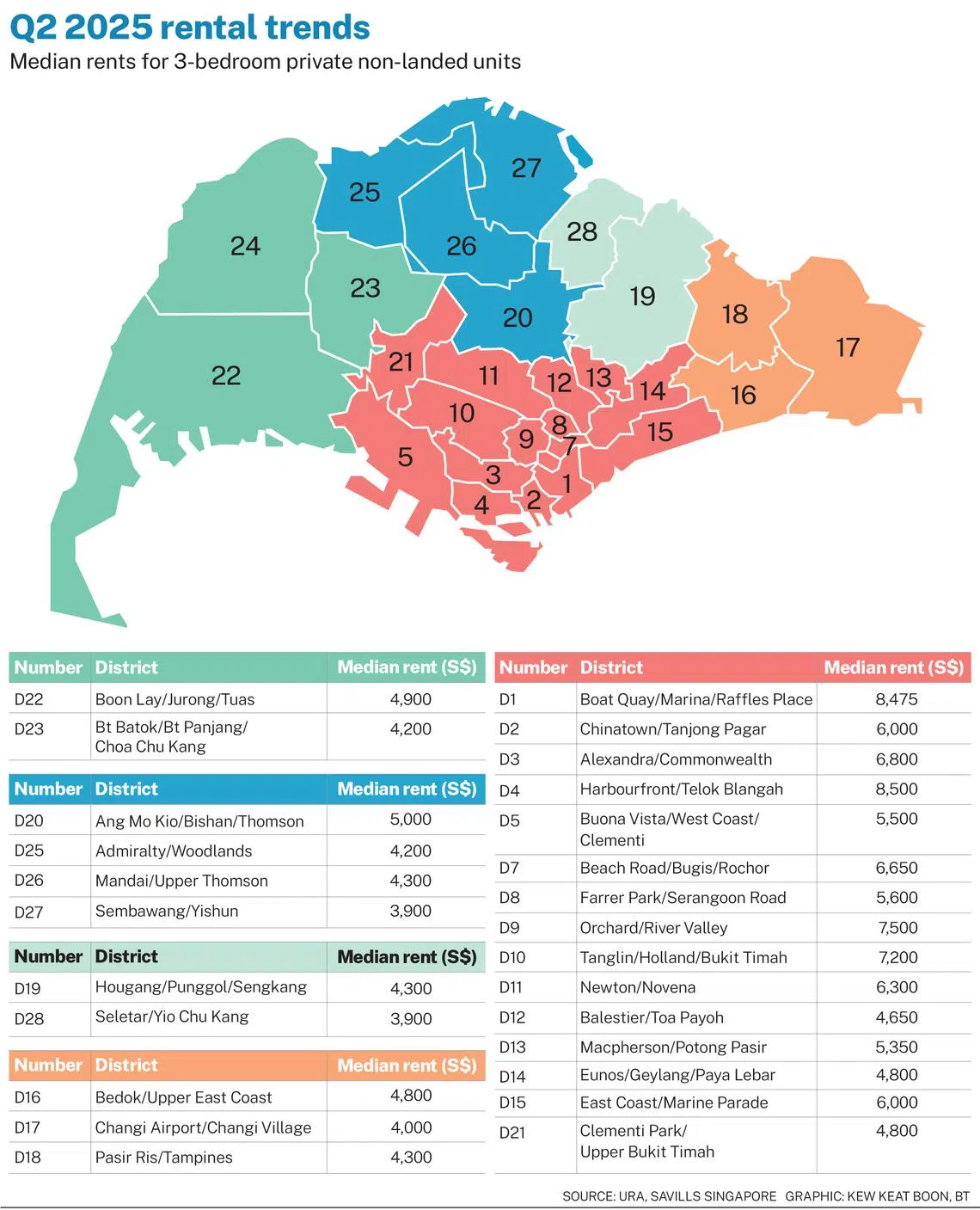
Median rents of small-sized units, particularly studio and one-bedroom apartments, have come under downward pressure. Among one to three-bedroom units, median rents slipped 0.1 per cent on quarter in Q2, said Savills.
Kelvin Fong, PropNex Realty’s chief executive officer, said: “With an increased supply of smaller units in the market and fewer tenants who want to rent smaller homes such as studio apartments or one-bedroom units, this may limit landlords’ ability to raise rents for these units.”
Meanwhile, rents for larger-format units have gone up given their scarcity and continued interest from families and expats seeking more spacious homes, he added.
PropNex’s senior associate director Anthea Yeo also pointed out that such units also offer landlords greater flexibility – apartments of 90 square metres (sq m) and above can be rented to up to eight unrelated individuals, allowing for higher potential yields.
Trend continues into Q3
Early Q3 data suggests the trend of steady demand and rent increase is continuing. Based on flash estimates released by SRX and 99.co, overall private residential rents rose 1.5 per cent month-on-month in July, after falling 0.2 per cent in June.
Notably, OCR rents have seen steady growth since bottoming in 2024, said Fong. Median rentals of private non-landed OCR homes reached a new high of S$4.65 psf per month in July, according to PropNex data.
Leasing activity remained robust, with an estimated 8,691 units rented in July – a 30.2 per cent increase from June and 6.6 per cent higher from a year ago.
In the first seven months of 2025, rental transactions of non-landed homes rose 4.3 per cent on year to 48,981 units, with one and two-bedders seeing the biggest increases, data from Huttons Asia showed.
Some tenants shifted back to condo units from public housing flats or co-living spaces, taking advantage of soft rents in 2024, said Huttons Asia’s senior director of data analytics Lee Sze Teck.
He added: “The unease from the US policy on foreign students may have also pushed some to reconsider studying in the US, opting for top universities in Australia, Asia or Europe. Singapore may be one of the beneficiaries.”
The number of luxury homes rented in H1 2025 was 3.1 per cent higher than H2 2024, said Lee, noting that global uncertainties led to some ultra-high-net-worth individuals moving to safe havens like Singapore.
Combining landed and non-landed rentals (excluding ECs), leasing volume stood at 9,970 units in July, exceeding the 2024 monthly average of 7,206 units, said Christine Sun, chief researcher and strategist at OrangeTee – Realion Group.
As demand returns, some landlords may be asking for higher rents in prime locations, with CCR median rents rising to S$5.66 psf and RCR rents to S$5.33 psf in the first seven months of 2025, she added.
PropNex’s Yeo also noted that some landlords have begun raising asking rents again after having adjusted them downwards in the 2023-2024 period.
This is largely driven by inflation and the rising costs of property maintenance, service fees and higher taxes, she said. “These higher operating expenses have narrowed rental margins, prompting a push to raise rents where demand is robust.”
Still, she expects price resistance in oversupplied or price-sensitive segments such as HDB rentals or suburban areas.
Outlook
Overall rents are expected to remain flat compared with 2024, as newly completed and let-out apartments carry a premium over the rest, said Savills Singapore’s executive director of research and consultancy Alan Cheong.
But he expects rents for one and two-bedders to soften as supply of smaller units hit the market, while five-bedders could face downward pressure as budget-conscious tenants downsize.
PropNex’s Fong said tapering private housing supply should lend support to rents in H2 and into 2026.
After nearly 20,000 completions in 2023, new supply plunged to 8,460 units in 2024 and is expected to moderate further to about 4,949 units this year. In 2026, completions are projected at around 7,065 units.
Sun reckons that the private rental market could take longer to fully recover amid global trade tensions.
“Hiring prospects may be cautious, which could cause some companies to slow down expat hiring. Nonetheless, lower interest rates may bode well for businesses as costs are reduced.”
TRENDING NOW

LTA proposes combining car COE categories, adding rebate-surcharge system
StarHub to acquire MyRepublic’s mobile business amid ongoing telco consolidation

DBS, OCBC, UOB rout lops billions off STI as inflation, rate concerns spook investors

Grab CEO’s wife Chloe Tong on life with Anthony Tan and finding her purpose

