Challenging economic conditions raise the bar for nascent biotech startups as funding dries up
The pullback in science and tech funding in the US has cooled investor sentiment for now, but observers say more money may eventually flow into Asia and Europe

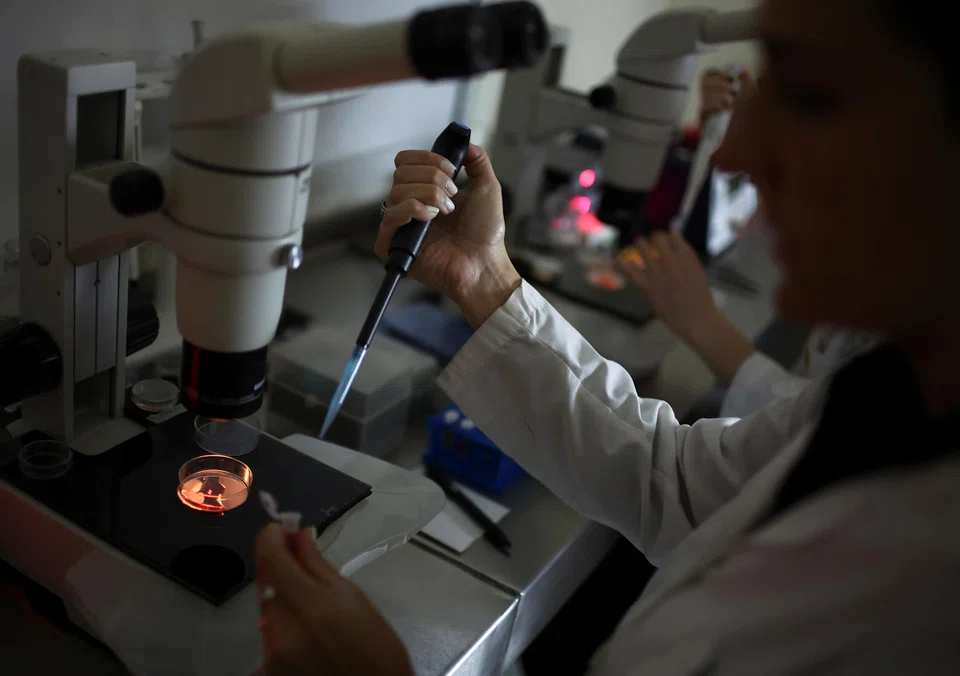
[SINGAPORE] As investors turn more cautious amid the uncertain economic climate, early-stage biomedical startups in Singapore may face higher hurdles in their quest for more funding, industry watchers told The Business Times.
“We have found that fewer companies or fewer investors are willing to invest early, given the high risk of macroeconomic factors,” said Tong Hsien-Hui, executive director for investments at SGInnovate, a government-backed deep-tech ecosystem builder.
“So they tend to invest later – in other words, de-risk as much of the science as possible,” he noted, adding that investors are stepping up on “due diligence”.
There are typically five phases in drug development. The earliest step involves discovery and development, followed by pre-clinical research in the second stage, where testing is conducted in the laboratory or on animals. If the results are favourable, this culminates in an investigational new drug (IND) application.
In the US, an IND application submitted to the Food and Drug Administration is necessary before clinical trials on an unapproved drug can be conducted.
Previously, investors were more open to investing in startups that had not reached the IND phase, Tong said.
“Now, they’re saying: ‘Okay, I need to see at least the stage one safety data before I even want to put money in, and I need to have some assurance that in stage two, the efficacy is going to be at least this percentage’, for instance.”
Tan Wee Kiat, chief executive officer of Singzyme, a biotech startup pioneering next-generation bioconjugation solutions, noted that the situation is “particularly pronounced” in Singapore, where the bulk of biotech startups are in the pre-clinical stage and looking for funding.
To be sure, the issue is not unique to the city-state, said Singzyme’s chief technology officer Abbas El Sahili. “It’s across the board, also even in places that are considered more successful, like Boston or Silicon Valley or even the UK. Their funding dried up the same way the Singapore one dried up.”
This represents a marked change from just a few years ago.
Teu Koon Kiat, vice-president and general manager of Singapore at Allay Therapeutics, said that, in his experience as a startup founder, he found that “the starting part is slightly easier” in the Republic due to the availability of grants from the government and research institutes, as well as private investors.
In 2016, he founded a startup working on drug-releasing implants that manage post-surgical pain. Two years later, it was acquired by California-headquartered Allay.
“Once you get things started and you get your bench, if you need to go in for any more tests, you need to go in for clinical, that’s where the funding starts getting a bit more challenging, where you need to do your next round of fundraising,” he said of his experience.
“For now, if you are at a later stage with clinical data, it helps, especially in this current climate.”
Funding cuts in the US
Mike Carusi, managing partner at global venture capital (VC) firm Lightstone Ventures, said that in 2020 and 2021, the biotech sector “paradoxically was actually quite robust”, as the ongoing Covid-19 pandemic highlighted the power of biotech, drugs, science and technology.
This led to a “significant uptick” in the biotech market, where a number of companies went public based on pre-clinical data – which Carusi pointed out was “too early”, but not uncommon during a bullish cycle.
Then, when these companies faced challenges, such as the science not working out – and the failure rate in biotech is quite high, he added – they began to fail.
“And so, then you started to get this kind of negative sentiment, and we went from a bullish market to a bearish market very quickly in 2023.”

This year, sentiment cooled further, as macroeconomic factors pushed investors into a more risk-averse stance.
This was partly driven by the pullback in science and research funding in the US, since the Trump administration took over, coupled with the uncertain economic climate underpinned by trade tensions and geopolitical conflict.
“I have had to field questions from my US investors, at least, around ‘Is life sciences still an interesting place to invest (in), because we see it’s not getting funded?’,” Carusi said, adding that they include pension funds, universities and endowments.
Getting funding
In recent years, Singapore has attracted many European and US venture capitalists in the biotech space, thanks to favourable intellectual property (IP) regimes, tax incentives and regulatory reforms. The city-state can also offer connections to the broader Asian market, particularly China, South Korea and Japan, and is like a central hub for many of them.
But even as the VC scene remains vibrant, these investors prefer later-stage investments rather than early-stage ones. Compared with other industries, biotech startups typically have long and uncertain timelines, as well as high capital requirements – all of which translate into perceived higher risk.
Over the last two years, the Singzyme team has spoken with more than 200 entities, including venture capitalists, many of whom turned it down as they did not understand the startup’s work and deemed it “too risky”.
Noting that the biotech industry is “not a conventional bricks-and-mortar business”, Tan said: “A lot of the value is actually within the IP, which is non-tangible; so people are less confident because they cannot touch it. And because the gestational period is long, they feel that the risk is inherently higher.”

For this reason, when deciding whether to invest in an early-stage startup, SGInnovate considers a range of factors beyond returns, noted Tong.
“If the only factor that we look at is returns, then we’ll be almost 100 per cent in the digital space, where we’re invested into agentic AI (artificial intelligence) and all that,” he said. Such startups have a faster turnover and are able to go to market quickly. They are also not enmeshed by the intricacies of pharmaceutical supply chains.
But the market potential of a solution is also important.
“If someone comes to me and says, ‘Hey, we want to cure all sorts of and address and break down solid tumours and all that’, I definitely will give them more time of day than just one incremental quantum startup, for instance,” added Tong.
Aspirational
Yet, entrepreneurs may find themselves in a quandary as to how “aspirational” their research subject should be, given that investors may not have the appetite for projects that are deemed overly ambitious and hence considered risky.
Here, government-backed investors such as SGInnovate sees itself as a bridge – in supporting “very aspirational” startups as well as early-stage ones that may have trouble with funding under the current climate.
Even so, Tong noted that it cannot deviate too far from what the private sector is looking for in terms of returns, as there needs to be an alignment in terms of the capital SGInnovate pours in and investments from the private sector, which follows after.
“We’re set up primarily to catalyse private investors, so we can’t just put in a big cheque into a particular company and take a big risk on that,” he said. “So we have got to be selective as well.”
New opportunities
But this is not necessarily a gloomy situation for startups, observed pharma veteran and consultant Dr Andreas Wallnoefer, who said he is an “optimist by nature”.
“It’s probably putting more selection pressure for the really very good opportunities,” said Dr Wallnoefer, who sits on the governing board of Singapore’s Experimental Drug Development Centre.
Promising startups would have to have good ideas and be able to demonstrate to investors how they plan to return the money.
Beyond being anchored in strong science, early-stage startups should also work with experienced investors who can bring together global syndicates and connect them with strategic partners, noted Dr Khoo Shih, CEO of life sciences investor and venture builder ClavystBio.
At the same time, Dr Khoo sees a “promising shift” among investors who are “increasingly open to sourcing innovations in Asia”.
In September, there were four biotech acquisitions by a major pharmaceutical company amounting to US$15 billion, while more initial public offerings are returning to Hong Kong, she said, adding that these are “important signals of improving investor sentiments”.
Lightstone’s Carusi, who is based in Palo Alto, California, said that funding cuts in the US would be a detriment to the country’s research pipeline, but that, eventually, investors would want to diversify and invest their capital elsewhere.
“There is an opportunity for Singapore, for Europe, with smart public policy and then the right ecosystem, to capitalise on it,” he added. “You can attract not only high-quality scientists, but also investors right now.”
This is the latest instalment in a series where The Business Times delves into the state of Singapore’s biotech scene, exploring a key challenge: converting its world-class research and development output into commercial victories.
Our first story looked at the reasons behind why few home-grown companies are listing on the Singapore Exchange, while our second looked at the many international biotech venture capital firms heading to Singapore.