‘Fundamental reshaping’ of Singapore car market as China and EV brands storm up the charts while legacy players hit hard
EV-centric brands such as Tesla, Chery MG, GAC increase registrations by 3 to 6 times as BMW and Mercedes-Benz sales slip almost 40%

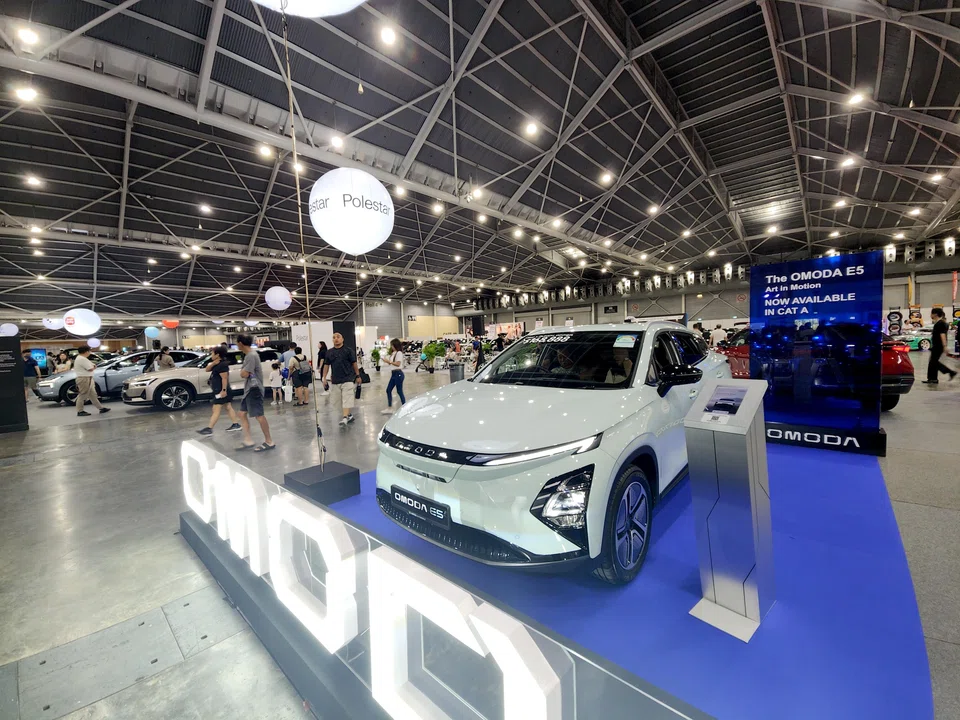
[SINGAPORE] Electric vehicle brands reached new heights in the first quarter of 2026, with registrations for some increasing by as much as five times. Meanwhile, registrations for legacy brands such as BMW, Mercedes-Benz and Honda dropped by more than 35 per cent.
Observers said this marks an increasing dominance for China and EV brands, a move that has been fast-tracked by recent changes to vehicle tax rebates.
Automotive consultant Say Kwee Neng said: “We are seeing an acceleration of the fundamental reshaping of the dynamics of our car industry, which began when EV adoption grew in 2024 and 2025.”
Land Transport Authority data for the first three months of 2026 showed EV-centric brands – most of them from China – increasing registrations by three to five times year on year, as established players slid down the chart.
Tesla more than trebled its registrations with 1,515 units. Chery, GAC and China-owned UK brand MG all entered the top 10 for the first time, posting registrations growth by around two to five times.
Chery rose 13 places on the ranking chart, having registered 600 units in Q1, compared with 90 in the previous corresponding period.
In contrast, legacy players – mostly Japanese and German brands – saw shrinking numbers, with some of the hardest-hit being Hyundai (down 59.6 per cent) and Subaru (down 76.8 per cent).
Toyota bucked the trend, increasing registrations by 38.7 per cent and remaining behind only market leader BYD. Observers attributed this to continued demand for the Japanese brand’s models from private-hire car companies and its dominant reputation for reliability.
Year on year, total car registrations increased by 22.1 per cent to 13,322 for the quarter.
End of the ICE age?
Industry observers said that reductions to the Preferential Additional Registration Fee (Parf) rebate – announced earlier this year – tipped the balance in favour of EVs, compared with petrol-electric hybrids and petrol cars.
According to Say, the reduction has “turbocharged” EV buying.
The Parf rebate is given to vehicle owners when they de-register a car before its 10-year Certificate of Entitlement lifespan expires.
Effective Feb 20, Singapore slashed the rebate by 45 percentage points and capped it at S$30,000, down from S$60,000.
Because Parf rebates are used to calculate car values for trade-in and other purposes, this leads owners of luxury cars to lose a higher proportion of their vehicle value (meaning higher depreciation) compared with less expensive cars.
As mainstream luxury leaders in Singapore, BMW and Mercedes-Benz have been particularly hard-hit – a“drastic” result for the luxury market leaders, said Say.
Collectively, Mercedes-Benz and BMW lost around 1,000 registrations and saw their combined market share virtually halved.
Rene Gerhard, managing director of BMW Group Asia, told BT: “Q1 2026 was a challenging quarter for all premium brands, shaped by the recent Parf announcement and increased competition from new entrants in the EV segment.”
Say added that higher depreciation levels “forced consumers to recalibrate their spending”; this was particularly the case for those buying entry-level luxury models. “When compared with Chinese EV cars with Parf rebates, the price differentials became even more stark.”
In Singapore, incentives offer a lower price point enhancing the appeal of EVs while simultaneously giving them an advantage in Parf terms.
EVs receive up to S$30,000 of combined rebates; these are calculated as discounts on the car’s Additional Registration Fee, which is used to calculate Parf. Accordingly, they have little or no Parf rebate, regardless of age.
Vincent Ng, an automotive consultant with the Vincar Group, said: “We predicted a boost to EV sales and the opposite for non-EVs when the Parf changes were announced – and now we are seeing it happen.”
High COE premiums may also have been a factor.
Ng said that COE premiums have adversely affected sales for legacy brands. With average COE premiums lower in Q1 2025 and more emissions-related penalties for internal combustion engine (ICE) cars, their average cost is higher in Q1 2026.
Marcel Luis Mustelier Perez, president and CEO of Mercedes-Benz Singapore, said: “The Q1 figures reflect market dynamics we had anticipated, with elevated COE premiums continuing to shape buying decisions across the industry.”
This includes customers delaying purchases as they wait for COE premium to soften, shifting towards alternatives including leasing, downsizing or switching to lower segments and extending COEs instead of purchasing new vehicles.
China speed, China savings
While the Parf change favours EVs, China brands will also continue to gain market share due to the increasing sophistication and competitiveness of their cars.
Hal Serudin, partner at automotive consultancy Lumina 3 Sixty, said that the trend of rising China and EV brand sales reflects that of other markets in the region, such as Malaysia and Thailand, where these brands have disrupted legacy players in the mainstream and luxury segments.
“Chinese brands have moved from the early adopter phase to the early-middle majority phase,” said Serudin.
“The Chinese brands have carefully catered to local needs and gained customer acceptance with their ‘value for money’ offerings, which are now well-designed and engineered... (with) aggressive, localised marketing campaigns, adding significant pressure to legacy players like BMW and Mercedes-Benz.”
Vincar’s Ng said that China brands move especially quickly in development compared with legacy players, helping them to gain market share.
For example, in Singapore, many brands introduced Category A COE models – for mainstream cars with lower engine capacity and hence lower prices – to maximise sales.
The demand for Category A EVs is such that the COE premium exceeded that of large-car Category B in the latest bidding exercise on Apr 22, and inched towards an all-time high.
“China model development takes 12 to 24 months, compared to 36 to 48 months that Toyota or Honda take. They are breaking all the norms,” said Ng.
He added that in the short term, the effect of Parf rebates boosting EV sales has only just begun.
“The Parf change only started on Feb 20, so we will see a continuation of this trend for the rest of the year at least.”
That means legacy players – especially luxury ones – could be in for a tough 2026.
Say noted that consumers are “now pulled to buy Chinese EVs simply because it is the economically more viable decision”.
“Most expected established luxury marques to be the most resilient to the onslaught, but even the strongest of brand equities are helpless against a massive Parf reduction.”