Heartland businesses go cashless, but teething problems remain
Heartland shops have grown used to e-payments after a pandemic-era push


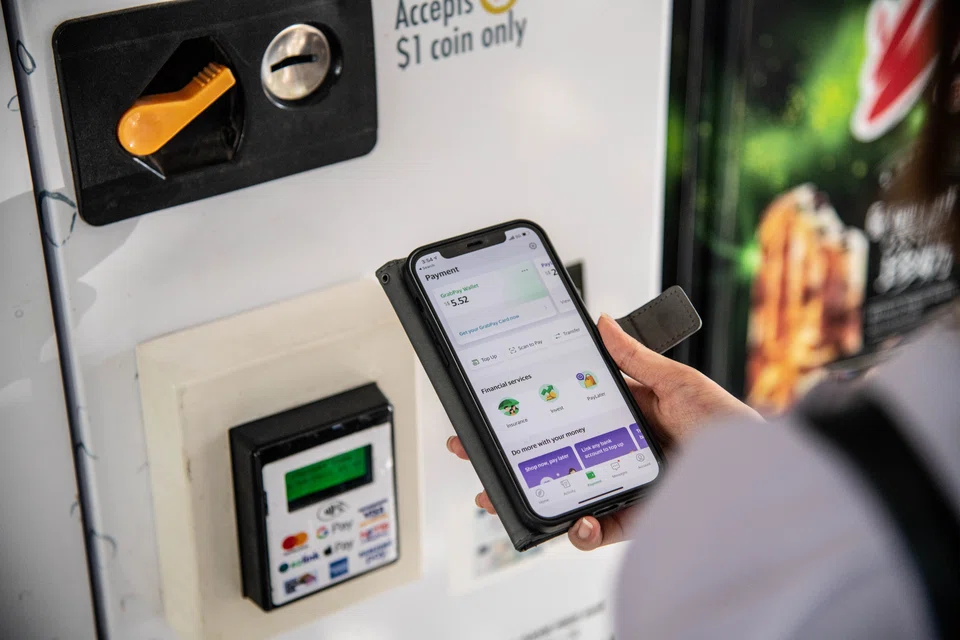
ELECTRONIC payments were slow to take off among small heartland retailers, but after a Covid-era government drive, 93 per cent of heartland enterprises had adopted these by end-2022.
Such digital payments are often enabled by QR codes such as SGQR and PayNow QR, which support payments from PayNow, DBS PayLah! and other banks’ e-wallets, with funds going directly into merchants’ bank accounts.
This e-payment revolution has won over many micro-retailers – but still has its share of teething issues.
Micro-retailers to whom The Business Times spoke mostly found electronic payments to be convenient: fast, simple, and with the funds going directly into their accounts.
While customers may sometimes key in the wrong payment amount, such issues are easily resolved, said Sabrina Sofwan, an employee at Ci Yuan Hawker Centre’s Nasi Lemak Ayam Taliwang. This is because customers have to show the approved transaction on their mobile screen before they can collect their food.
But most customers still prefer cash, she added, except on Fridays when DBS PayLah! offers S$3 subsidies at SGQR-enabled hawker stalls islandwide.
Connectivity issues
The main problem that micro-retailers report is simple, but beyond their control: mobile internet connectivity.
Intermittent internet connections are an issue, said Sabrina. “Sometimes there’s no connection and customers tend to have difficulty processing their payment.”
Ryan Choo, owner of Chuan Lok Lok in Yishun, faces a similar problem: mobile coverage at his skewers shop tends to be weaker, as it is located in an industrial area. During peak periods, this adds additional pressure as a lone customer’s delay can hold up the queue.
For Choo, cash is king. Each time someone pays digitally, Choo has to check that he has received the money – which can be troublesome, especially during busy periods.
Better without a middleman
While many micro-retailers have adopted digital payments, intermediate platforms like ShopBack and FavePay are less commonly accepted.
Choo accepts payments via PayNow, PayLah!, ShopBack, and FavePay, but prefers the former two methods. The problem with cashback and rewards platforms is that merchants have to foot the cashback credited into customers’ accounts, in addition to a platform commission fee and sometimes the goods and services tax.
The platforms’ pitch is that this encourages repeat visits from customers to make use of this cashback.
But Choo felt this was not worth it, given that he sells his skewers at a dollar per stick. “If (the food is) nice, people will come back. If it’s not nice, (with) that amount of money, people won’t even bother to come back, so I feel like it’s a waste of time.”
Other heartland merchants similarly felt little need to use cashback platforms, as their customers are often nearby residents who are likely to become regulars regardless.
Merchants also said they were put off by the need to explain to customers how these intermediate platforms work, which can further slow down their business during busy hours.
To POS or not to
While micro-retailers may accept multiple payment methods, tracking payments across different platforms is not necessarily a priority. Many have not even adopted digital point-of-sale (POS) systems – and express no intention of doing so.
POS systems log every transaction, making it easy to keep track of inventory and accounts. But for Fruit Corner at Toa Payoh North, which does not use a POS system, the lack of a full transaction log is not a problem due to the small nature of the business.
The store accepts cash, SGQR and ShopBack. At the end of each business day, owner Loo Mei Yi simply adds up the total amount received from each channel.
“We do not check each transaction as long as the total earnings of the day seem right,” she said, adding that she has not encountered any significant discrepancies.
POS systems are also required for accepting card payments. Yet many micro-retailers remain reluctant to take cards, as this would mean additional fees.
Nets charges 0.8 per cent for each transaction. For credit cards, the fee can range from 1 per cent to 3 per cent depending on the payment networks. Furthermore, unlike the instant nature of cash payment, Nets payments are only received the next working day.
While many POS systems allow merchants to indicate the payment method for each transaction, these systems are not fully integrated with digital payment systems.
Merchants still need to manually tally the amounts received through each system. This often means checking the respective apps, which can be difficult for stores with only one device that is logged into these platforms.
“It would be more convenient if all merchant portals offered a voice notification function, so that we would not have to check notifications and refresh the apps from time to time,” said the owner of a bakery located at an MRT station, who declined to be named.
Her store, which has been in operation for six years, is equipped with a POS terminal and accepts cash, cards, and various digital payment methods.
Nonetheless, one advantage of a POS system is reducing incorrect payments, she said: “QR payments through the POS terminal allow us to request the amount from customers. This avoids having customers keying in wrong amounts, which is a common problem with QR stickers.”
“However, the code refreshes every 30 seconds, for customers who take longer to log into their e-wallets, the lapse of time could lead to payment failures,” she added.