Singapore sells less marine fuel in August as higher prices bite
Lower sales in line with fewer vessels calling at the Republic for refuelling

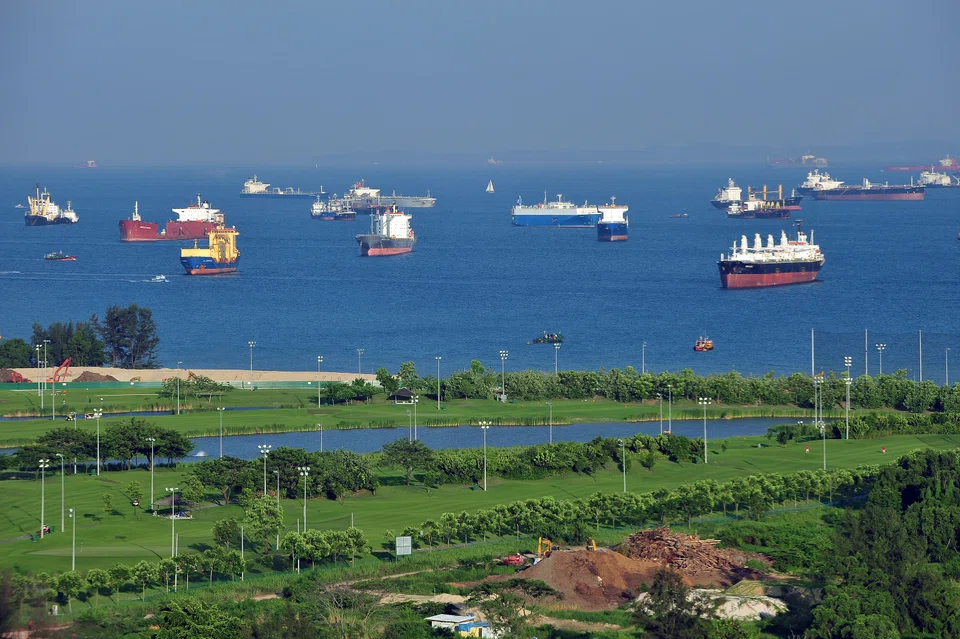
[SINGAPORE] Singapore, the world’s largest bunkering hub, posted a 3.9 per cent dip year on year in marine sales in August even as the figures continued to improve from the trough in April after the Middle East war started.
Sales of marine fuel in Singapore reached nearly 4.8 million tonnes in August, statistics from the Maritime and Port Authority of Singapore published on Monday (Sep 14) showed.
While this is lower than a year ago and the second straight month of a year-on-year dip, sales have been improving since April. That was when the impact of the Middle East war started to be felt, and led to an 8.6 per cent slide month on month.
The lower sales were in line with fewer vessels calling at Singapore for refuelling – 3,588 in August against 3,675 in July and 3,608 in August 2025.
Notably, there were 1,542 oil tankers that arrived in August, 8.7 per cent fewer than a year ago or 1.7 per cent fewer than July; their gross tonnage (total internal volume) of 63.5 million was 3.9 per cent lower than a year ago, but 1.5 per cent higher than July.
The single-most important factor contributing to the lower bunker sales was the 12.3 per cent year-on-year drop in low sulphur fuel oil (LSFO) consumption to 2.2 million tonnes, noted Mahua Mitra, head of marine fuels pricing for the Asia-Pacific at energy and commodity market intelligence provider Argus Media.
LSFO is a cleaner marine fuel designed to lower sulphur oxide emissions from ships.
“Most shipowners and buyers were pushed back by high prices arising from tight, prompt availability,” she said.
A tight supply continues to underpin high pricing of fuel oil, with a lack of key blendstock components playing a part as well. This is because regional fuel-oil supply was limited, and Russian fuel-oil and vacuum gasoil (a heavy oil product that refineries use to make petrol and diesel) exports were reduced.
Prices of wholesale and retail very low sulphur fuel oil are still rising in September.
Prices of bunkers delivered in Singapore spiked for key grades shortly after the US-Israel attacks against Iran on Feb 28, as the supply of crude oil flowing through the Strait of Hormuz was reduced to a trickle after Iran closed the waterway.
Normally, about 20 per cent of global crude oil volume would have flowed through this passage.
Meanwhile, Singapore posted a 2.3 per cent increase in container throughput at more than 3.9 million 20-foot-equivalent units (TEUs) although this was 0.9 per cent lower month on month.
Singapore fell one rank to the third-busiest port in the world in the first half of this year, despite handling 4.7 per cent more or 22.7 million TEUs. It was narrowly overtaken by Ningbo-Zhoushan in China. Shanghai was at the No 1 position with 28.7 million TEUs.
The Singapore Registry of Ships remains appealing to owners, as the number of vessels it administers reached 4,529 with a total gross tonnage of 145.4 million as at August. This is up 9.5 per cent in terms of numbers or 21.4 per cent in terms of gross tonnage.