SIT sets up lifelong learning school that combines assessment, training and research
It works with industry in multiple aspects, from creating assessment tools to teaching programmes

[SINGAPORE] A new Singapore Institute of Technology (SIT) school will go beyond course delivery to help individuals navigate changing careers and support enterprises in building future-ready workforces, the institute announced at the main session of its Convocation 2026 ceremony on Monday (Oct 12).
The SIT School of Lifelong Learning and Career Development, or SITLearn, will connect skills assessment, continuing education, career development, industry partnerships and applied workforce research within one integrated model, the university said.
Bernard Nee, deputy president (industry and community) of SIT and dean of SITLearn, said that the integration of these pieces, as well as the focus on applied learning, are what creates a distinctive offering.
There are many providers in Singapore’s continuing education landscape, but most (including SIT previously) were focused just on running programmes and work-study degrees, he said.
“Looking at the changing landscape and the shortening lifespan of skills, we think that that is insufficient, which is why we have set up the CET (continuing education and training) school,” he said.
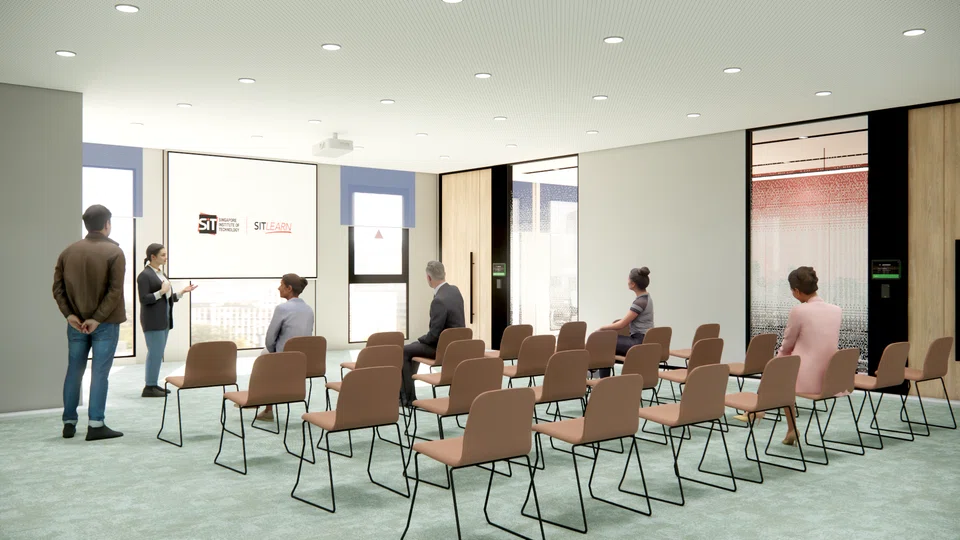
While training courses are already being carried out across the institute’s facilities or on clients’ premises, SIT is developing a dedicated SITLearn hub at the Punggol campus, which is expected to be ready in the first half of 2027.
As technology advances and working lives lengthen, individuals and enterprises face parallel changes in assessing capabilities, identifying gaps and building skills, SIT noted.
For individuals, SITLearn creates a personalised pathway from skills discovery to career progression. It extends this support to adult learners enrolled in selected longer-form CET programmes.
As for enterprises, it provides a coordinated path from workforce diagnosis to capability building and impact.

Multifaceted, integrated model
SIT highlighted several key features of the integrated model.
First, SITLearn provides skills assessment and validation, which informs training.
While some skills can be acquired through formal courses and represented on certificates, others can be acquired on the job, with no way to show them.
“So skills assessment makes (these) skills visible,” said Nee.
SITLearn develops assessment tools and frameworks in partnership with industry and public agencies. It is working with more than 40 organisations in sectors including hospitality, healthcare and social services agencies, on artificial-intelligence readiness and workforce capability-building projects.
“As we go into more and more sectors, we build a portfolio of tools that can be applied to different use cases,” Nee said.
Second, programmes – including specialist certificates, stackable micro-credentials, postgraduate programmes and shorter continuing education modules – are designed around emerging market needs.
The latest programmes include those addressing AI capability, governance and responsible adoption, digital infrastructure for green data centres, and assessing, managing and mitigating emerging risks associated with the energy transition.
Course fees for CETs offered at SITLearn vary depending on the course type, duration and level of specialisation.
For example, a two-day professional course may cost about S$1,700 before government subsidies, while a several-month-long micro-credential programme could cost about S$10,000 before subsidies, SIT said.
Programmes will be taught by a mix of professors and industry partners.
Through its Corporate Adjunct Professorship Scheme, SITLearn works with companies to identify staff suited to mentor and coach, alongside their industry careers.
This brings real world experience into the classroom and ensures what is taught is connected to what is happening in the world, Nee said, adding that these companies believe in teaching as a key developmental pathway for their senior leadership.
Third, the new school strengthens connections between learning and employment, broadens access to industry exposure, and ensures programmes stay aligned with evolving workforce needs.
This is done by bringing on board industry partners to complement and enhance various aspects of the SITLearn model, and SIT will continue to expand its network.
Finally, SITLearn incorporates research for “evidence-based high-quality adult learning”.
The university is leading a national research project in collaboration with the Institute for Adult Learning and other research partners, to develop the Digital Adult Learning Quality Index.
This framework measures the quality, impact and value of digital CET courses across live-online, self-paced and hybrid formats.
The project aims to create evidence-based benchmarks to guide more informed decisions about course design, quality assurance and learning outcomes.
AI and applied learning
At the convocation ceremony, Minister for Digital Development and Information Josephine Teo shared her thoughts about the opportunities and challenges posed by AI, as well as how the graduands can apply their practical approach to problem-solving in their working lives.
First, build what works by applying one’s training and growing one’s expertise, she said.
“As AI enters more industries and physical systems, it will become even more important that you have in-depth knowledge and the ability to apply it to unexpected situations.”
Second, keep learning, especially how to work well with AI. Teo also said one should be “AI bilingual” – combining technological skills with industry know-how.
Third, the more capable technology becomes, the more human judgment matters.
It is important to recognise AI’s limitations, and retain and apply foundations learnt, she said, adding: “Remember that empathy, ethics and an understanding of context will always matter.”
And while AI safety is a still-evolving field, judgment can already be exercised through careful testing and putting in place proper safeguards, Teo noted.
Decoding Asia newsletter: your guide to navigating Asia in a new global order. Sign up here to get Decoding Asia newsletter. Delivered to your inbox. Free.
Copyright SPH Media. All rights reserved.