


From community garden to megafarm: Greenphyto’s path to the world’s tallest hydroponic farm
Automation helps the agritech startup reach new heights
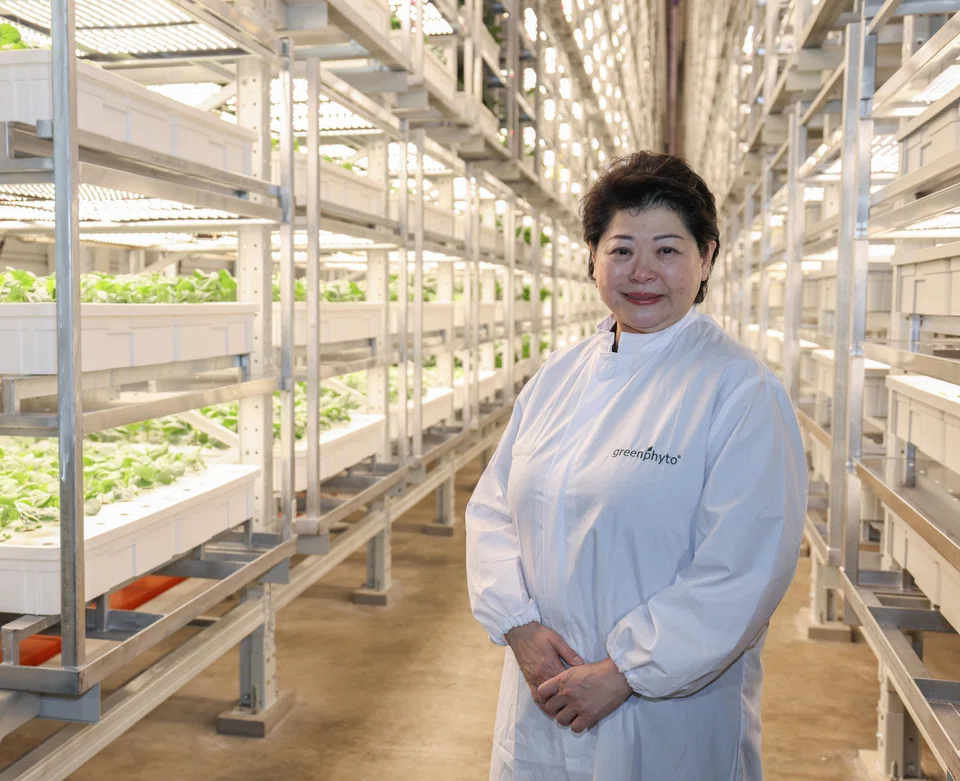
[SINGAPORE] Susan Chong, the founder of agritech startup Greenphyto, had never planned to become a vegetable farmer. After all, she already had a multimillion-dollar business designing environmentally friendly packaging for companies.
But it was a “simple community project” with that company, Greenpac, that introduced her to growing vegetables.
Sometime around 2011, Greenpac engaged senior citizens and secondary school students in Taman Jurong – where the company is located – to grow vegetables using hydroponics systems.
“We just wanted to have an edible garden, so that we could start growing some vegetables to donate to the neighbouring community,” said Chong.
A chance meeting with Jurong GRC’s anchor minister at the time, Tharman Shanmugaratnam, seeded the idea for a new venture: Greenphyto.
“Instead of donating vegetables, he said, ‘Why don’t you donate the (hydroponic) system?’” she recalled.
The ‘aha’ moment
To make vegetable growing accessible to the community, Chong simplified the hydroponic process and formalised it into a set of standard operating procedures.
“After three or four years of repetition (with different community groups), we became better and better… and it dawned on me that I knew how to automate the process using my supply chain knowledge,” she said.
That “aha moment” led her to register Greenphyto in 2014.
Climate change and an ageing workforce will put pressure on future food supply, she noted. “You must be able to scale to feed the world. (And) the only way is through automation.”
Controlling the parameters for growing vegetables – such as light and nutrients – would also help ensure consistency, she noted. “That led me to see it had to be done like manufacturing.”
Working out of a small research and development (R&D) space in Greenpac’s building, Chong began developing an early prototype for a vegetable farming process that was automated end to end.
The idea of automated industrial-scale farming was “unheard of”, she recalled. A soil-farming expert whom the team consulted said it would “never happen”.
But this scepticism only strengthened her resolve. What followed was more than a decade of R&D, during which Chong kept Greenphyto largely under the radar while refining the system and proving it could scale.
The work eventually demanded her full attention, and she decided to step away from Greenpac, which she described as her “first love”.
Nearly two decades after Greenpac solo in 2002, she sold it to investment group Treis in 2021.
“Greenphyto was taking a lot of my time, and I didn’t want to continue sitting there milking Greenpac,” she said. “It’s not fair to the (Greenpac) team.”
Fruits of her labour
Greenphyto developed a proprietary farming system that treats vegetable production less like traditional agriculture and more like advanced manufacturing.
The company now holds 69 patents across 34 countries and is preparing to launch its first full commercial farm in early January.
At just over 23 metres in height, the facility is believed to be the world’s tallest indoor hydroponic farm, and is designed to produce up to 2,000 tonnes of vegetables a year. Greenphyto says this is about “45 times higher than traditional farming”.
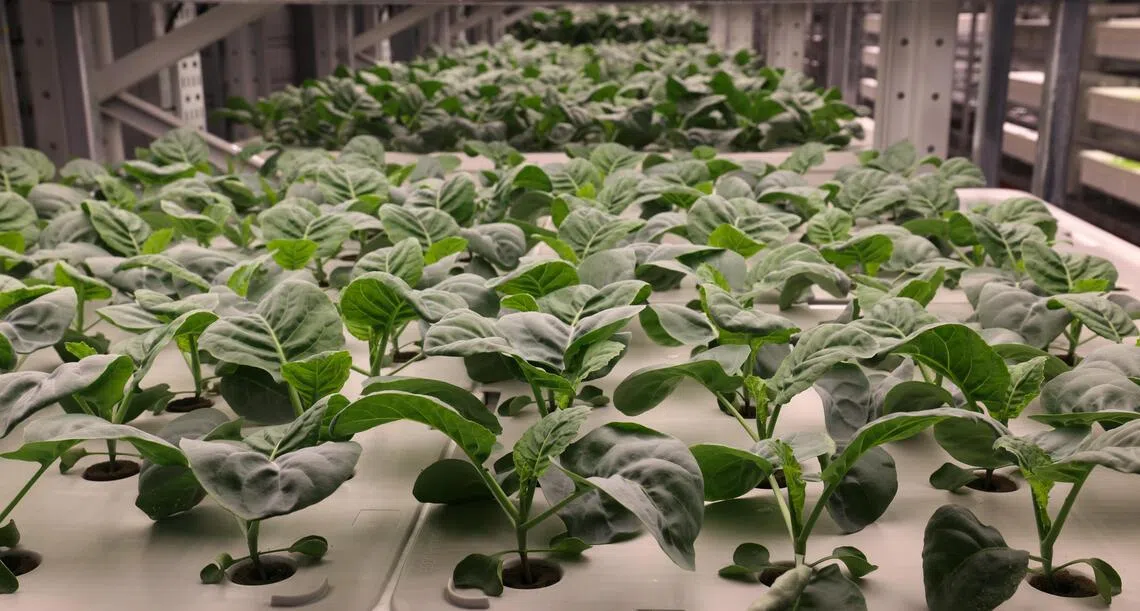
The farm focuses on fast-growing leafy vegetables such as nai bai, chye sim and other Asian greens. These are staples in local diets and well suited to automation, said Chong.
Instead of farmhands, the operation relies on technicians, software engineers and operations planners, with about 70 staff in total – around one-fifth the manpower Chong estimates would be required under conventional farming methods.
“Because of automation, we don’t need a lot of manpower, but we do need technicians, so we’ve been recruiting from ITE and polytechnic students… so that young people can be part of the agriculture industry,” she said.
Rather than applying automation selectively, Greenphyto automates the farming process end to end, from seeding and nutrient delivery to crop movement and climate control.
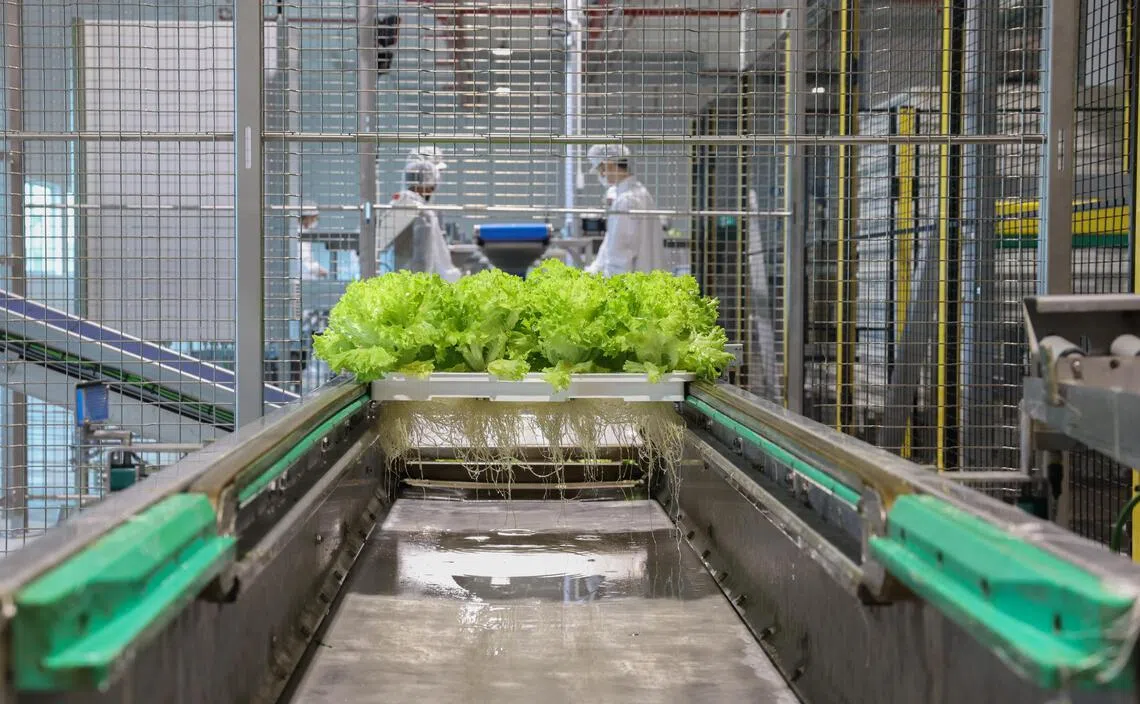
Harvesting and packaging, however, remain semi-automated and still require some manual work.
Artificial intelligence (AI) and a digital twin of the farm are used to monitor growth and plan production weeks ahead. This allows output to be scheduled precisely, rather than fluctuating with weather or seasonal volatility.
To control electricity costs – “a big variable expense” – Greenphyto also uses technology and AI to optimise energy use.
Although the farm has yet to be officially launched, it has already been operating and selling its produce.
Since January 2025, its vegetables have been sold under the Hydrogreens label to 95 retail stores. It also runs a vegetable donation programme supporting low-income households, reflecting its roots as a community initiative.
By relying on scale and automation to keep costs down, Chong hopes Greenphyto can offer vegetables at prices comparable to imports.
Beyond the “buy local” argument, consumers should choose the produce for its freshness, reliability and pesticide-free growing process, she said.
Sowing the next phase
Greenphyto plans to expand beyond Singapore, with longer-term growth focused not just on producing vegetables, but also licensing its farming system and software overseas.
The company is working with partners in markets such as Europe and China, and earlier this year set up an office in the Netherlands to support outreach in the region.
When asked, Chong did not rule out the possibility of establishing a farm in the Johor-Singapore Special Economic Zone’s agrifood hub, the Southern Agropolis.
At home, she said Greenphyto sees its role as being part of a broader effort to strengthen food resilience in Singapore, rather than providing a standalone solution.
Granted, recent years have seen closures of local farms. But Chong noted that the pressures facing the sector affect operators differently, depending on scale and business model.
She declined to comment on individual farm closures, but noted that operators were at “different phases” of development.
Often, the issue might not have been technological failure, but the difficulty of sustaining R&D in a tougher funding environment. In such cases, she said, operators “just needed a little bit more resources for the R&D to make it happen”.
As for the worry that large, automated farms could crowd out smaller growers, Chong said Greenphyto sees itself as complementary to other farms.
“We are here not to replace any of the farmers,” she said. Instead, the aim is “to build the ecosystem” to strengthen local supply.
Given that Greenphyto focuses on only certain crops, collaboration is essential, she added. “Everybody has a part to play… so we should come together to build the ecosystem for Singapore.”
TRENDING NOW
Once staunchly pro-China, Malaysian Chinese businesses are now distancing themselves from Beijing

Grab CEO’s wife Chloe Tong on life with Anthony Tan and finding her purpose

Could stablecoins be the future of money?
ST Engineering opens tech-focused aircraft maintenance facility in Changi; to create over 500 jobs

